AMERICAN HAUNTINGS INK

Showing posts with label ghost. Show all posts

Friday, June 27, 2014

THE LAKE CLUB GHOST

Haunting at Springfield’s Hottest Gambling Club

Firefighters were called to a scene near Lake Springfield in Central Illinois one early Sunday morning in August 1992. When they arrived, they found a dilapidated, old building that had been closed for years completely engulfed in flames. The fire, which later turned out to have been deliberately set, destroyed a place called the Lake Club, a once-grand restaurant and nightclub that had been out of business since the 1960s. Other businesses had come and gone in the building since the demise of the club but most people recalled the 1940s and 1950s as the golden age of the Lake Club.

It was from this time period that stories of big bands, live radio shows, and illegal gambling emerged as fond remembrances of yesterday. But it was also during this time that the stories of the club’s resident ghost emerged – a tragic nightclub employee who simply refused to leave.

 The Lake Club during its heyday

The Lake Club opened as a nightclub in 1940, but the building on Fox Bridge Road had seen many incarnations in the years prior to that, including as several restaurants and even a skating rink called the Joy Inn. In 1940, two dance promoters named Harold Henderson and Hugo Giovagnoli renovated the place and opened it for business as the Lake Club.

The interior of the Lake Club during its prime

 The club soon became one of the hottest nightspots in Illinois, drawing customers from all over the state. It boasted a raised dance floor surrounded by a railing, with curved walls and a swanky atmosphere that made patrons feel as though a New York club had been transported to the shores of Lake Springfield. The owners concentrated on bringing big name entertainment to the club and succeeded. Among the many top performers were Bob Hope, Ella Fitzgerald, Guy Lombardo, Pearl Bailey, Spike Jones, Nelson Eddy, Woody Herman, Mickey Rooney, and many others. The constant stream of entertainers and big bands brought capacity crowds to the club every night. During the height of its popularity, the club even hosted a radio call-in show that broadcast music and entertainment all over the area.

A music program from the heyday of the club shows that some of the biggest names in entertainment came to Springfield and played at the Lake Club.

The Lake Club thrived for nearly two decades, becoming known not only for its swinging entertainment, but for its first-rate gambling, as well. Wealthy customers and the society elite of Springfield and Decatur frequented the club for the musical guests and also for the billiard tables, craps and gaming tables, slot machines, and card games. This part of the club operated in secret in a back part of the building, known only to high rollers and special customers. However, in December 1958, the golden days of the Lake Club came to an end. The partners had survived many setbacks over the years, from lawsuits to foreclosures, but the club would not survive the two undercover detectives who gained access to the gambling rooms that Christmas season.

The club was immediately shut down, although patrons continued dining and dancing while the actual raid was going on. The two state troopers who entered the gambling rooms were the first police officers to arrive, but many more followed. Newspaper accounts reported the police confiscated all sorts of gambling equipment including tables, dice, slot machines and large quantities of cash. The billiard tables were so large they had to be dismantled to get them out of the room.

Business began to falter in the wake of the raid and the place finally closed down in the 1960s. Giovagnoli blamed the failure of the club on the gambling crackdown, always maintaining that the entertainment had been just part of the club’s appeal. However, he refused to give up. Despite his partner Harold Henderson’s death in 1977, Giovagnoli managed to open the club again with other parties managing different projects in the building. During this next popular time in the club‘s history, it was managed by Bill Carmean and Tom Blasko as a rock club. In 1980, it was leased by Pat Tavine, who also operated it as a rock club until 1988, when it closed down for good. The Lake Club was destroyed in the fire just a few years later.

It was in August 1979 that the Lake Club, known in 1980 when the story came out as the “Sober Duck Rock and Disco Club,” gained national notoriety. It was at this time when the ghost of Albert "Rudy" Cranor was finally put to rest.

According to the many patrons and staff members who had experiences there, the haunting of the Lake Club first began in 1974. At the time, the club was in the midst of a revival in interest and the business was under the ownership of Tom Blasko and Bill Carmean, two Springfield men who were booking rock acts into the club. The building itself was still owned by Hugo Giovagnoli and Harold Henderson.

Bill Carmean was the first to notice that something strange was going on at the club. Both he and Tom Blasko had experienced cold chills in the building, along with hearing odd sounds and getting the feeling of being watched in certain rooms. One afternoon, he came into the club and sat down at the bar with the lights off. Suddenly, he heard the sound of a piano being played in another room. He got up to see who else was in the building with him and as he stepped into the room, the music stopped. The room was completely empty.

Weird things continued to happen. Often on Monday nights, while Carmean would be in the building going over the weekend receipts, he would hear a door near the office open and footsteps crossing the floor. He would jump from his seat to see who was there, but the hallway was always empty. Carmean also remembered a salesman visiting his office one evening when a glass flew off a table and hit the wall on the opposite side of the room. The salesman left in a hurry.

By 1976, the haunting had intensified and things began happening more often, and in front of more witnesses. A club bartender was pouring a drink one night when the glass in front of him suddenly shot up into the air and landed over his shoulder. A waitress also experienced the antics of the ghost one night when she went to serve a drink to a customer, only to find the glass inexplicably filled with chocolate. She would later insist the glass had been absolutely clean when she handed it to the bartender.

Carmean was the first of the club’s staff to guess the identity of the ghost who was plaguing the club. He recalled that a former employee had committed suicide in the building several years before. On a lark, he started calling the ghost by this man’s name, which was Rudy.

Albert "Rudy" Cranor had worked at the Lake Club during its heyday of the 1940s and 1950s. He was described as being well-liked and popular with the entertainers and the customers. He was a very large man, well over 250 pounds, and he had snow-white hair. He was remembered as one of the club’s most memorable characters and even 50 years later, I have spoken with people who remember him. They speak fondly of him and recall his as a nice man and their favorite bartender.

After the club fell on hard times following the gambling raid, Rudy also began experiencing some personal difficulties. He was a very private person, so no one really knew what was going on, but they did notice that he began to drink heavily while on the job. They also began to notice some changes in his personality and appearance. He seemed to be more tired than usual and dark circles had begun to appear under his eyes. Then, one night, he became sick and had to be rushed to the hospital. It took several men to carry him downstairs to the ambulance. He returned to the club after a two-week stay in the hospital, but he was never the same again.

On June 27, 1968, Rudy shot himself with a high-powered rifle in one of the back rooms at the club. He died in the hospital the next morning, never regaining consciousness. No one was ever sure why Rudy had killed himself, but regardless, he wouldn’t stay gone for long. In a few short years, he would return to haunt his beloved club.

The strange events at the club continued in the form of weird antics and pranks, apparently carried out by the ghost of Rudy Cranor. One night, Tom Blasko placed a pile of tablecloths on an empty table and left the room. When he came back, the cloths were on the floor. He picked them up and left again, only to return moments later and find them once again on the floor. This was repeated several times until Blasko finally gave up and left them on the floor.

Employees and visiting musicians also reported strange occurrences like doors opening and closing by themselves, the sound of footsteps in empty rooms, a drink that lifted off a table and then dumped in a customer’s lap, office equipment that operated on its own, feelings of being poked and prodded by unseen hands and numerous other bizarre happenings.

A frightening event took place in the summer of 1977 when Barbara Lard, a waitress at the club, had an encounter with Rudy himself. She was working one evening and went to the bathroom behind the back office. As she came out, she glanced over the back bar and saw Rudy looking at her. She described what she saw as just a head, hanging there in space, and although she could see through it, the head appeared life-like. She said that the apparition had snow-white hair – and she had never known, heard about, or had even seen a photograph of, the late bartender. The apparition looked at her for a moment and then spoke, telling the waitress that one of the owners of the club was going to die. This was not a threat, Lard recalled later, but merely a warning.

The waitress ran out of the room in tears, visibly shaken and close to hysterics. Other staff members who saw her that night reported that she was very frightened and that she was not a person known for being hysterical or easily frightened. Tom Blasko later stated that he went back into the room after Lard’s encounter and claimed to feel the same bone-chilling cold that he always associated with Rudy’s spirit.

Needless to say, Blasko and Carmean were more than a little unnerved by the ghost’s warning. By this time, they had no doubt the ghost was real and that the club was genuinely haunted. Because of this, they also had no reason to doubt that Barbara Lard’s encounter had been real. Her description of the late Rudy Cranor had been too accurate to have been imagined. The two men waited and probably were more careful than usual when doing things like driving to work or climbing ladders. Then, two weeks after the incident, Harold Henderson, one of the original owners of the club, died at the age of 69. He was still the owner of the building itself and was an owner that Rudy would have known during his lifetime.

This incident would shake Blasko more than anyone else. He had spent two weeks living in fear for his life and he felt that it was time to get rid of the ghost if possible. Perhaps Rudy had been trying to be helpful with his warning, but Blasko didn‘t really care. He contacted a woman he knew who was interested in the occult and she suggested that he ask a priest for help. Blasko was a practicing Catholic, but when he contacted his parish priest, the man declined to become involved. He suggested that Blasko pray for Rudy on his own and Tom spent the next six months carrying a rosary around the club with him. But it didn’t help – Rudy was still there.

Finally, in August 1979, Blasko attended a high school class reunion and ran into one of his former classmates, Reverend Gary Dilley, a priest who now lived in Fort Worth, Texas. Tom mentioned the problems at the club to Father Dilley and the priest was intrigued. After some discussion, he agreed to come out to the club and take a look around. He said later that he believed Blasko was sincere about what he said was happening. He had known the man for many years and had never thought of him as the hysterical type.

After arriving at the club, Father Dilley also sensed something out of the ordinary there. He experienced some unexplained cold chills and felt as if someone was watching him. He said in a later interview, "I also had the feeling that someone was trying to communicate with me.”

The priest questioned several of the club’s employees and found that their stories were very similar. He knew they had not had time to compare notes before he spoke with them. He was convinced that something was going on, but he declined to do an "exorcism" of the club. To do that, the case would require a thorough investigation and permission from the local bishop, which he doubted that he would get. Instead, he decided to bless the place and pray there, hoping this would perhaps put Rudy to rest.

Father Dilley contacted two other priests to take part in the ceremony, Father John Corredato of Kankakee and Father Gerald Leahy of Griffin High School in Springfield. The three men were quick to point out that they were merely trying to bless the building, to clear out any negative spirits and to help at least one "very restless soul" to find peace. The three priests went from room to room in the club, blessing each with holy water and praying. They asked that any negative spirits depart from the building and they prayed specifically for Rudy Cranor. They entered the room in which he had committed suicide and prayed that his spirit be at rest.
           
So, was that the end of the haunting? Apparently, it was. The same people who considered the club to be haunted were now sure that Rudy had departed. The day of the religious ceremony was the last day when anyone was aware of Rudy’s presence in the building. It seemed that the prayers and blessings had helped the bartender find his way to the other side. It certainly seemed possible that Rudy might have chosen to stay behind in a place where he had many attachments in life. Perhaps the intervention of the priests was all he needed to be convinced to move on.

Once Rudy was gone, some staff members realized they hadn’t minded his ghost as much as they had once thought. In a 1980 newspaper interview, Tom Blasko said, "In a way, I sort of miss Rudy. We were all fond of him. It’s been pretty quiet since the priests were here – sometimes I wish that I hadn’t asked them to come."

Missed or not, Rudy finally found some peace and a release from his suffering, somewhere on the other side.


FROM TROY TAYLOR’S BOOK, BLOODY ILLINOIS

Friday, March 7, 2014

THE MYSTERY OF JOHN HAMILTON

DEATH & MYSTERIOUS AFTERLIFE OF A DILLINGER GANG MEMBER

Little is known about the life of John “Red” Hamilton previous to his criminal career and his association with famed bank robber, John Dillinger. Perhaps even less is known about what happened to him following the ill-fated FBI raid on the lodge known as Little Bohemia in April 1934. Despite an astonishing lack of evidence, speculation about his death runs rampant and rumors persist about where he died, if he died at all and whether or not his ghost still haunts a house in Oswego where he may have breathed his last.


John “Red” Hamilton

“Red” Hamilton (who was also sometimes known as “Three-Fingered Jack”) was a small-time hood from Canada when he lucked into meeting John Dillinger while serving time at the Indiana State Prison in Michigan City. On March 16, 1927, he had been convicted of robbing a gas station in St. Joseph, Indiana, and sentenced to 25 years. While incarcerated, Hamilton became friends with a number of prominent bank robbers, including John Dillinger, Russell Clark, Charles Makley, Harry Pierpont, and Homer Van Meter – the men who would go on to comprise the original Dillinger gang.


John Dillinger

Dillinger was paroled in May 1933, but swore that he would break his friends out of prison. Using a list that had been compiled by Hamilton and Pierpont, Dillinger began robbing banks to finance the escape. In September of that same year, he managed to get a barrel filled with guns smuggled into the penitentiary and a total of 10 armed men, including Hamilton, escaped out the front gates.

Soon after they escaped, the gang learned that Dillinger had been arrested and was being held at the Allen County Jail in Lim, Ohio. Determined to free him, they, in turn, needed cash to finance the escape and robbed the First National Bank at St. Mary’s, Ohio, on October 3, 1933. They escaped with $14,000. Nine days later, Hamilton accompanied Charles Makley, Harry Pierpont, Russell Clark, and Ed Shouse to the Lima jail where Dillinger was being held. However, he did not go inside of the building and did not participate in the murder of Sheriff Jess Sarber, which Makley and Pierpont would later be convicted for.

Over the course of the next couple of months, Hamilton took part in a number of daring robberies with Dillinger and the rest of the gang. After a profitable robbery in Wisconsin, the gang went down to Florida for a time and then went west to Tucson. Hamilton, however, decided to go to Chicago instead, where, on December 13, 1933, he took part in the robbery of a local bank. A day earlier, Hamilton had left his car at a Chicago garage for some bodywork. For some reason, the garage’s mechanic called the police with his suspicion that the vehicle was a “gangster’s car.” When Hamilton returned to pick up the car, he was confronted by Sergeant William Shanley and two other officers. Hamilton opened fire, killing Shanley, and managed to elude capture by the other officers.

Meanwhile, Dillinger and the others had been apprehended by the authorities in Tucson, leading to disaster for several members of the gang. A short time later, Dillinger managed to escape from the Crown Point, Indiana, jail and mustered a new gang, which included Hamilton, Homer Van Meter, Tommy Carroll, Eddie Green, and Baby Face Nelson.

Hamilton subsequently accompanied the gang on a string of lucrative but chaotic bank robberies, including a heist that resulted in Hamilton being wounded. The robbery occurred at a bank in Mason City, Iowa, which allegedly had over $240,000 in its vault. The gang arrived at the bank on March 13, 1934. Nelson stayed with the getaway car while inside the bank, the rest of the gang ran into one problem after another. When the bank president, Willis Bagley, saw Van Meter walk in carrying a machine gun, he thought that a "crazy man was on the loose." He ran into his office and bolted the door. Van Meter, knowing that Bagley had the keys to the vault, fired a number of shots through the door, but gave up trying to break in and helped his associates clean out the teller drawers.

Moments later, a guard in a special steel cage above the lobby fired a tear gas shell at Eddie Green. It hit him in the back and almost knocked him down. As he swung around, he fired off his machine gun and several bullets clipped the guard.

At the same time, a female customer, who was missing a shoe, ran out of the bank and down the alley outside, where she ran directly into a short man wearing a cap. She begged him to call for help -- the bank was being robbed. Unfortunately for her, the short man was Baby Face Nelson and he sent her back into the bank.

Meanwhile, John Hamilton was having his own problems. Cashier Harry Fisher had barricaded himself in the locked room with the vault. Since Hamilton could not open the door, he ordered Fisher to start passing money to him through a slot in the door. Fisher began handing him stacks of one-dollar bills.

Dillinger was outside, guarding prisoners on the street. An elderly policeman named John Shipley spotted him from his third-floor office and took a shot at him. He winged Dillinger on the arm and the bank robber whirled around and fired a burst from his machine gun. The bullets bounced off the front of the building and Shipley ducked away unhurt. With that, Dillinger decided that it was time to leave. He sent Van Meter inside to get the others.

Hamilton was still having problems with Cashier Fisher. He could see the stacks of bills on the shelves inside the vault where Fisher stood. He demanded that the man open the door but Fisher told him that he couldn't do it without the key. Hamilton continued to threaten him with his gun and Fisher continued to load stacks of one-dollar bills into the bandit's bag. He was enraged when Van Meter came inside and told him that they were leaving as he had only about $20,000 in his bag and there was over $200,000 still sitting in the vault! Gritting his teeth in frustration, he turned and ran out of the bank, leaving the crafty Fisher to count his blessings. Hamilton later groaned that he should have shot the man -- just out of spite.

At the same moment that Hamilton ran out of the bank to join the others, Officer Shipley returned to the overhead window and started shooting again. He wounded Hamilton in the shoulder but the bank robber managed to get to where Dillinger and the others were waiting. They forced 20 hostages to stand on the running boards, fenders and hood of the getaway car, serving as human shields. The bank robbers piled inside and drove slowly away, the car groaning and creaking under all of the extra weight. The police were unable to shoot or try and stop them with all of the hostages on the vehicle so they were forced to follow at a distance. A few miles out of town, Baby Face Nelson climbed out of the car and fired his machine gun in their direction, finally forcing the police to turn back. After following back roads at slow speeds for more than two hours, Dillinger dropped off the reluctant passengers and headed for St. Paul. What should have been a prosperous raid had netted the outlaws a disappointing $52,000.

After a close call with the authorities in St. Paul, Hamilton and Dillinger made a discreet visit to Hamilton’s sister’s house in Sault Sainte Marie, Michigan, on April 17. Looking for a place to lie low for a while, Pat Reilly, a fringe member of the group, told Dillinger about a quiet Wisconsin resort that he knew of called Little Bohemia. It was a remote fishing camp that was not due to open until May and would make the perfect place to hide out for a time. Over the next day or two, the gang drove into the Wisconsin woods and checked into the Little Bohemia Lodge to plan their next robbery.

Little Bohemia Lodge

Little Bohemia seemed to be just the answer for the gang but somebody talked and soon, Melvin Purvis, the head of the FBI office in Chicago, received a tip from a rival resort owner in Rhinelander, Wisconsin, that Dillinger was at Little Bohemia. Within hours, Purvis moved dozens of agents from Chicago and St. Paul to the forests of Wisconsin. They planned a raid on the lodge for April 22, 1934.

On the night of the assault, Purvis moved his agents into position at the front of the lodge just as three men were emerging and getting into a parked car. As the engine started, Purvis shouted for the men to stop but they never heard his warning. Seconds later, the FBI agents unleashed a hail of gunfire and ripped the car apart. Eugene Boiseneau, a Civilian Conservation Corps worker, was killed instantly and his two fishing buddies were both wounded.

Hearing the gunfire outside, Dillinger, Van Meter, Carroll and Hamilton ran out the back of the lodge and disappeared into the woods along the lake. Baby Face Nelson, who was staying in a nearby cabin with his wife, ran outside, fired some random shots at the agents and also vanished into the trees.


Chicago FBI agent Melvin Purvis
  
Purvis, believing that Dillinger was still inside the lodge, ordered the assembled agents to continue firing into the building. They pounded the lodge all night long, shattering windows and splintering the walls, floors and ceilings with bullets. When morning came, and there was no resistance, they entered the building to capture the gang's girls, who had been hiding in the basement all night.

While FBI agents were pouring more than 1,000 bullets and thousands of pellets of buckshot into the empty floors of Little Bohemia, Dillinger and the gang were stealing cars at neighboring farms and resorts and heading off in different directions. Nelson killed one federal agent and wounded another, as well as a local officer, at a nearby resort. Tommy Carroll eluded everyone and Dillinger, Hamilton, and Van Meter stayed together.

In Park Falls, Wisconsin, they commandeered a Ford coupe and headed towards St. Paul. The trio ran into Rusk County Sheriff Carl Nelson at the Flambeau River Bridge near Ladysmith, Wisconsin, and Van Meter managed to slip past the sheriff and his deputies long enough to hit Wisconsin Route 46, cross the Mississippi River, and enter Minnesota at Red Wing. On U.S. 61, they headed for St. Paul. The tired gangsters were not thinking clearly and were heading back to the same city from which they had escaped before. The authorities were thinking much faster and Dakota County deputies spotted their Wisconsin license plates on a bridge at Hastings, just 15 miles from St. Paul. Officers gave chase, only to be blocked by a slow-moving cattle truck on the two-lane bridge. Once they could pass, they managed to track down the blue Ford about 10 miles further north at St. Paul Park.

Deputy Norman Deiter leaned out the window with a .30-30 rifle and fired at one of the Ford’s rear tires. The slug punched through the thin body of the automobile between the fender and the spare, tore through the rear seat, and drilled into John Hamilton’s back. He screamed in agony and slammed forward against the front seat of the car.

Dillinger smashed out the window behind Hamilton and returned fire with his .45, shattering the windshield of the police car just above Deputy Joe Heinen’s head. The daring officers stayed with the fleeing vehicle and the two cars traded 40 or 50 rounds for the next 50 miles or so, until finally the bandits managed to lose them about two miles from where the chase started. They continued their journey, doubling back through St. Paul Park and crossing the Mississippi River once again. 

With Hamilton losing blood from the gaping wound in his back, and the local police surely on to them by now, Dillinger decided to head to Chicago and find a doctor for his friend. First, though, they would need a faster and less- recognizable vehicle. Van Meter cut off a 1934 Ford V8 Deluxe at City Road 10 and Fifth Avenue. Power company manager Roy Francis, his wife, Sybil, and their 19-month-old son, Robert, were ordered out of the car as the bandits tossed their belonging into the flashy roadster. After the injured Hamilton managed to get himself inside, Dillinger ordered the Francis family back inside, as well. Sybil Francis recognized Dillinger right away, but he smiled at her reassuringly. He told her, “Don’t worry about the kid. We like kids.”

Van Meter followed in the other car to Robert Street and Willy Road, where the slower, bullet-riddled Ford was dumped. The Francis family was dropped off a short time later, a few miles outside of Mendota. The bandits wished them well and continued on toward Chicago.

When they arrived in the city, Dillinger desperately tried to find a doctor to treat his failing friend, John Hamilton. The wound in his back, which was the size of a silver dollar, was festering and starting to stink of gangrene. They managed to track down the unscrupulous Dr. Joseph Moran, the greedy practitioner who was well known for treating underworld characters and had previously hit up Dillinger for $5,000 after caring for wounds from a previous robbery. This time, though, Moran refused to lend his services at any price, possibly because he knew that Hamilton would never recover from his wound. Moran suggested that they take him to Elmer’s Tavern in Bensenville and let him die there. Hamilton, his agony increasing by the hour, spent a few days at Elmer’s, but he simply didn’t die. Finally, Dillinger took him to a Barker-Karpis gang safe house in Aurora at 415 Fox Street. The place was being rented by Volney Davis and his girlfriend, Edna “Rabbits” Murray. Edna took care of Hamilton as best she could, but he was a lost cause. Ravaged with gangrene and stinking up the house, Hamilton finally died on Thursday, April 26.

Dillinger, Van Meter, Volney Davis, and some of the Barker-Karpis crew buried Hamilton in a gravel pit near Oswego, Illinois, covering the body with 10 cans of watered-down lye to make identification more difficult. Dillinger delivered a eulogy, “Sorry, old friend, to have to do this. I know you’d do as much for me.” Davis placed a roll of rusty wire that he found nearby on the grave as a makeshift marker.

John Hamilton was left there to rest in peace – or so the story went. Legend, however, tells many different tales about his eventual fate.

Hamilton supposedly died in Aurora in the house that had been rented to Volney Davis. His girlfriend, Edna, had been ordered out of the house before Hamilton died and did not hear about his death and Oswego burial until she reunited with Davis later on that year.

But as far as the FBI knew, and despite the blood that was liberally splashed around the backseat of the car that he, Dillinger, and Van Meter had abandoned, Hamilton’s death was still uncertain, based on second- and third-hand accounts of others connected with Dillinger. None of those who talked had actually been there to see Hamilton die and all of seemed to have different stories to tell. One rumor claimed that he had been buried in the sand dunes of northern Indiana. Another claimed that he had been weighted down and dropped into an abandoned mine shaft in Wisconsin. It was not until Davis had been arrested, escaped, and arrested again that FBI agents learned of the unsuccessful efforts of Dillinger and Van Meter to get medical treatment for Hamilton from Dr. Joseph Moran.

It’s possible, though, that Dillinger persisted. After Dillinger was (allegedly) killed on July 22, girlfriend Polly Hamilton (no relation to John) said that Anna Sage had told her that Hamilton was being treated for a “badly infected wound” by Dr. Harold Cassidy. If this were true, then Hamilton was alive as of June 1934, and possibly later.

Nevertheless, Volney Davis, and others, stuck to the story that Hamilton had died in agony at the Aurora safe house, and he provided a general description of the burial site. There were inconsistencies of the actual time and place of Hamilton’s death and the persons involved in the burial, but more than a year later, on August 28, 1935, federal agents who went digging in an Oswego gravel pit found a badly decomposed body.

Before the body was found, the FBI had been receiving reports from police and individuals claiming that John Hamilton was alive and hiding out in northern Indiana. Since he had been reported killed on other occasions, the search continued until the body was found in Oswego, minus a hand and so corroded from the lye that had been poured over the remains that the agents had little to identify the corpse with besides some strands of hair and a belt size. The best they could do was to pull a few molars from the skull and send them to the physician at the Indiana state prison. He compared them to Hamilton’s dental chart, which showed some fillings, and declared that the FBI had found their man. This satisfied J. Edgar Hoover, who proclaimed the belated discovery of the last member of the Dillinger gang to every newspaper in the country. The case of John Hamilton was now officially closed.

The body that was taken from the gravel pit was buried in the Oswego cemetery and the funeral service was paid for by Hamilton’s sister from Michigan. Rumors spread around Oswego and some of them still linger today. According to some stories, Hamilton did not die in Aurora at all, but right there in Oswego. One story even pointed to a house in town where Dillinger and his gang allegedly holed up while Hamilton slowly died in agony. Past owners of this house reported to me first-hand that the house was definitely haunted and they believed the lingering spirit was that of John Hamilton.

But was Hamilton really dead at all?

Reports that claimed that Hamilton was still alive continued coming in to the FBI on a regular basis, but they were apparently disregarded. Most could be written off as cases of mistaken identity but at least one of them was particularly convincing. The letter was recorded by the FBI on August 24, 1936 (a year after Hamilton’s body was supposedly found). It was sent by a former prisoner who was known as “Happy.” He knew some of the gang members, as well as Arthur O’Leary, an investigator for Dillinger’s attorney, Louis Piquett. It is believed that “Happy” may have been an associate of Dillinger named Fred Meyers, who lived in Chicago.

The letter read:

Dear Sir:
Will you kindly advise how much you will guarantee in cash secret and confidential information about the movements of John Hamilton? There are three people who know that he is still living and happen to know the details concerning him.

If interested please make offer through personal column of Chicago Tribune as follows, HAP * Will buy ,000 bushels, meaning of course that many thousand dollars for this information and place ED after the word bushels. If this offer is OK you will be supplied with an amazing detail report on his present physical condition and movements. Money must be on deposit at your Chicago Office but will not have to be paid until this man is captured or killed or both. This information must be kept strictly confidential between you and I and must be kept out of the newspapers except code transmissions between you and I. I am a hardworking electrician and took considerable time and money to get this data and do not want to risk my life for the deal. Everything will be handled by correspondence and code in the Chicago Tribune. If your offer is accepted, I will make you proposals which must be guaranteed by you as a strictly gentlemen’s agreement.

The FBI received the letter, but there is nothing to indicate that J. Edgar Hoover ever saw it. There was likely no follow-up ever done because by the time that the body believed to be Hamilton was found, Hoover had won the national “War on Crime,” appeared on the cover of Time magazine, and was turning his attention to the communist threat.

Could the letter writer have been telling the truth? There are many who believe so. One of those who became convinced that John Hamilton survived his wounds and was never buried in Oswego was a nephew, Bruce Hamilton. Many years after the fact, he described a trip that was taken by family members in 1945 that resulted in the collection of a large amount of money. He was later told that the money had been stashed away by the Dillinger gang – the whereabouts of which was known to the gang’s only surviving member, John Hamilton.

After the trip was over, Bruce’s father, Wilton Hamilton, paid off the mortgage on his home in South bend, Indiana, bought a new house, and purchased the family’s first new car.

Less than a year later, Wilton planned a trip to Sault Sainte Marie on the Canadian border to see relatives at the home of John Hamilton’s sister, Anna. The journey was made by Wilton and his wife, Harriet, their older son Douglas, their daughter, Jane Margaret, and Bruce, then 15 years old. It was during this trip, which centered around a gathering of about a dozen relatives, that Bruce met the man that he was told afterward was his relative, John Hamilton. He and his brother and sister were told not to discuss the trip with anyone.

Around this same time, Hamilton’s brother, Foye, who was recently released from prison, came into a great deal of money. He used it to build a machine shop in Rockford, Illinois, and he also purchased Turtle Island in the Great Lakes area near Sault Sainte Marie, as well as boats and a seaplane to use getting to and from the island. Bruce suspected that a large cabin on the island provided a hiding place for his uncle John.

Bruce’s interest in John Hamilton increased with age and he learned more details about what had happened to him from his father. Apparently, the wounded Hamilton, after stopping in Aurora and then Chicago (where the FBI originally believed he had died), obtained treatment from Dr. Cassidy and then went into hiding with his brother, Sylvester, in East Gary, Indiana. Dillinger then returned to Aurora, while Sylvester took John to the home of William Hamilton, Bruce’s grandfather, in South Bend. William helped get him to a hideout previously used by the Dillinger gang, a nearby place called Rum Village Woods. Hamilton recuperated well enough to go to work as an electrician at a family-owned bowling alley in South Bend in 1936 and 1937. According to an elderly aunt of Bruce Hamilton, John later moved to Canada and died in the 1970s.

But if John Hamilton didn’t die in Aurora in 1934, then whose body was disinterred in Oswego in 1935? One possibility is that the body belonged to Dr. Joseph Moran, who disappeared shortly after refusing to treat Hamilton’s wound in Chicago. Hoover had continually pursued Moran for months after he vanished, and later declared that he had been killed and dumped in Lake Michigan. Alvin Karpis, one of the leaders of the infamous Barker-Karpis gang would only say that Moran had been murdered, and was buried, but he would not say where.


Was the decomposed corpse found in the gravel pit Moran’s? And if so, could he be the spirit who haunts the nearby house? These mysteries, like the death of John Hamilton, will likely never be solved.

Monday, February 4, 2013

Kidnapped! The Murder of Marion Parker


FATE, DEATH & THE FOX
The Horrific Murder of Marion Parker

On this date, February 4, 1928, one of the most heinous killers in Los Angeles history went to the gallows for the kidnapping and murder of a young girl named Marion Parker. What started as a tragic, but ordinary, kidnapping turned out to be a horrible murder by one of the period’s most twisted killers. And it should come as no surprise that this horrific event left a haunting behind…

Marion Parker
To a parent, there is no greater, or more heart-shattering, crime than the kidnapping – and death – of a child. This was exactly the horrifying event that faced Perry Parker, a prominent Los Angeles banker, on December 15, 1927 when his 12-year-old daughter, Marion, was abducted. The girl was taken from her junior high school. The kidnapper walked into the principal’s office that afternoon, claiming that Perry Parker was ill, and that he wanted to see his daughter. The kidnapper didn’t realize there were twin Parker daughters, and did not know either child’s name, but the school administrator turned one of the girls over to him. The next day, the first of three ransom notes arrived at the Parker home, demanding $1,500 in $20 gold certificates.

Letters began to arrive in the mail for Perry Parker over the course of the next few days. All of the correspondence, which taunted him with threats against his daughter’s life, was signed with names like "Fate," "Death," and "The Fox." The negotiations with the kidnapper continued until the price was agreed upon and a meeting was set. Parker placed the ransom money, $1,500 in cash, in a black bag and drove off to meet "The Fox."

Parker, alone in his car, met the kidnapper, a shadowy young man, at an isolated spot on the outskirts of Los Angeles. As both men faced off from their separate automobiles, Parker asked the abductor if his daughter was alive. He could see Marion, wrapped in a blanket and apparently sleeping, slumped in the passenger’s seat of the kidnapper’s car. “Give me the money and I’ll leave her down the road a way,” the kidnapper softly told him.

Parker threw the money from the window of his car into the young man’s auto. The kidnapper sped away. Minutes later, following the road, Parker saw a blanket-wrapped bundle on the side of the road. He stopped and ran back to his daughter. Throwing back the blanket, he moaned in despair. Marion was dead. She had been choked so hard that her head had been severed. Her eyes had been wired open to make it appear that she was still alive. Her killer had insanely – and inexplicably – severed her legs. Her internal organs had been removed and later, were found strewn about the L.A. area. 

The shrouded torso of murder victim Marion Parker. Detectives found her severed body parts scattered throughout Elysian Park
The vicious killing shocked the country and set off one of the greatest manhunts in California history. The search involved over 20,000 police officers and huge cash rewards were offered to anyone who could provide information that led to the identification and capture of "The Fox." Suspicion quickly settled upon a former employee of Parker named William Edward Hickman. Several years before the abduction, Hickman was arrested on a complaint by Parker regarding stolen and forged checks. Hickman was convicted and did prison time, so investigators were able to compare his fingerprints on file with prints found on the ransom note. The fingerprints were a definite match. Hickman's photo was plastered all over the newspapers and sent to every police department on the West Coast.

Only a week after the murder, two police officers who recognized him from the wanted posters, found Hickman in Echo, Oregon, where he took a vacation with the ransom money. Hickman was sent south on the first train to L.A. He was docile while in captivity, but tried twice to commit suicide in the train’s washroom. They were feeble attempts, designed to convince his guards, and later the jury in his trial, that he was insane.

Thousands of curious spectators gathered at stations along the route of the train, hoping to catch a glimpse of the murderer who had been featured some prominently in the previous week’s headlines. Hickman idiotically waved and smiled at them. Some of them nervously waved back.

Hickman was grilled by investigators and was quick to admit his guilt. "This is going to get interesting before it's over," he told detectives. "Marion and I were good friends," he said, "and we really had a good time when we were together and I really liked her. I'm sorry that she was killed."

Hickman never said why he had killed the girl and cut off her legs. He was one of the earliest defendants to use California's new law that allowed pleas of not guilty by reason of insanity. The jury didn’t buy it, though, and he was sentenced to death.

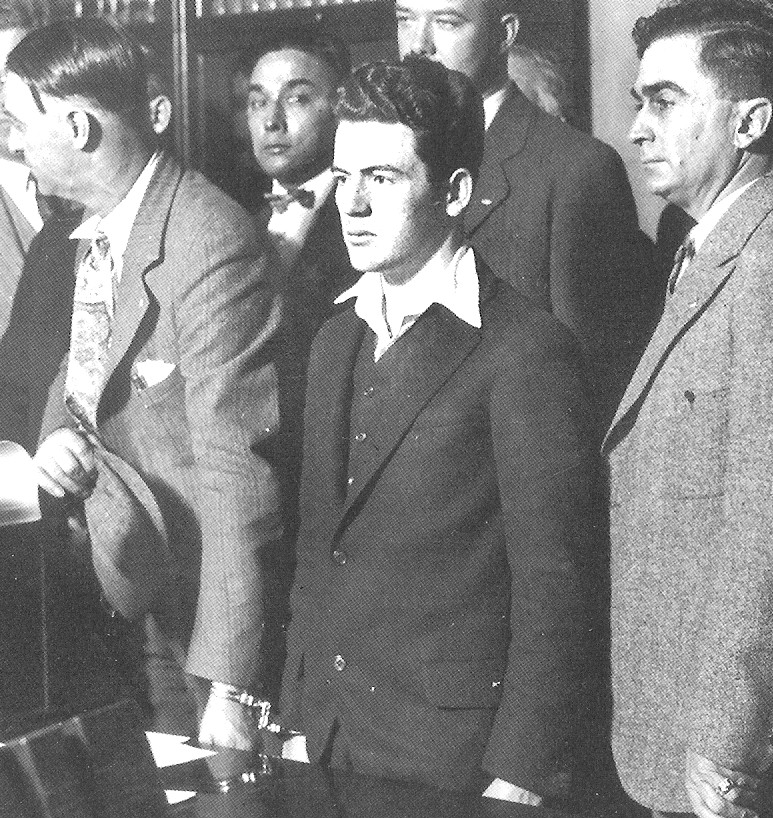
William Hickman in court, just before his death sentence was announced
Hickman was hanged at San Quentin prison on February 4, 1928 – bringing in an end to one of the most tragic cases in Southern California history.

A number of years later, the owners of the former Perry Parker house on South Wilton Place in Los Angeles revealed that the house seemed to be haunted by a ghost of a young girl. The owners, skeptical of the idea of ghosts and completely unaware of the home’s tragic history, stated that they often heard footsteps on the stairs and that their cat often seemed to acknowledge someone in the room that everyone else was unaware of. The family dog, however, was disturbed by whatever presence was in the house. One day, he reacted to a noise that no one else heard (the family had caught a number of glimpses of a figure out of the corner of the eye), ran out of the front door and never returned.

Objects often disappeared from the kitchen, including utensils, cups and glasses. Things placed in one spot would often turn up in others. One week, the lights in the house began turning on and off on their own. This weird phenomenon continued all week long, to the puzzle of the owners. They later learned it was the 47th anniversary of the kidnapping and murder of Marion Parker. 

The full story of the kidnapping, murder and subsequent haunting of Marion Parker is featured in Troy Taylor's "Hell Hath No Fury" series book, entitled, "I WANT TO COME HOME TONIGHT." It's available here as a Kindle title from Amazon