AMERICAN HAUNTINGS INK

Showing posts with label Bloody Illinois. Show all posts

Friday, December 12, 2014

THE HUNDLEY MURDERS

Or, How to Ruin the Holiday Season...

On December 12, 1928, two murders were committed in a historic home in Carbondale, Illinois and those who have lived and worked in the place since that time have come to believe that the spirits of the dead still linger within its walls. The legend of the house claims that “you can bury the bodies in Oakland Cemetery, but you can’t make them rest there.” Such stories are spread about a myriad of allegedly haunted houses in the state of Illinois, but few of them have seen the kind of carnage and violence that occurred in the Hundley House in 1928.


John Charles Hundley was a prominent wealthy citizen of Carbondale at the time of his death. He had been the mayor of the city in 1907 and 1908 and enjoyed many friendships and business acquaintances throughout the area. But Hundley’s life had not always been perfect. In fact, in 1893, he had committed murder. At that time, Hundley had killed a music teacher in town, but was acquitted by a jury after pleading the “unwritten law,” meaning that he had murdered the man who had been sleeping with his wife. The incident led to him divorcing his wife, which caused bitter feelings between him and his son, Victor. Although the problems between them had been supposedly been settled years before the elder Hundley’s death, some witnesses would later claim that the quarrel continued. This led to Victor becoming the chief suspect in the murder of his father.

Hundley remarried a few years later and in 1915, he and his wife, Luella, purchased a lot at the corner of Maple and Main Streets and constructed what became their sprawling and luxurious home. 

Luella Hundley was the daughter of Ruffin Harrison, one of the founders of the city of Herrin and the owner of numerous coalmines in the region. She was the sister of George Harrison, president of Herrin’s First National Bank. She was said to have been an accomplished musician and very involved in local charity work. Perhaps for these reasons, she was regarded as having no enemies, which made her murder all the more puzzling. 

The lives of the Hundleys were destroyed just before midnight on Wednesday, December 12, 1928. Investigators believed that Mr. Hundley was murdered first. His body was found in an upstairs bedroom, dressed only in a nightshirt and socks. He had been shot six times from behind by a .45-caliber revolver. His face had been ripped apart as the bullets exited his head. Mrs. Hundley was killed downstairs. She had been shot twice in the back of the head and once in the heart. She had been shot in a rear stairway, up which she had apparently started to climb in order to aid her husband. Her body had rolled into the kitchen and a pencil was resting next to her left hand. An unfinished letter on the table in an adjoining room was mute evidence of what she was doing when she was alarmed by the shots that killed her husband. 

According to newspaper reports, police officers called by neighbors across the street who heard the shots being fired, arrived at the scene of the crime within minutes. Chief of Police Joe Montgomery told the press the following morning that robbery seemed to be the most likely motive for the murders, even though the house was not disturbed when officers arrived. The only evidence that pointed to a robbery of the house, which contained valuable artwork, expensive furnishings, and a large amount of cash, was the discovery of an empty pocketbook on the floor near Luella Hundley’s body. Neighbors told police that they believed the purse was kept in a writing desk downstairs. For this reason, and others still to be discovered, the police soon began to believe that there were other, darker motives for the crime.

On the morning of December 13, police investigators thoroughly searched the Hundley House. Tracking dogs were brought in and placed on the trail of the killer and four times, the dogs led their handlers straight to the home of John Charles Hundley’s son, Victor, a prominent coal dealer in the city. 

Investigators believed that the killer might have been known to Mrs. Hundley because it appeared that she had opened the door and let him into the house, as she would have done, even at that late hour, for her step-son.

Victor also seemed to have a motive for the murders. At an inquest that was held that afternoon, Joab Goodall, a friend of the Hundleys and the last person to see them alive, testified that the elder Hundley had recently told him that he planned to make a new will and disinherit Victor “because he was no good.” A bitter feud had long existed between father and son and, while allegedly patched up, it had possibly flared into existence again. If this was the case, then Victor Hundley stood to lose a great amount of money if his father changed his will. With an estate worth more than $350,000, Victor would be left with only his trust fund, which amounted to less than $15,000. 

Goodall also told the coroner’s jury that the Hundleys had been in excellent spirits when he visited with them on the night of their murders. They were planning a motor trip to their winter home in Florida and they planned to leave on Sunday. Goodall left the Hundley home around 8:00 p.m. on Wednesday evening and stated that Mrs. Hundley had locked the rear door behind him. Officers who arrived at the house four hours later found this door unlocked.

Another neighbor, Olga Kasper, who lived next door to the Hundleys, testified at the inquest that she had heard the fatal shots fired and had seen the lights in the house turned off immediately after. She said she heard someone running past her home, coming from the direction of the Hundley house and toward Victor’s house, a short time later. The person was so close to the house, she said, that they stumbled against a radio ground wire. 

Investigators from the Jackson County sheriff’s office searched the route described by Mrs. Kasper and followed it to Victor Hundley’s home, which was just 200 yards away. Along the path, officers found several slips of paper that were presumed to have been lost in flight. One paper, dated December 5, was a notice of the termination of partnership of Mr. and Mrs. J.C. Hundley with Victor Hundley in his coal business. Another paper was a bank deposit slip, the back of which bore notes that figured out the interest on a loan that amounted to $532. The note was in Luella’s handwriting and at the top of the paper was written “Vic.” 

Victor Hundley was brought in for questioning and subjected to seven hours of interrogation by Sheriff William Flanigan and his investigators. His house was also searched and a bloodstained khaki shirt was discovered. Hundley claimed that he had been wearing the shirt when he was told about the crime. Police officers awakened him and told him that his father and stepmother had been murdered and asked him to come to the house. While he was wearing the shirt, Hundley said, he had picked up the body of his stepmother. According to investigators, Hundley had never touched the body, so the blood had to have come from somewhere else. Suddenly, Victor recalled that he had been wearing the shirt while quail hunting and that was where the blood had come from.

Victor denied that there was any trouble between him and his father. They had gone through some troubles in the past, he admitted, but that was all over. He told investigators that on Wednesday night, he had been home all evening, reading and playing with his son. He had gone to bed early and was awakened by the police. Hundley also admitted that he owned a .45-caliber revolver, but he claimed that he had recently loaned it to his father. A search of both of the Hundley’s houses failed to turn up the gun. To this day, it has never been discovered. 

After hours of exhaustive questioning, Victor broke into tears and cried out, “Oh my God! This is terrible!” He again swore that had had nothing to do with the murders. He was taken home, but was placed under house arrest as the investigation continued.

On December 15, immediately following the funeral of the Hundleys, Victor was arrested for their murders. While the coroner’s jury was unable to name the killer, Fletcher Lewis, the state’s attorney, believed that he could prove that Victor was guilty in a court of law. Unfortunately, it wouldn’t work out that way and on December 31, Lewis was forced to let Victor go. He filed a motion during Hundley’s preliminary to dismiss the case due to insufficient evidence. The judge sustained the disappointed prosecutor’s motion. 

Lewis made a statement to reporters after the hearing. “While the facts and circumstances learned from the investigation amply justified the holding of Victor Hundley and the filing of a complaint charging him with murder… I have decided to prosecute this particular case no further,” he said.

Then, he added, “I feel quite sure that the atrociousness of this crime will compel the conscience of the person who committed it to someday make public his guilt.”

But Lewis was wrong. No one ever came forward and the killers of J.C. and Luella Hundley were never found. The case languished in limbo for a time and then was relegated to the “unsolved” section of the city’s law enforcement files. There were many who believed that Victor Hundley had gotten away with murder, but they could never prove it. Victor never spoke of the crimes again and he continued to live on in the Carbondale area for the rest of his life. Eight decades later, the murders of Carbondale’s former mayor and his wife remain unsolved. 

And perhaps, for this very reason, many have come to believe that their spirits do not rest in peace.

The Hundley mansion at the corner of Maple and Main streets remained empty for two years after the murders. The only physical reminder of the horrific crimes that occurred there was a bullet hole in a wall near where Luella’s body had been found, but the memories of that night remained in the minds of people in town. 

The house remained vacant until 1930, when it was purchased by Edwin William Vogler, Sr. He bought the house and all of its contents from the Hundley estate. It remained in the Vogler family until 1972, when it was sold to a family named Simonds, who converted the huge residence into a gift shop with apartments upstairs. In 2000, it was sold to Victoria Sprehe, who ran the gift shop for five years before selling it to make more time for her young son. It was later turned into a bed and breakfast for a time. 

Rumors that date back many years claim that the Hundleys still haunt this house. A number of the past owners and tenants in the building have had strange encounters that they are unable to explain. One former resident told of loud knocking sounds that reverberated in her room at night and the faint sound of the downstairs piano as the keys tinkled by themselves. Her family also recalled hearing footsteps going up and down the stairs, as if perhaps the killer of the Hundleys was doomed to repeat his walk to J.C. Hundley’s bedroom again and again. 

Former owner Victoria Sprehe said that whenever she was alone in the house, lights would turn on by themselves, as if someone were watching over her. She said that she believed that Luella’s ghost followed her home from work on at least one occasion. Walking into the empty house, she heard pots and pans clanging and noticed that lights were on in the kitchen. However, she noted, “It’s not like a scary presence. It’s a very peaceful vibe.”

Perhaps it’s not a scary presence, but it could be unnerving. Sprehe was sometimes bothered by a door that opened by itself and by footsteps that she heard walking on the stairs – the same stairs where a previous family also reported disembodied steps. Tenants who lived in apartments on the upper floor also told stories of the creaking stairs and what definitely seemed to be the sound of boots, or heavy shoes, clomping on the wooden risers. One tenant laughed and stated that this was only the sound of the old house settling and then lost his grin when he admitted that he had never heard of a house that settled in just that way.

Victoria Sprehe’s daughter, Nina Bucciarelli, also recounted odd incidents in the house, like the front porch swing that would move by itself, even when there was no wind. Sprehe’s husband had also noticed this odd occurrence. Nina had her own explanation for the swing’s strange movement. “As night, if you drive by the porch swing, it’s just swinging away. I think Mr. and Mrs. Hundley still like to swing at night,” she said.

And perhaps she’s right, because if the stories of the past decades are to be believed, the Hundleys have not yet departed from the house they called their own – and the place where their lives were taken away too soon.

An excerpt from Troy Taylor's book, BLOODY ILLINOIS


Friday, June 27, 2014

THE LAKE CLUB GHOST

Haunting at Springfield’s Hottest Gambling Club

Firefighters were called to a scene near Lake Springfield in Central Illinois one early Sunday morning in August 1992. When they arrived, they found a dilapidated, old building that had been closed for years completely engulfed in flames. The fire, which later turned out to have been deliberately set, destroyed a place called the Lake Club, a once-grand restaurant and nightclub that had been out of business since the 1960s. Other businesses had come and gone in the building since the demise of the club but most people recalled the 1940s and 1950s as the golden age of the Lake Club.

It was from this time period that stories of big bands, live radio shows, and illegal gambling emerged as fond remembrances of yesterday. But it was also during this time that the stories of the club’s resident ghost emerged – a tragic nightclub employee who simply refused to leave.

 The Lake Club during its heyday

The Lake Club opened as a nightclub in 1940, but the building on Fox Bridge Road had seen many incarnations in the years prior to that, including as several restaurants and even a skating rink called the Joy Inn. In 1940, two dance promoters named Harold Henderson and Hugo Giovagnoli renovated the place and opened it for business as the Lake Club.

The interior of the Lake Club during its prime

 The club soon became one of the hottest nightspots in Illinois, drawing customers from all over the state. It boasted a raised dance floor surrounded by a railing, with curved walls and a swanky atmosphere that made patrons feel as though a New York club had been transported to the shores of Lake Springfield. The owners concentrated on bringing big name entertainment to the club and succeeded. Among the many top performers were Bob Hope, Ella Fitzgerald, Guy Lombardo, Pearl Bailey, Spike Jones, Nelson Eddy, Woody Herman, Mickey Rooney, and many others. The constant stream of entertainers and big bands brought capacity crowds to the club every night. During the height of its popularity, the club even hosted a radio call-in show that broadcast music and entertainment all over the area.

A music program from the heyday of the club shows that some of the biggest names in entertainment came to Springfield and played at the Lake Club.

The Lake Club thrived for nearly two decades, becoming known not only for its swinging entertainment, but for its first-rate gambling, as well. Wealthy customers and the society elite of Springfield and Decatur frequented the club for the musical guests and also for the billiard tables, craps and gaming tables, slot machines, and card games. This part of the club operated in secret in a back part of the building, known only to high rollers and special customers. However, in December 1958, the golden days of the Lake Club came to an end. The partners had survived many setbacks over the years, from lawsuits to foreclosures, but the club would not survive the two undercover detectives who gained access to the gambling rooms that Christmas season.

The club was immediately shut down, although patrons continued dining and dancing while the actual raid was going on. The two state troopers who entered the gambling rooms were the first police officers to arrive, but many more followed. Newspaper accounts reported the police confiscated all sorts of gambling equipment including tables, dice, slot machines and large quantities of cash. The billiard tables were so large they had to be dismantled to get them out of the room.

Business began to falter in the wake of the raid and the place finally closed down in the 1960s. Giovagnoli blamed the failure of the club on the gambling crackdown, always maintaining that the entertainment had been just part of the club’s appeal. However, he refused to give up. Despite his partner Harold Henderson’s death in 1977, Giovagnoli managed to open the club again with other parties managing different projects in the building. During this next popular time in the club‘s history, it was managed by Bill Carmean and Tom Blasko as a rock club. In 1980, it was leased by Pat Tavine, who also operated it as a rock club until 1988, when it closed down for good. The Lake Club was destroyed in the fire just a few years later.

It was in August 1979 that the Lake Club, known in 1980 when the story came out as the “Sober Duck Rock and Disco Club,” gained national notoriety. It was at this time when the ghost of Albert "Rudy" Cranor was finally put to rest.

According to the many patrons and staff members who had experiences there, the haunting of the Lake Club first began in 1974. At the time, the club was in the midst of a revival in interest and the business was under the ownership of Tom Blasko and Bill Carmean, two Springfield men who were booking rock acts into the club. The building itself was still owned by Hugo Giovagnoli and Harold Henderson.

Bill Carmean was the first to notice that something strange was going on at the club. Both he and Tom Blasko had experienced cold chills in the building, along with hearing odd sounds and getting the feeling of being watched in certain rooms. One afternoon, he came into the club and sat down at the bar with the lights off. Suddenly, he heard the sound of a piano being played in another room. He got up to see who else was in the building with him and as he stepped into the room, the music stopped. The room was completely empty.

Weird things continued to happen. Often on Monday nights, while Carmean would be in the building going over the weekend receipts, he would hear a door near the office open and footsteps crossing the floor. He would jump from his seat to see who was there, but the hallway was always empty. Carmean also remembered a salesman visiting his office one evening when a glass flew off a table and hit the wall on the opposite side of the room. The salesman left in a hurry.

By 1976, the haunting had intensified and things began happening more often, and in front of more witnesses. A club bartender was pouring a drink one night when the glass in front of him suddenly shot up into the air and landed over his shoulder. A waitress also experienced the antics of the ghost one night when she went to serve a drink to a customer, only to find the glass inexplicably filled with chocolate. She would later insist the glass had been absolutely clean when she handed it to the bartender.

Carmean was the first of the club’s staff to guess the identity of the ghost who was plaguing the club. He recalled that a former employee had committed suicide in the building several years before. On a lark, he started calling the ghost by this man’s name, which was Rudy.

Albert "Rudy" Cranor had worked at the Lake Club during its heyday of the 1940s and 1950s. He was described as being well-liked and popular with the entertainers and the customers. He was a very large man, well over 250 pounds, and he had snow-white hair. He was remembered as one of the club’s most memorable characters and even 50 years later, I have spoken with people who remember him. They speak fondly of him and recall his as a nice man and their favorite bartender.

After the club fell on hard times following the gambling raid, Rudy also began experiencing some personal difficulties. He was a very private person, so no one really knew what was going on, but they did notice that he began to drink heavily while on the job. They also began to notice some changes in his personality and appearance. He seemed to be more tired than usual and dark circles had begun to appear under his eyes. Then, one night, he became sick and had to be rushed to the hospital. It took several men to carry him downstairs to the ambulance. He returned to the club after a two-week stay in the hospital, but he was never the same again.

On June 27, 1968, Rudy shot himself with a high-powered rifle in one of the back rooms at the club. He died in the hospital the next morning, never regaining consciousness. No one was ever sure why Rudy had killed himself, but regardless, he wouldn’t stay gone for long. In a few short years, he would return to haunt his beloved club.

The strange events at the club continued in the form of weird antics and pranks, apparently carried out by the ghost of Rudy Cranor. One night, Tom Blasko placed a pile of tablecloths on an empty table and left the room. When he came back, the cloths were on the floor. He picked them up and left again, only to return moments later and find them once again on the floor. This was repeated several times until Blasko finally gave up and left them on the floor.

Employees and visiting musicians also reported strange occurrences like doors opening and closing by themselves, the sound of footsteps in empty rooms, a drink that lifted off a table and then dumped in a customer’s lap, office equipment that operated on its own, feelings of being poked and prodded by unseen hands and numerous other bizarre happenings.

A frightening event took place in the summer of 1977 when Barbara Lard, a waitress at the club, had an encounter with Rudy himself. She was working one evening and went to the bathroom behind the back office. As she came out, she glanced over the back bar and saw Rudy looking at her. She described what she saw as just a head, hanging there in space, and although she could see through it, the head appeared life-like. She said that the apparition had snow-white hair – and she had never known, heard about, or had even seen a photograph of, the late bartender. The apparition looked at her for a moment and then spoke, telling the waitress that one of the owners of the club was going to die. This was not a threat, Lard recalled later, but merely a warning.

The waitress ran out of the room in tears, visibly shaken and close to hysterics. Other staff members who saw her that night reported that she was very frightened and that she was not a person known for being hysterical or easily frightened. Tom Blasko later stated that he went back into the room after Lard’s encounter and claimed to feel the same bone-chilling cold that he always associated with Rudy’s spirit.

Needless to say, Blasko and Carmean were more than a little unnerved by the ghost’s warning. By this time, they had no doubt the ghost was real and that the club was genuinely haunted. Because of this, they also had no reason to doubt that Barbara Lard’s encounter had been real. Her description of the late Rudy Cranor had been too accurate to have been imagined. The two men waited and probably were more careful than usual when doing things like driving to work or climbing ladders. Then, two weeks after the incident, Harold Henderson, one of the original owners of the club, died at the age of 69. He was still the owner of the building itself and was an owner that Rudy would have known during his lifetime.

This incident would shake Blasko more than anyone else. He had spent two weeks living in fear for his life and he felt that it was time to get rid of the ghost if possible. Perhaps Rudy had been trying to be helpful with his warning, but Blasko didn‘t really care. He contacted a woman he knew who was interested in the occult and she suggested that he ask a priest for help. Blasko was a practicing Catholic, but when he contacted his parish priest, the man declined to become involved. He suggested that Blasko pray for Rudy on his own and Tom spent the next six months carrying a rosary around the club with him. But it didn’t help – Rudy was still there.

Finally, in August 1979, Blasko attended a high school class reunion and ran into one of his former classmates, Reverend Gary Dilley, a priest who now lived in Fort Worth, Texas. Tom mentioned the problems at the club to Father Dilley and the priest was intrigued. After some discussion, he agreed to come out to the club and take a look around. He said later that he believed Blasko was sincere about what he said was happening. He had known the man for many years and had never thought of him as the hysterical type.

After arriving at the club, Father Dilley also sensed something out of the ordinary there. He experienced some unexplained cold chills and felt as if someone was watching him. He said in a later interview, "I also had the feeling that someone was trying to communicate with me.”

The priest questioned several of the club’s employees and found that their stories were very similar. He knew they had not had time to compare notes before he spoke with them. He was convinced that something was going on, but he declined to do an "exorcism" of the club. To do that, the case would require a thorough investigation and permission from the local bishop, which he doubted that he would get. Instead, he decided to bless the place and pray there, hoping this would perhaps put Rudy to rest.

Father Dilley contacted two other priests to take part in the ceremony, Father John Corredato of Kankakee and Father Gerald Leahy of Griffin High School in Springfield. The three men were quick to point out that they were merely trying to bless the building, to clear out any negative spirits and to help at least one "very restless soul" to find peace. The three priests went from room to room in the club, blessing each with holy water and praying. They asked that any negative spirits depart from the building and they prayed specifically for Rudy Cranor. They entered the room in which he had committed suicide and prayed that his spirit be at rest.
           
So, was that the end of the haunting? Apparently, it was. The same people who considered the club to be haunted were now sure that Rudy had departed. The day of the religious ceremony was the last day when anyone was aware of Rudy’s presence in the building. It seemed that the prayers and blessings had helped the bartender find his way to the other side. It certainly seemed possible that Rudy might have chosen to stay behind in a place where he had many attachments in life. Perhaps the intervention of the priests was all he needed to be convinced to move on.

Once Rudy was gone, some staff members realized they hadn’t minded his ghost as much as they had once thought. In a 1980 newspaper interview, Tom Blasko said, "In a way, I sort of miss Rudy. We were all fond of him. It’s been pretty quiet since the priests were here – sometimes I wish that I hadn’t asked them to come."

Missed or not, Rudy finally found some peace and a release from his suffering, somewhere on the other side.


FROM TROY TAYLOR’S BOOK, BLOODY ILLINOIS

Thursday, March 14, 2013

THE STARVED ROCK MURDERS

Horror at One of Illinois’ Most Historic Sites

On this date, March 14, 1960, the bodies of three women from the Chicago suburbs were discovered in St. Louis Canyon, one of the many natural wonders at Starved Rock State Park, near Utica, Illinois. The crime shocked northern Illinois and led to a manhunt that snared a confessed killer who has been in prison ever since. It is one of the most shocking stories to ever occur in this otherwise peaceful region.

But no one can say that Starved Rock does not have a violent and bloody past. The park takes its name from a rock fortress on the Illinois River, where a band of Illiniwek Indians were besieged in the seventeenth century. As their numbers decreased from starvation, desperate warriors attempted to escape, only to be slaughtered in the surrounding forests.

In March 1960, the violence of the past returned to Starved Rock with the discovery of the bludgeoned bodies of three women from Riverside, Illinois. The land around high stone fortress had been turned into state park years before and on March 14, the women’s bloody corpses were found in one of the park’s fabulous box canyons.

The three women from the Chicago suburbs, Mildred Lindquist, Lillian Oetting and Frances Murphy, who hiked to their fate in Starved Rock’s St. Louis Canyon. 
The three middle-aged women, Mildred Lindquist, Lillian Oetting and Frances Murphy, had driven from their upscale homes in the Chicago suburbs for a four-day holiday at Starved Rock Park. The three friends, who all attended the Riverside Presbyterian Church, had been anxious for an outing together. Oetting, who had spent the entire winter nursing her husband after a heart attack, was especially looking forward to several days of hiking, bird watching, and spending time outdoors. Employees at the park’s lodge would later remember the arrival of the three ladies. Frances Murphy had parked her gray station wagon in the inn’s parking area and she and her friends had unloaded their few pieces of luggage. They registered for two rooms, dropped off their bags and then ate lunch in the dining room. Afterward, they remarked to one of the staff members that it was a beautiful day for a hike and they left carrying a camera and a small pair of binoculars.

The women walked away from the lodge wearing rubber galoshes. The path was covered with a light snow and they trudged and slipped along, pausing occasionally to take photographs of one another. Eventually, they came to the dead end of St. Louis Canyon, where steep rocky walls framed a majestic, frozen waterfall. The three women were only one mile from the lodge. Lillian Oetting struggled with the controls of her friend’s camera and snapped several color slides of the canyon. When she was finished, the group turned to leave --- and they walked into a horror that stunned the entire nation.

The first sign that something was wrong occurred that evening when George Oetting tried to telephone his wife at the lodge. She had promised to call him but when she had not, Oetting placed his own call. He was told by staff on duty at the desk that his wife was not available. It was surmised that the ladies had gone out somewhere and the staff member suggested that she would call in the morning. Unconcerned, Oetting went to bed.

On Tuesday morning, he called the lodge again and once more, asked to speak to his wife. The employee who answered mistakenly told the worried man that the three women had been seen at breakfast and were simply out of the lodge at that time. Reassured, Oetting ended the call.

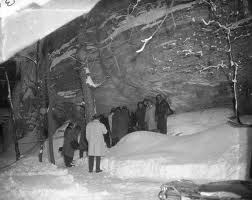
That night, a late winter storm hit the Illinois Valley. In St. Louis Canyon, several inches of snow covered up footprints, blood stains and other vital pieces of information around three cold and still bodies. The near-blizzard conditions continued all night long, making the roads in the park nearly impassable.

St. Louis Canyon in the warm weather months. In March 1960, the water was frozen and an early spring snow blanketed the region. 
George Oetting telephoned the lodge again on Wednesday morning but his wife and her friends could still not be located. At his insistence, employees entered the women’s rooms and found that the beds and bags were untouched. A quick check of the parking lot also showed that the Murphy station wagon had not been moved. Shocked, Oetting realized that his wife and her friends had now been missing for more than forty hours.

As soon as Oetting broke off the call, he telephoned his longtime friend, Virgil W. Peterson, the operating director of the Chicago Crime Commission. When Peterson learned of the news, he contacted the state police and other law enforcement agencies in the area. Within minutes, word of the missing women had reached the LaSalle County Sheriff’s office and Sheriff Ray Eutsey began organizing search parties to look for the women. He accompanied one of the groups that left immediately for the park.

Bill Danley, a local newspaper reporter, was just finishing his last story for the day’s edition when he got a tip about the disappearances. Grabbing a camera, he braved the snow-packed roads and headed for the park. When Danley reached the park’s west entrance, he noticed a boy running across an icy ravine toward the road. He drove to a small parking area and found several other youths, shouting that bodies had been found on one of the trails. Danley recognized the boys as members of the nearby Illinois Youth Commission Forestry Camp, where he had once led an Explorer Post, and he pulled them aside to a nearby storage garage for some questions. When they told him of the bodies, he called the lodge, where law enforcement officials had gathered, and then called the newspaper to report the discovery. In a matter of minutes, the story was flashing across news wires around the country.

Danley was among those who entered St. Louis Canyon and got the first look at the bodies. The three mutilated women were lying side-by-side, partially covered with snow. They were on their backs, under a small ledge, and their lower clothing had been torn away and their legs spread open. Each of them had been beaten viciously about the head and two of the bodies were tied together with heavy white twine. They were covered with blood and their exposed legs were blackened with bruises.

Recovering the bodies from the depths of the canyon was a major undertaking in the snow. 


State Police detectives soon arrived and began a search of the immediate area. Except for the floor of the overhang where the bodies were found, the entire canyon was covered in nearly six inches of snow. The fine, white powder had to be carefully removed and as it was, signs of a violent struggle were revealed. Mrs. Murphy’s camera was found about ten feet from the victims. Its leather case was smeared with blood and its strap was broken. They also found the women’s bloody binoculars. A short distance away, LaSalle County’s States Attorney Harland Warren stumbled across a frozen tree limb that was streaked with blood. The snow beneath it was covered with blood and it was realized that this was likely the murder weapon. A trail of gore also led them to speculate that the women had been killed deeper in the canyon and then their bodies had been dragged and positioned under the rock ledge. The bodies remained in place for hours, until pathologists and state crime lab officials could arrive. The vigil lasted long into the night and then, aided by lanterns and flashlights, the victims were removed on cloth stretchers.

The bodies were taken to the Hulse Funeral Home in Ottawa, where they were examined and autopsied. The women had obviously been molested, but the cold, and limitations of medical techniques at the time, failed to find any evidence of rape. The doctors were able to determine the time of death, placing it shortly after they had enjoyed lunch at the lodge. No motive was suggested for the murders but robbery was dismissed, as the women had left their money and jewelry behind in their rooms when they went for their afternoon hike.

The investigation went nowhere, almost from the start. There were few clues to follow and theories began to grow wilder and wilder. Things were further confused by all of those who wanted to maintain jurisdiction in the case. State’s Attorney Warren, a hard-working and respected official, was technically in charge but the state police maintained their authority in the case because the murders were committed on park property. The two law enforcement camps clashed but Warren was in a bind. He was forced to deal with the state authorities because the officials in LaSalle County simply had no experience dealing with crimes of this manner.

As the investigation slowly moved forward, fear was gripping the region. Doors that were never locked before were now firmly secured. Hardware stores experienced a run on new dead bolts and sporting goods stores saw guns vanish from their cases at an alarming rate. The number of overnight guests at the Starved Rock Lodge dropped off to almost nothing and some motorists went miles out of their way to avoid driving near the canyon entrance. Newspapers and radio broadcasters around the state widely reported the slow progress of the investigation and elevated the level of panic in the area.

The continued newspaper scrutiny of the case kept pressure on police officials to make progress, especially at Harland Warren’s county office. He was doing everything in his power to move the investigation forward, but he had a hard time coping with the pressure, especially during an election year. Money was becoming a problem as well, since the investigation budget was soaring. Throughout 1960, he was under ever-increasing pressure to solve the murders. Frustrated, he felt that he had taken enough criticism for the investigation. He was an attorney, not a detective, but he decided to take one last desperate run at the case. He asked himself what the killer had left behind at the scene of the crime and the obvious answer was the twine that he had used to bind two of the victims.

Using his own money, Warren purchased a microscope and began intently conducting a study of the twine. Research revealed that there were two kinds of twine used, a 20-ply cord and a 12-ply one. With this information in hand, he sought out help to follow the lead. Instead of choosing someone from his staff, he handpicked two county detectives who would report to him alone. The two men were deputies Bill Dummett and Wayne Hess. They were both trustworthy and intelligent and would not leak the details of what Warren was doing to the newspapers.

The men chose the most logical place to start the search for the source of the twine, which was Starved Rock Lodge. In September 1960, Warren and his deputies met with the manager of the lodge’s kitchen. Within minutes and without much difficulty, Warren found both kinds of twine used in the murder. They were each used for wrapping food and Dummett and Hess, using lodge purchasing records, soon tracked down the twine’s manufacturer. The twine used to bind the murder victims had been taken, without question, from the supply in the lodge’s kitchen. Just as Warren had always suspected, the killer either worked at, or had access to, the park’s lodge.

Faced with the fact that all of the lodge employees had been given polygraph tests, and had passed, Warren now had to wonder if the tests had been accurate. He boldly decided that it was time to run some of his own tests. Hiring a specialist for a prominent Chicago firm, Warren recalled all of the employees who had worked during the week of the murder. One by one, they came to a small cabin located near the lodge and again submitted to an exam. The first dozen or so were quickly cleared and Warren and the deputies wondered if they might be wasting their time. Then Bill Dummett brought in a former dishwasher named Chester Otto Weger and everything changed.

Chester Weger stepping out of a car. 
When Weger’s polygraph test was completed, Warren noticed that the examiner’s face had gone pale. As soon as Weger left the cabin, the technician ended months of endless leads and wasted time. He turned to Warren and the two deputies and quietly stated, “That’s your man.”

Weger, twenty-one, was a slight, small man with a wife and two young children. He had worked at the park until that summer, when he resigned to go into business with his father as a house painter. Dummett remembered the man’s name from an earlier police report, but he had never made much of an impression on the investigators. Warren intensified the investigation of the man and strangely, Weger happily cooperated with him. He surrendered a piece of a buckskin jacket that he owned so that some suspicious “dark stains” on it could be examined. It later turned out to be human blood, but in 1960, it could not be typed and matched to a specific victim. Warren also asked Weger to submit to further polygraph tests and again, Weger agreed. He was given an entire series of tests and he failed all of them.

Once the jacket was determined to be stained with blood, Warren put the former dishwasher under constant surveillance by the state police. Warren, along with Dummett and Weger, began checking into Weger’s past and also into similar crimes in the area, which might have escalated into murder. Dummett came across a reported rape and robbery that took place about a mile from Starved Rock in 1959. With Warren’s approval, he approached the young female victim with a stack of mug shots. As she slowly sorted through them, she began to scream as she came across the face of Chester Weger.

With this positive identification, Warren could have easily have ordered Weger arrested, but he was forced to wait. A new problem had reared its ugly head.  With all of time and energy involved in the investigation, Warren had worked very little on his campaign for re-election. If he booked Weger on rape and murder charges before the election, defense attorneys would simply say that he had done so as a stunt to retain his job. He left Weger under surveillance, not wanting to jeopardize the case against him with the election. Confident of his record of cleaning gambling and prostitution out of LaSalle County during his eight years in office, Warren let his past actions speak for themselves. Unfortunately, his opponent let the “bungling” of the Starved Rock murder case speak for him. Out of 60,000 votes case in the election, Warren lost by nearly 3,500.

Disappointed by the election results, Warren still had time in office to pursue the case against Weger. Although his evidence was not as strong as he would have liked, he obtained an arrest warrant against Weger for the 1959 rape and ordered Hess and Dummett to pick him up. He believed that when he saw all of the evidence mounting against him, Weger would confess to the crime – and to the Starved Rock murders.

Warren made careful plans with his two deputies about how to interrogate Weger before confronting him with murder charges. A short time later, Hess and Dummett arrived at the young man’s apartment and explained that they had some more questions for him. They made no mention of the arrest warrants that were waiting at the courthouse. Once they had him in custody, the officers began to question him about the rape and also began to press him about the murders. They kept him in the interrogation room until past midnight and then finally, weary of questions and nearly exhausted, Weger stopped in mid-sentence and asked to see his family. A police car was dispatched to his parents’ home in Oglesby and his mother and father were brought to the courthouse. Dummett and Hess gave them a few minutes alone with their son.

In his official statement, which was taken the next day, Deputy Hess stated, “When Bill stepped out of the back room in the states attorney’s office to show Mr. and Mrs. Weger to the door so they could go home, I could see that something was bothering Chester. I said ‘Chester, why don’t you tell me about it? There are just the two of us here… just tell me about it.’ He said, ‘All right. I did it. I got scared. I tried to grab their pocketbook, they fought and I hit them.’ The pocketbook that Weger claimed that he tried to take was actually Mrs. Murphy’s camera.

Minutes later, the confession was transcribed and signed by Weger. During the confession, when he was asked why he had dragged the bodies under the overhang in St. Louis Canyon, Weger said that he had spotted a small airplane flying low over the park. Weger said that he was afraid that it was a state police plane so he moved the bodies so that they could not be seen from above. A few days later, the flight over the park was confirmed by the pilot’s testimony and log book.

Although Weger later claimed that he had been coerced into confessing, he gave the investigators many details about the crime and even went out to St. Louis Canyon with them to re-enact how he carried out the murders. 
Weger confessed several more times to the murders over the next few days and even reenacted the killings for a crowd of policemen and reporters at the canyon. Then suddenly, after his first meeting with his court-appointed attorney, Weger changed his story and stated that he was innocent of all of the charges. Weger claimed that Dummett and Hess had coerced a confession from him by threatening him with a gun. He had lied in his confession, but had been so scared that he signed the papers anyway. Weger also said that Dummett had fed him the information about the airplane. He claimed to be in Oglesby at the time of the killings.

Weger was brought to trial. Jury selection took almost two weeks and the trial began on January 20, 1961. The new state’s attorney, Robert E. Richardson, was in charge of the prosecution and was assisted by Anthony Raccuglia. The trial, which gained national attention, was presided over by Judge Leonard Hoffman and because the two prosecutors had never tried a murder case before, he suggested that Harland Warren be named as a special prosecutor for this case only. Richardson, who had strongly criticized Warren during the election, dismissed the idea. Richardson and Raccuglia decided to file charges against Weger for only one of the three murders. The reason for this was that in the event of a mistrial or an acquittal, they could still file charges against him for the other killings. They sought the death penalty in the case.

On March 4, almost exactly a year after the murders, the jury brought back a guilty verdict for Chester Weger. On the day of his twenty-second birthday, he was sentenced to a term of life imprisonment. After Judge Hoffman dismissed the jurors, reporters asked them if they knew that a life sentence in Illinois meant that Weger would be eligible for parole in a few years. Most of the jurors were shocked -– they had no idea. Some of them even said that if they had known that Weger was not really being sent away for the rest of his life, they would have voted for the electric chair. A lack of knowledge of Illinois law, and the prosecutor’s failure to properly instruct the jury, ended up saving Weger’s life.

Chester Weger was incarcerated at the Statesville Penitentiary in Joliet and remains in prison today at the Illinois River Correctional Center in Canton. Weger has been denied parole two dozen times since 1972 and most feel that he belongs securely behind bars.

However, in the minds of some people, there are questions about the case that remain unanswered. Many feel that the evidence that was used to convict Weger would not stand up in court today. His prosecution largely turned out to be based on his confession, which pre-dated Miranda warnings that are required today. Others question how a small, slight man like Weger could have overpowered the three middle-aged women, and then moved their bodies by himself to leave them hidden under the rock overhang.

Others who believe in Weger’s innocence point to a “deathbed confession” that allegedly occurred in 1982 or 1983. A Chicago police sergeant named Mark Gibson submitted an affidavit in 2006 that recounted the confession. It was being used in court to support a motion for new DNA tests in the Starved Rock murder case. In the affidavit, Gibson stated that he and his partner, now deceased, were called to Rush–St. Luke’s Presbyterian Hospital to see a terminally-ill patient who wanted to “clear her conscience.

The affidavit stated, “The woman was lying in a hospital bed. I went over toward her, and she grabbed hold of my hand. She indicated that when she was younger, she had been with her friends at a state park when something happened.”

The woman then told Gibson that she was at a park in Utica and things “got out of hand,” multiple victims were killed and “they dragged the bodies.”

Gibson said that the woman’s daughters cut the interview short, shouting that their mother was “out of her mind” and ordering the police from the room. In the affidavit, Gibson did not provide the exact date of the interview, or the woman’s name, but said he passed the information along to a detective. The affidavit did not address whether or not there was any follow-up or why the confession was not presented until 2006. The alleged “confession” was not allowed into the court hearings, although new DNA tests were ordered. However, they failed to clear Weger of anything because the samples had been corrupted over the years.

After these attempts for release failed, a clemency petition was sent to Governor Rod Blagojevich, but it was denied in June 2007.

To this day, Chester Weger continues to maintain that he was framed for the murders by Deputies Dummett and Hess. But both of the deputies, until the day each of them died, insisted that Weger had confessed. They firmly believed that he had committed the murders and had been the perpetrator of one of the most heinous acts in the already-bloody history of Starved Rock.

The story of the Starved Rock Murders and other crime and haunting stories around the state can be found in my book BLOODY ILLINOIS, which is available autographed on the website or as a Kindle edition.


Sunday, February 10, 2013

The Girl in the Snow


THE GIRL IN THE SNOW
The Haunting Story of Marion Lambert

The First World War was raging in Europe in the middle days of February 1916 but among Chicagoans and others across the country, one of the most riveting newspaper stories of the day was the mysterious case of Marion Lambert. The attractive daughter of the gardener at a North Shore estate was found dead in the woods near the Lake Forest interurban railroad station on the early morning of February 10. She had celebrated her eighteenth birthday just four days before and she had last been seen on February 9, when she had left for classes at Deerfield High School in Highland Park. She never arrived there, and was not seen again until her body was discovered the following day. She had been killed by a deadly dose of poison, although what exactly happened to her remains a lingering mystery to this day.

And because of this mystery, there are many who do not believe that Marion Lambert rests in peace. Like other restless young women in the Chicago area, her ghost is said to be seen along the area roadways, not far from where she died.

Marion Lambert
Marion Lambert was a beautiful young girl, as photographs that remain of her clearly show. She was a pretty and vivacious senior at Deerfield High School. Her light brown, wavy hair was cut stylishly short and her minister called her the liveliest girl at the Lake Forest Presbyterian Church. She lived a happy life, usually with a smile on her face. She was the beloved only child of Frank Lambert, the head gardener employed by clothing millionaire Jonas Kuppenheimer, on whose estate the family lived. The Lambert family did well for themselves and times were good in Lake Forest. Many of the local tycoons were becoming wealthier by equipping the warring armies in Europe and they paid their employees well. Marion was starting to dream of going off to college in the fall.

But perhaps the one thing that made her happiest was the young man in her life, Will Orpet, a college student three years older than she was. Orpet’s father was also a caretaker; he worked on the estate of farm equipment tycoon Cyrus McCormick. The two families had known each other for years and were friendly with one another but the friendship between Will and Marion blossomed when he began sending her letters from Madison, where he was studying journalism at the University of Wisconsin. The letters were only flirtatious at first, but soon grew more serious. “I want to see you dearest, and want you badly,” he wrote to Marion on April 8, 1915. “If only I could get my arm around you now, and get up close to you and kiss the life out of you, I would be happy.”

It was later recalled that Will was not content with mere words.  When he came to see her, he sat scandalously close to her on the sofa, insisting on holding her hand and daring to kiss her. Marion did not approve at first but Will refused to give up and slowly, she started to give in to his advances. In September of that year, he came to her home in Lake Forest, took her for a drive and stopped at the edge of the woods just south of the Sacred Heart Convent. They went for a walk in the forest and then sat down together in a remote spot, carefully hidden among the trees. Marion gave herself to him there and they made love in the quiet of the forest.
   
Marion began dreaming of a wedding but Orpet, apparently bored after getting what he wanted out of the pretty young woman, began to lose interest. His letters became short and often he told her that he didn’t have time to write. In November, when Marion confessed that she feared she might be pregnant, the letters grew even colder. Orpet was angry and stopped just short of calling her a liar. They had only been intimate once, he insisted, and he didn’t believe that it could have happened. In spite of his denials, he called on a pharmacist friend and sent Marion a potion that was meant to relieve her “delicate condition.” Orpet was determined not to let his dalliance with Marion became a trap. She wasn’t his only girlfriend – a college pal said that he had several others on the side -- and he wasn’t serious about her. He was planning to marry another girl, a young chemistry teacher from DeKalb, and he wasn’t going to let Marion trap him into a marriage that he didn’t want.

By the time the holidays arrived, Marion undoubtedly knew that she wasn’t pregnant but it’s unknown whether or not she told Orpet about this. She wanted to hang onto him as long as she could, believing the two of them were meant to be together. On February 6, 1916, Marion celebrated her eighteenth birthday at a spirited party thrown by her best friend, Josephine Davis.

Two days later, while Josephine was visiting at her home, the telephone rang and Marion left her friend in the sitting room when she into the hallway went to answer it. The telephone call was from Will Orpet. Josephine later stated that Marion was uneasy when she returned to the sitting room, but later, at Orpet’s trial, she said that Marion was “confused” and became “greatly distressed and depressed.” She even testified that Marion confided in her that, “if Will throws me over and marries that other girl, I’ll kill myself.”

But was Josephine’s testimony the truth? Marion’s parents and several other of her friends claimed that the girl had been happy and untroubled in the days leading up to her death. This bit of testimony remains one of the lingering mysteries in the case.

On the morning of February 9, Marion, bundled up in a green coat, walked with Josephine to the Sacred Heart station, where they usually caught the train to Deerfield High School. But having arrived on the platform, Marion decided not to take the train. She told her friend that she had to go to the post office to mail a letter to her Sunday school teacher. That was the last time that Josephine saw her alive.

Later that night, Frank Lambert waited for his daughter at the Sacred Heart station. Marion had told her parents that she was going to attend a party after school and would return on the 8:05 p.m. electric car from Highland Park. When the train arrived, though, Marion was not on board. She was not on the next train either. Lambert waited for over an hour before he drove into Highland Park. He was told that Marion was not at the party and in fact, her friends told him, she had not come to school at all that day.

Confused and worried, Lambert returned home and he and his wife spent a sleepless night waiting for and worrying about their daughter. Finally, before dawn, he couldn’t wait any longer and he returned to the Sacred Heart station to search for any clues as to Marion’s whereabouts. He stumbled about in the darkness, looking for footprints in the snow by the light of burning matches. It was too dark to see anything so he left to go get a friend. When they sun came up, they returned and found a line of footprints leading away from the station in the snow. One of the sets of prints was small, like a girl’s, the other was larger. They formed a side-by-side trail that wandered out into the forest.

The two men followed the trail into a small clearing and there, beneath three winter bare oak trees, Lambert saw a bright patch of green in the snow. He let out a small cry and began to run toward it. He soon saw Marion lying there on her side, her school books tucked under her arm and the letter to her Sunday school teacher still in her pocket. Her right hand was ungloved and it stretched away from her body. In the palm of her ice-cold hand her father saw a smear of white, powdery crystals. Her lips were bloody and blistered as if they had been burned.

The clearing in the snow where Marion’s body was discovered. 
Marion’s autopsy was performed at midnight, as soon as her body had thawed from the bitter cold. A few hours later, Ralph Dady, the state’s attorney of Lake County, held a press conference for the horde of newspaper reporters that had gathered, seeking information about the tragedy. “We are confident Miss Lambert was poisoned,” Dady told the reporters. We do not know if the poison was taken with suicidal intent or whether it was administered by someone else. We believe a man was with her when she died. We are bending our efforts toward locating that person, and when we do, we believe the motive of her act will be explained.”
   
Although a search of the area by police detectives found no trace of a bottle, the coroner concluded that Marion had swallowed cyanide mixed into an acidic solution. That had caused the blistering on her mouth and had left behind the white residue on her hand.

Marion’s father, Frank Lambert, waiting at the police station after his daughter’s body was discovered. 
Suspicion quickly fell on Will Orpet. A reporter for the Chicago Tribune was the first to track him down at his rooming house in Madison, Wisconsin. Orpet said that he was shocked by the news of Marion’s death. He told the reporter that he and Marion had corresponded, but that they had not been involved in a “serious affair.” In fact, he said he had just sent her a friendly letter wishing her good luck with some upcoming exams and expressing regret that he would not be able to come and visit her soon. 
   
Orpet had indeed mailed the letter – but the rest of the story was a lie.
   
It was discovered that the affair had been serious and that Marion had thought she was pregnant after their rendezvous in the woods. He sent her drugs meant to cause a miscarriage, even though he claimed that he could not be responsible for her condition. The police searched the post office and found the innocent letter that Orpet had posted but at Marion’s house, they found a different one. “Dear Marion,” it read, “Jo has told me that you’ve been pretty sick. Just got word yesterday morning, hence the delay. I hope that everything is all right now and that you will soon be up and around. I’ll try to get down to see you, probably the 9th of February, and will call you on the evening of the 8th. Remember the dates… If everything is not all right by the time I see you, it will be, leave it to me.”

After this discovery, Orpet was arrested and subjected to serious questioning – first by a reporter who had arranged to have himself locked up so that he could share Will’s cell, and then by a collection of police officers, prosecutors and private detectives. They interrogated him for a full night in Madison, and then brought him to Lake Forest, where he was forced to walk for hours in the woods where Marion’s body had been found. They even forced him to stand by the side of the road and watch as her funeral procession made its way to the cemetery.

Orpet’s story changed several times but it came down to him admitting that he had kept company with Marion and may have loved her once, but his feelings had changed. He said he had been intimate with her only one time and while she told him that she thought she was pregnant, he didn’t believe it. As it turned out, Marion’s autopsy showed that she was not pregnant.

In early February, Marion had harassed him into coming to Lake Forest to see her, hinting that if he refused, she might kill herself. He eventually agreed but came in secret because, he said, he did not want his parents to know he was in town. He called her from the train station that evening, but Josephine Davis was at the house and Marion told him that he couldn’t come over then. They agreed to meet the next morning in the woods near the Sacred Heart Convent. They walked in the woods for two hours before stopping near three oak trees. Marion pleaded with him to stay true to her, but Orpet refused. He planned to marry another woman, he told her, a chemistry teacher with whom he had fallen in love.

Marion was crying when Will walked away. “Is there no hope?” she called after him.

Orpet didn’t answer. He simply kept walking. After a few more steps, he heard the sound of a small cry. When he turned around, he saw that she had fallen into the snow and her body was violently shaking. In only a few moments, he could see that she was dead. Terrified of a scandal, he said he ran away and took the first train back to Madison.

Investigators doubted his story. Why had Orpet written that friendly letter to Marion that said he was unable to come to Lake Forest if he wasn’t trying to establish an alibi? And why had he purchased an empty medicine bottle from a pharmacy clerk just before he left Madison? But the real evidence of his guilt came when the police searched the greenhouse at the McCormick estate, where Orpet’s father worked as a caretaker. As they sifted through an ash heap in the basement, they found three large clumps of cyanide crystals. They were enough, State’s Attorney Ralph Dady said, “to kill a whole high school of girls.”

Will Orpet was arrested and locked up at the Waukegan, Illinois, jail. Three weeks later, a grand jury indicted him for Marion’s murder and Ralph Dady vowed to send the killer to the gallows.

From jail, Orpet continued to proclaim his innocence, although it was hard for him to explain the letter he sent to Marion and the fact that he had rumpled his bed in Madison on the night before her death to make it appear that he slept there. He had actually, unbeknownst to his family, spent the night in the garage next to their Lake Forest home. He had not done this to create an alibi, he claimed, and he swore that he did not take the medicine bottle that he purchased to the meeting with Marion. The authorities could not link him to the purchase of any poison but they insisted that he could have easily obtained it from the cyanide in the greenhouse where his father worked. However, some of the newspapers pointed out that the poison could also have been found at the Lambert house and also in the laboratory of Deerfield High School.

Will Orpet on his way to the courthouse for trial
The case finally went to trial at the Waukegan courthouse on May 15 with Judge Charles Donnelly presiding. The formidable prosecution included Ralph Dady, state’s attorney of McHenry County, David R. Joselyn, who had been called in as a special prosecutor, and Eugene M. Runyard. They were opposed by a defense team that consisted of James H. Wilkerson, Ralph F. Potter and Leslie Hanna, who had been retained on Orpet’s behalf by Cyrus McCormick.

That the people of Lake County heartily believed in Orpet’s guilt was indicated by the fact that it took 23 days and more than 1,200 interviews to find a dozen men who said they could sit on the jury and review the evidence impartially.

In his opening statement, Ralph Dady stated that he would summon witnesses to prove that Orpet had murdered Marion Lambert because she was a threat to his future. He stressed that he would combat the suicide defense with testimony showing that the girl had left home on Wednesday morning in excellent spirits and happy with her life, not depressed or thinking of killing herself.

Then came setback after setback for the prosecution.

Dady’s star witness, Josephine Davis, changed her story, telling the jury that Marion had threatened to kill herself if Orpet left her for another woman. Special prosecutor Joselyn had called her confidently to the stand and was stunned by the turn of events, asking the judge to be able to refer to Josephine’s prior statements when interviewed by police. The young woman explained her change of heart by saying that he had originally been hostile and vindictive toward Orpet, blaming him for breaking her best friend’s heart, but now she saw things in a different light. Marion had been depressed after speaking to Orpet on the telephone on the night before her death, she said, and claimed she would commit suicide if Orpet left her.

Will Orpet’s trial at the Lake County Courthouse

Although Joselyn managed to get Marion’s parents and some of her other friends to refute this testimony, the damage had already been done. And there was more to come… A classmate testified that just before Marion’s death, he had found her alone in the high school chemistry lab where cyanide was stored.

The prosecution bounced back with testimony from Dr. Ralph Webster, a toxicologist with Rush Medical College, who said that Marion must have taken the fatal dose in liquid form because the cyanide residue had been found in the palm of her hand. This went along with the theory that Orpet had mixed up a deadly concoction with poison from his father’s greenhouse.

When Will Orpet took the stand, Dady was convinced that he could break the young man’s story. He and his co-counsel were merciless, cross-examining him for nineteen hours over a four-day period. Orpet spoke in a subdued, monotone voice and admitted to terrible things. He had romanced, seduced and tossed away a fragile young woman and he was a liar, denying everything until the facts were thrown in his face. He was also a coward, he confessed, and had abandoned his one-time lover’s body in the woods rather than seek help for her because he was worried about a possible scandal. But, he remained adamant, he was not a murderer. Marion had taken her own life when he told her that their relationship was over; he denied he had given her poison.

But for all of the drama that surrounded Orpet’s testimony, the case really turned on the facts offered by three chemists that had been hired by the defense. Marion had been killed by potassium cyanide, the kind, it turned out, that could be found in her high school chemistry lab. But the poison that had the police had recovered from the greenhouse where Orpet’s father worked was sodium cyanide. Sodium cyanide, it was brought out, had replaced potassium cyanide on the open market several years before but this had not been known to the general public – nor the state‘s expert, Dr. Webster. Recalled to the stand, Webster had to admit that he had not tested the Orpet poison for anything but its cyanide content. He had taken for granted that it was potassium cyanide, the type that had killed Marion.

This small fact clinched the case for the defense. The jury took three ballots, the third of which was unanimous, and on July 15, Orpet was declared not guilty. “I’m going to the country,” he told reporters, “I’ve had a bad time but my nerve is still with me. I’m just going to start in where I left off and make good.”

Will Orpet almost immediately vanished into obscurity. Within three months, he had left Lake Forest. Records show that he enlisted in the military and served as a sergeant in the U.S. Army Air Forces during World War I. Some stories claim that he later became an oil wildcatter and a cowboy in Wyoming. In 1920, under the assumed name of W.H. Dawson, he was briefly in trouble in San Francisco after he abandoned a nineteen-year-old bride whom he had lured from Detroit. After that, Orpet stayed out of the newspapers until he died in 1948. He was buried in a military cemetery in Los Angeles.

In spite of what the jury decided, the story of what really happened in the woods that day remained a popular subject for speculation. Many feel the case has never really been solved. Several pulp detective magazines recapped the story as an unsolved mystery. The death of Marion Lambert left an unsettling mark on the annals of true crime in America – but it also left a mark on supernatural history as well.

Over the years, a strange story had circulated about a stretch of Sheridan Road in Lake Forest, near the site of what used to be Barat College. It was close to this spot in 1916 that Marion’s frozen body was discovered by her heartbroken father. The story of the roadway involves a young woman who appears in the headlights of passing cars – and leaves a terrifying impression on the drivers who are unlucky enough to encounter her.

For instance, a woman was traveling along Sheridan Road one stormy night when she saw a rain-soaked, barefoot girl in a blue dress on the side of the road. As the driver approached, she started to telephone for help, believing the girl might have been in an accident, but before she could dial, she saw something truly out of the ordinary. The lights from her car seemed to pass right through the girl, as if she was not even real. When the car pulled up next to her and the driver slowed down to peer out of her water-streaked window, the girl smiled, displaying ruined teeth inside a blackened and burned mouth – almost as if she had swallowed a burning acidic poison.

The ghost stories have continued for years, often recounting such frightening details as the spectral girl’s short brown hair or the terrifying burns around her mouth and lips. Is this chilling specter that of Marion Lambert, refusing to rest until her case has finally been solved? Or does her ghost still wander in search of redemption for taking her own life on that bitter February day?

We may never know.