AMERICAN HAUNTINGS INK

Showing posts with label Gettysburg. Show all posts

Tuesday, June 3, 2014

AMERICA'S 10 MOST HAUNTED PLACES

COMPILED BY TROY TAYLOR & APRIL SLAUGHTER
Co-authors of the upcoming book, DISCONNECTED FROM DEATH


BELL WITCH CAVE
Adams, Tennessee

Few accounts of ghostly phenomena in American history can compare to that of the Bell Witch. Beginning in 1871 and lasting nearly four years, the Bell family was plagued by disturbing experiences in their home. What began as simple yet inexplicable rapping and scratching noises quickly escalated into violent personal attacks. When the entity responsible for the anguish found its voice, it claimed to be the “witch” of Kate Batts, a former neighbor who’d fostered resentment for John Bell over bad business dealings. John fell ill and would eventually die, all at the hands of the witch who was more than willing to take credit for his demise. The spirit left the family in peace for seven years, only to return to taunt them again for weeks. Whether or not the ghost was the spirit of Kate Batts or something far more sinister, nobody really knows, but it is speculated that when it retreated, it took up residence in a cave close to the Bell home near the Red River. Many who visit the cave today report experiences such as hearing the sound of footsteps, seeing apparitions, and even feeling as though they have been pushed or slapped. Some believe the ghost of Kate Batts is the culprit, while others believe the cave’s famous resident was never a human at all. You can read more about it in "Season of the Witch!" 


WAVERLY HILLS SANATORIUM
Louisville, Kentucky

This massive structure was built in 1926 to house and treat patients afflicted with tuberculosis; a disease that gripped much of the nation, but was particularly prominent among the residents of Louisville. Hundreds of patients were admitted and treated for the disease, but many of them did not survive. Treatments were not only painful and usually ineffective, they were often deadly. Bodies were removed via the “bloody chute” which was a tunnel leading from the back of the building down a hill to a railway where they were kept out of site of the surviving patients. By 1943, advances in medicine had nearly eradicated the disease in the U. S. and the sanatorium closed. A year later, it was re-opened as the Woodhaven Geriatrics Sanitarium and would remain in operation until 1982, when conditions and budget cuts led to mistreatment and the neglect of patients and the state of Kentucky shut it down permanently. Waverly Hills has exchanged hands a number of times over the years, but one thing remains constant… visitors to the building continually experience a wide range of paranormal phenomena from hearing disembodied voices, feeling an ominous presence, to seeing shadow figures move from room to room. With so much and death and suffering that occurred within its walls, is it any wonder that the sanatorium is considered one of the most haunted locations in the country? Read more about this location in “Haunting of America!”


THE MYRTLES PLANTATION
Near St. Francisville, Louisiana

This plantation was originally built in 1794, and in the many years since, has become a home of ghostly legend. The most famous of which tells of a jaded house slave named Chloe, who – knowingly or not – poisoned her master’s wife and children. Another tale includes the tragic death of previous owner William Winter, who was shot on the porch of the house and then wounded, made his way into the house and up the staircase to the 17th step where he collapsed and died in the arms of his beloved. While stories such as these would certainly support the claims of paranormal activity within the home, they are unfortunately untrue. No record exists of Chloe, and those she allegedly poisoned all died at different times from yellow fever. William Winter was indeed shot, but died immediately and did not stumble into the house. Even so, there are a few ghosts of the Deep South that have made The Myrtles their home. The apparition of an African American woman wearing a green bonnet has been seen (and photographed) on the premises. Children are often seen playing in and around the house and peering into windows. The grand piano on the first floor often plays on its own, only to stop as soon as anyone enters the room to investigate. The legends of The Myrtles may not be accurate, but one thing remains true… it is a home with a deep history that continues to haunt visitors to this day. Read more about this location in “Haunting of America!”


THE LEMP MANSION
St. Louis, Missouri

The Lemp family began building their empire in the beer brewing business in St. Louis in 1838. Driven and quite successful, the Lemps enjoyed many prosperous years in the industry, but with success also came hardship. Death would first visit the family when it came for William Lemp Sr.’s eldest son, Frederick. In 1901, and at only 28 years of age, his health rapidly deteriorated and he passed away, leaving his father completely devastated. Ultimately unable to pull himself out from underneath the sadness, William retired to his room in the family home on the morning of February 13, 1904 and shot himself with a .38 caliber revolver.  His daughter Elsa Lemp Wright would follow in his footsteps in 1920 after struggles with a rocky marriage and the decline of the family business. The Lemp plant was eventually sold to the International Shoe Co., which devastated William Lemp, Jr. By December 1922, Will had slipped into a terrible depression and social withdrawal and he too took his own life in the Lemp family home. The remaining Lemp brothers, Charles and Edwin, were largely involved in other ventures, but tragedy would reduce the family yet again. In May of 1949, Charles was found dead in the home he’d loved, a victim of a self-inflicted gunshot wound. Edwin passed away at his estate in Kirkwood at the age of 90 in 1970. The family home was sold after Charles’ passing, and while it briefly served as a boarding house, it fell into disrepair until 1975, when it was purchased and remodeled as a restaurant and inn by Dick Pointer. During renovation, the Pointer family experienced phantom footsteps and voices in the house. Restaurant staff have reported seeing apparitions appear and vanish at will, glasses inexplicably flying from the shelves, and hearing the bar piano play entirely on its own. In 1980, an article appearing in LIFE magazine named the Lemp Mansion as “one of the most haunted houses in America.”  Discover the full history in “Suicide &Spirits!”


THE BATTLEFIELDS OF GETTYSBURG
Gettysburg, Pennsylvania

Famous haunts across the country attract large numbers of ghost hunters every year, but few of them can compare to the allure and reputation of Gettysburg. Three bloody days of battle during the Civil War in June of 1863 resulted in a large number of casualties, and this small town was ill-prepared to handle the fall out. Nearly one third of all the soldiers engaged in battle here were dead by the end of the third day; a catastrophic loss leaving bodies strewn in all directions. The wounded were treated in homes and businesses that were made into makeshift hospitals while the dead were exposed to and rotted in the Pennsylvania summer heat. The suffering and death that occurred in the fields, in local homes, and the surrounding areas has left a lasting impression on the land, as is evident by the sheer number of paranormal encounters that are experienced and recorded here. It is said that when the ladies of Gettysburg traveled through town following the battle, their only relief from the overwhelming stench of death were scented handkerchiefs pressed tightly to their faces. “Phantom smells” of peppermint and vanilla are experienced by visitors even to this day. Apparitions seem to frequent homes and various other buildings, disembodied voices and the sounds of war still linger in the air. The most active location in Gettysburg is an area called The Devil’s Den. Visitors find it difficult to keep their electronic gear up and running, as inexplicable failure is common here. Many people have often encountered an unkempt man amongst the boulders, who approaches to speak with them and suddenly vanishes. Soldiers are seen, gunfire is heard, and the weight of the devastation that occurred here is quite often felt. Those who visit the battlefields of Gettysburg come hoping for an encounter with those on the other side… and few are disappointed. Discover the many stories of Gettysburg in “Soldiers& the Supernatural!”


THE STANLEY HOTEL
Estes Park, Colorado

This beautiful and historic hotel, which sits in the picturesque community of Estes Park, has been home to ghostly activity experienced by staff and guests alike for years. Famed writer Stephen King was so impressed by the hotel that it became the inspiration behind his novel The Shining. No one knows exactly when the activity began in the hotel, or why, but experiences have long been a part of the hotel’s mystique. Nearly every room has been host to one phenomenon or another, though most of the activity seems to occur on the fourth floor. Guests often report that items are inexplicably moved in their rooms, and children are heard at odd hours running and playing in the hallways. F.O. Stanley (of Stanley Steamer fame) and his wife Flora opened the hotel in July of 1909, but neither seem to have left it behind. It is not unusual for guests and staff to briefly encounter F.O. walking through the lobby, and the sound of the piano playing on its own in the Music Room is often attributed to Flora. The beauty and comfort of the Stanley Hotel attracts hundreds of people every year; more, if you count those who remain unseen.


THE WINCHESTER MYSTERY HOUSE
San Jose, California

Haunted houses are interesting, but there aren’t any in existence that can compare to the oddity of the Winchester Mystery House. The story begins with the birth of Sarah Pardee in 1839 to a family in New Haven, Connecticut. At the age of 23, Sarah married William Wirt Winchester, heir to the Winchester rifle empire. Life seemed to be going well until disaster struck four years later. Sarah had given birth to her first and only child, Annie, but the infant fell ill and passed away a mere nine days later. Sarah drew inward from the loss, and struggled to regain a balanced emotional footing. In 1881, Sarah lost her husband William to pulmonary tuberculosis, which only added to her agony. Urged by a friend to visit a Spiritualist medium for guidance, Sarah was told that a terrible curse loomed above her family for all of the deaths the Winchester rifles had been responsible for. The medium relayed to Sarah that her husband wished for her to move on and build a home she could inhabit with the spirits of those who’d lost their lives to the weapon. In order to remain living, Sarah needed to keep construction on the home constant. If she ceased, she would die. Sarah and her vast fortune moved west, eventually settling in California’s Santa Clara Valley in 1884. She purchased an existing six bedroom house resting on 162 acres and immediately began construction on her new home. As time passed, the house continued to grow. Crews worked round the clock to add entire wings, doors that were joined to windows. There were countless staircases that led nowhere; a blind chimney that stop short of the ceiling; closets that opened to blank walls; trap doors; double-back hallways; doors that opened to steep drops to the lawn below; and dozens of other oddities. Sarah also maintained a connection to the spirits in her home by communing with them in a séance room she had constructed for that purpose. After one such session on September 4, 1922, Sarah retired to her bedroom where she passed away at the age of 83. The mansion is now a California Historical Landmark, and many believe that the spirits Sarah worked so hard to appease still occupy the house. Inexplicable footsteps, banging doors, strange lights and cold spots are just a few of the things reported to have occurred in the home over the years.  Read more about this location in “Haunting of America!”


BACHELOR’S GROVE CEMETERY
Chicago, Illinois

This cemetery sits on land first set aside for burial in 1844. Now largely abandoned and sheltered by trees on the edge of the Woods Forest Preserve, this piece of land has become fairly well known for the accounts of paranormal phenomena it has produced over the years since the last recorded burial in 1989. Problems arose in the 1960s when vandalism and decay descended on the cemetery. Headstones were broken, stolen, and defaced. Caskets were unearthed and bones strewn about the ground. Rumors of occult rituals taking place also began to surface. Today, the cemetery is unkempt, overgrown, and surrounded by a large chain link fence, which has proven to be a poor deterrent for anyone determined to enter the premises. The apparition of a horse has been seen emerging from a small stagnant pond near the rear barrier of the cemetery, pulling a plow and driven by the ghost of a man who had allegedly drown when the horse plunged into the pond, dragging him under. The apparition of a woman wandering aimlessly around the cemetery, holding an infant has been a common sight, though she seems unaware (or perhaps disinterested) in interacting with anyone who encounters her. The surrounding area seems to be equally active, as phantom vehicles have appeared only to vanish on the nearby roadway. For several decades, individuals have reported the appearance of a phantom farm house appearing and disappearing from sight in various locations nearby as well. Many cemeteries are often rumored to be haunted; the phenomena experienced at Bachelor’s Grove leave little doubt that it is.  Read more about this location in “Haunting of America!”


YORKTOWN MEMORIAL HOSPITAL
Yorktown, Texas

Tucked away in a small south Texas town sits a privately owned vacant building that was once the Yorktown Memorial Hospital. Built in 1950 and operated by the Felician Sisters of the Roman Catholic Church, the hospital remained in operation until it closed its doors in the late 1980s. It is reported that close to 2,000 people passed away in the building, and over the years, stories of strange occurrences have poured out from within its walls. Caretakers of the property often see and hear sounds emanating from within, as though the hospital were still in working order. Women crying out as if in labor, the groans of individuals in a great deal of pain, disembodied conversations, and shadowy figures moving from room to room are commonly experienced. Investigators who have repeatedly visited the building report encountering spirits who have identified themselves on several occasions and seem to recognize them upon their return, engaging in lengthy conversations via Electronic Voice Phenomena (EVP) and the use of Instrumental Transcommunication (ITC) devices. Orbs of light (seen with the naked eye) have been witnessed moving about the halls and doorways of Yorktown, and the activity within is no less active in the daylight hours than it is at night. While no one knows exactly what sets this hospital building apart from any other, one thing remains clear… Yorktown is one of the most consistently active paranormal locations in America. Read about this location in April's "Ghosthunting Texas!"


THE VILLISCA AX MURDER HOUSE
Villisca, Iowa


On the morning of June 10, 1912 the bodies of eight individuals were discovered bludgeoned and blood-soaked in the Moore family home in the tight-knit community of Villisca. J.B. Moore, his wife Sarah, their four children Herman, Catherine, Boyd, and Paul were all murdered, their skulls crushed with an ax, along with Lena and Ina Stillinger, two young girls who had spent the night. J.B. Moore’s brother Ross had been alerted by neighbor Mary Peckham who became concerned about the family’s well-being when she realized there was no activity in the usually busy home. Ross’ discoveries of the bodies sent the community reeling, as nothing quite like this had ever happened in their town before. News spread quickly, and soon the house was overrun with those curious about the murders, which likely destroyed whatever evidence there might have been. While there were several suspects in the case, it was unfortunately never solved and remains a mystery to this day. In the years that have passed since the grisly discovery, the Moore home has had various owners and tenants, but in 1994 it was purchased and restored as closely as possible to its original condition by Darwin and Martha Linn. Individuals who have stayed in the house have reported waking to the sound of children’s voices when there were no children present at the time. Children’s laughter, moving objects, and strange banging sounds are just a few of the experiences many have had in the Villisca Ax Murder House. Read the true story of the Villisca Ax Murders in “Murdered in their Beds!” 


Tuesday, February 19, 2013

Legally Insane: Murder & Daniel Sickles


LEGALLY INSANE
Murder & Daniel Sickles

On this date, February 19, 1859, one of the most colorful and eccentric politicians and Civil War generals in American history, Daniel Sickles, was cleared of murder charges. But his defense was a novel one – and like nothing that American courts had ever heard before. It seems that the respected politician murdered his wife’s young lover because he was insane at the time. It was the first time that such a defense had ever been attempted in the United States and bizarrely, it worked.

By 1959, murder had already become sadly commonplace in Washington, D.C. so it was rare when a single homicide attracted much attention -- unless that homicide involved a well-known congressman, a famous composer’s son and an attempted cover-up by the president of the United States. With those elements combined, it’s no wonder that Washington society was stunned in February 1859 when they heard of a murder that occurred in wealthy Lafayette Square.

The scandalous event involved Representative Daniel Sickles of New York and his friend, Phillip Barton Key, the son of “Star-Spangled Banner” composer Francis Scott Key. Sickles murdered Key in broad daylight, practically in front of the White House, with a number of witnesses present. But thanks to some help from President James Buchanan and the new legal defense of “temporary insanity”, he got away with it.

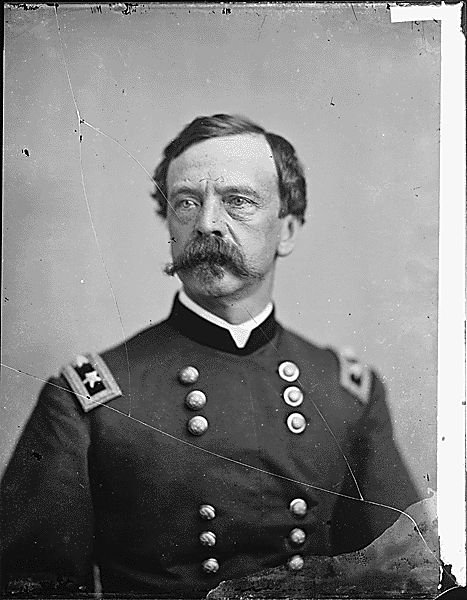
Daniel Sickles – Legally Insane
Sickles was well-known in Washington. He was married to the beautiful daughter of an Italian music teacher and his wife, Theresa, was described as being charming and well-educated, along with being very attractive. After his marriage, Sickles worked in London for the Foreign Service for a short time and then was involved in the election campaign of President James Buchanan. He and his wife moved into their home on Lafayette Square and became a major part of Washington’s elite society. Twice weekly they entertained the influential of Washington and the house became the center of both social and political circles.

Sickles later succeeded in winning back his congressional seat in New York and this caused him to start spending a lot of time away from home, leaving his wife, who had been just 17 when they married, to fend for herself. While Sickles was away, Theresa began being spotted in the company of handsome widower Phillip Barton Key.

Theresa Sickles
Everyone in Washington was soon talking about the affair, which was not carried out very discreetly. Key even rented his own house in Lafayette Square, just a block away from the Sickles home, so that they could get together as often as they liked. Rumor had it that they met at least three times each day. Key would stand in the park in front of Theresa’s home and wave his handkerchief at her whenever he wanted to meet.

Sickles missed all of the signs of the affair, which had started on a sofa in his own parlor. Meanwhile, Key grew even bolder, ignoring warnings of violence that could result if the affair was found out. He boasted that he carried a weapon in his pocket, just in case.

Phillip Barton Key

Gossip about an improper relationship between Theresa and Key eventually made its way to Sickle but it was an anonymous note that convinced him of the affair. The note, which had been slipped under his door read, in part:
 “I do assure you, [Key] has as much use of your wife as you have.”

Sickles investigated and found that the allegations were true. According to House clerk George Woodridge, the revelation “unmanned him completely.” The congressman’s “exhibitions of grief” were so violent that Woodridge assisted him in retreating to a private room near the House chamber to avoid a public scene. Ironically, Sickles himself was not above scandalous accusations. He was censured by the New York State Assembly for escorting a known prostitute, Fanny White, into its chambers. He also reportedly took her to England, leaving his pregnant wife at home, and presented White to Queen Victoria, using as her alias the surname of a New York political opponent.

But his wife’s affair unhinged him. He was enraged and distraught over the affair. He went home and confronted Theresa with what he knew. That same evening, she wrote a long and detailed confession, which was very explicit for those prudish times. She implored her husband to “spare her,” which Sickles did, but only after she signed the confession in front of two witnesses. That night, Theresa slept on the floor of her friend Octavia’s room, while Sickles stayed in the bedroom. Servants later told of hearing sobbing coming from both bedrooms that night.  Sickles told a friend the next day: “I am a dishonored and ruined man”.

The next morning, Phillip Key, not realizing that the affair had been found out, walked past the Sickles house and waved his handkerchief at the window. When Theresa failed to respond to his signal, he left, but came back and tried again later on in the day. On his third trip to the park, Key was met by the Sickles’ dog, which ran out of the house when he saw him. Key made a show of playing with the dog, waving his handkerchief the entire time.

Sickles, however, had seen the less than subtle signals and shouted at George Woolridge and another visitor, Samuel Butterworth: “That villain has just passed my house!” Butterworth tried to placate his friend, arguing that a public scene would only provide more gossip about the affair. Sickles brushed him off, stating that the whole town knew of it anyway. By now, the congressman was well past reason and hardly concerned about appearances.

Arming himself with two derringers, Sickles rushed out of the house and into the park. He screamed at Key: “Key, you scoundrel! You have dishonored my house -- you must die!”

As Key thrust his hand into his jacket, Sickles fired but the shot only grazed the other man. Sickles raised his hand to fire again and Key grabbed by him the collar of his coat. As they struggled, the gun fell to the ground. Sickles pulled away from him and drew the second gun. Key pleaded with him: “Don’t murder me!” Then, he threw a pair of opera glasses at Sickles as a desperate attempt to ward off his attacker.

Sickles was undeterred and fired again. This time, the bullet struck Key, penetrating near his groin. Key murmured that he was shot and collapsed against a tree. Sickles stood over him and pulled the trigger again. The gun misfired. As Key cried in desperation, Sickles calmly re-loaded the derringer and pressed it close to his former friend’s chest. He fired again and this time, the shot was fatal. Even so, Sickles was still not finished. He placed the muzzle against Key’s head and again, pulled the trigger. It misfired again and he stepped away.

Thomas Martin, a Treasury Department clerk, had witnessed the murder and he ran to the scene. Sickles turned to him and asked: “Is the scoundrel dead?”

Several men picked up Key’s body and carried him to a nearby house, where he died a short time later. As he watched them go, Sickles stood at the edge of the park and mumbled the same phrase over and over again: “He violated my bed.”

Sickles turned himself into the authorities immediately after the murder. At about the same time, President Buchanan received news about the incident from a young page, J.H.W. Bonitz, who had witnessed it. After hearing the report, Buchanan lied to Bonitz to try and protect his friend. He told the page that he should get out of town right away. Otherwise, he might be jailed and held without bond as a witness to the crime. Apparently, the president was unaware that others had witnessed the murder too, but his tactic worked on Bonitz. The page took some money that was offered to him by Buchanan and left Washington on the first train.

Before he was taken to jail, Sickles was permitted to make a short visit to his home. A large crowd was gathered outside, hoping for a glimpse of the famous killer. He was escorted inside and he found Theresa lying on the bedroom floor, stricken with grief. He uttered only once sentence to her before he left: “I’ve killed him.”

News of the murder spread throughout the city and dominated newspaper headlines for days to come. Editorials were written that inflated the importance of the killing, stating that it reflected the moral decay of society in general and more specifically, the increasing lawless conditions of Washington.

Sickles was indicted for murder and his trial was a spectacular one. He hired eight of the nation’s most prestigious lawyers to defend him, including Edwin Stanton, who would later become Lincoln’s Secretary of War. The prosecution was hampered from the beginning. Robert Ould, who was appointed by President Buchanan to replace Phillip Key as Washington’s district attorney, was an inexperienced lawyer and incapable of handling such a complicated case. Despite pleas from the Key family (the president was still trying to help Sickles), Buchanan refused to replace him.

The courtroom was crammed with curious spectators when the trial began and people outside peered in the windows, hoping to catch a look at the proceedings. The case itself should have been simple. Sickles stalked and killed Key in an act of “remorseless revenge” and had done the deed in the open with plenty of people watching. He was obviously guilty of the crime with which he had been charged.

But the defense complicated the case by arguing that Sickles had been temporality insane at the time of the murder, and that Key’s defilement of his wife had made him that way. The insanity defense had been well-established in American courtrooms but, at that time, there was no precedent for what the defense called an “irresistible impulse.” Sickles, his counsel attested, had acted in a “transport of frenzy” that was fleeting in nature. He could not resist this impulse and acted in a manner that could not be stopped. For this reason, they said, he was not guilty of the crime. The jury agreed and after deliberating for less than an hour, Sickles was acquitted.

The verdict was followed by a spontaneous celebration in the streets of Washington, including a parade that was led by the U.S. Marine Band. Sickles was not exactly proclaimed a hero but his actions were certainly understood by most. They believed that Sickles had a right to stand up for his honor and one of the jurors in his trial, William Hopkins, even told newspapers: “I would not have been satisfied with a derringer or a revolver, but would have brought a howitzer to bear on the seducer.”

Sickles had been grievously wronged and the public was prepared to welcome him back to his proper place in society. But then Sickles did the unthinkable --- he reconciled with his wife.

All of the goodwill that had followed the trial suddenly vanished and the public was in an uproar. Newspapers turned against him, as did many of his friends. Sickles was not ruined by the murder, but for forgiving his wife. Public reaction was so angry that Sickles was compelled to justify himself in a lengthy newspaper statement that was reprinted all over the country. In the letter, he made no apologies for murdering Key and for taking back Theresa. Instead, he appealed for the right to conduct his personal family life in private. The open letter did little good. Sickles was considered a joke and was ostracized by his fellow members of Congress. Despised and the object of ridicule, Sickles decided not to run for re-election. But his colorful career was far from over.

When the Civil War began, Sickles raised a contingent of men from New York and organized them for battle. His patriotism so impressed President Lincoln that he assured Sickles a position after the war. He managed to wrangle a commission and rose to the rank of major general. At Gettysburg, Sickles continued his controversial career by gloriously disobeying orders. He decided to move his corps forward from its assigned position in General Meade’s “fish-hook” across the battlefield. This jeopardized the entire Union line at the same time that Longstreet’s Confederates were moving to attack the very place that Sickles had been ordered to hold.

Daniel Sickles’ shattered leg – and the cannonball that took it – at the Army’s National Medical Museum
During the battle, Sickles’ right leg was hit and horribly mangled by a cannonball. On his way to the field hospital, where the leg would be amputated, Sickles calmly sipped wine and smoked a cigar. The wound ended his active service but he displayed the stump of his leg as a sign of his valor and heroism. In fact, he was so proud of his wound that he donated the shattered leg to the Army’s National Medical Museum, where it remains on display today. For years after, he visited the leg on the anniversary of its removal.

Despite his one-legged disability, Sickles remained in the army until the end of the war and was disgusted that Lieutenant General Ulysses S. Grant would not allow him to return to a combat command. In 1867, he received appointments as brevet brigadier general and major general in the regular army for his services at Fredericksburg and Gettysburg, respectively.

A photograph of Sickles and his staff after Gettysburg
When the war ended, President Andrew Johnson kept Lincoln’s promise to find Sickles a position in government and appointed him military governor over the Carolinas during Reconstruction. Sickles described his new position: “I am a sort of Sultan, a sort of Roman consul. I was not only the military commander, I was the Governor of these two states; I was the Court of Chancery of these two states. I was a sort of Poobah.”

Soon after the close of the Civil War, in 1865, he was sent on a confidential mission to Colombia to secure its compliance with a treaty agreement of 1846 permitting the United States to convey troops across the Isthmus of Panama. From 1865 to 1867, he commanded the Department of South Carolina, the Department of the Carolinas, the Department of the South, and the Second Military District. In 1866, he was appointed colonel of the 42nd U.S. Infantry (Veteran Reserve Corps), and in 1869 he was retired with the rank of major general.

Sickles served as U.S. Minister to Spain from 1869 to 1874, after the Senate failed to confirm Henry Shelton Sanford to the post, and took part in a controversial affair that almost had the U.S. in a war with Spain. His inaccurate and emotional messages to Washington promoted war, until he was overruled by Secretary of State Hamilton Fish and the war scare died out.

In 1867, Theresa Sickles died at the age of 31. General Sickles remarried four years later to Carolina Creash, whom he had met while serving as the “Yankee King of Spain,” as he called it. He was forced to resign in 1873, but not before reportedly carrying on a steamy affair with the deposed Queen Isabella II.

Not surprisingly, his second marriage was a disaster and he and his wife were estranged for almost 30 years when she refused to return with him to the United States. Sickles managed to stay busy, though. He was president of the New York State Board of Civil Service Commissioners from 1888 to 1889, sheriff of New York in 1890, and again a representative in the 53rd Congress from 1893 to 1895. For most of his postwar life, he was the chairman of the New York Monuments Commission, but he was forced out when $27,000 was found to have been embezzled.

Daniel Sickles in 1902
He had an important part in efforts to preserve the Gettysburg Battlefield, sponsoring legislation to form the Gettysburg National Military Park, buy up private lands, and erect monuments. One of his contributions was procuring the original fencing used on East Cemetery Hill to mark the park's borders. This fencing came directly from Lafayette Square in Washington, D.C. – where he had killed Phillip Barton Key.

Of the principal senior generals who fought at Gettysburg, virtually all, with the conspicuous exception of Sickles, have been memorialized with statues at Gettysburg. When asked why there was no memorial to him, Sickles supposedly said, "The entire battlefield is a memorial to Dan Sickles." However, there was, in fact, a memorial commissioned to include a bust of Sickles, the monument to the New York Excelsior Brigade. It was rumored that the money appropriated for the bust was stolen by Sickles himself; the monument is displayed in the Peach Orchard with a figure of an eagle instead of Sickles' likeness.

Sickles lived out the remainder of his life in New York City and was said to still be a womanizer in his old age. He died on May 3, 1914 at the age of 94. He was buried in Arlington National Cemetery – except for that one leg, of course. It’s still on display at the National Medical Museum.