AMERICAN HAUNTINGS INK

Showing posts with label railroad disaster. Show all posts

Wednesday, February 6, 2013

The Wreck of "The Broker"


THE CRASH OF “THE BROKER”
The Woodbridge, New Jersey Train Disaster

On this date, February 6, 1951, one of the worst train wrecks in America occurred at Woodbridge, New Jersey. It had been an ordinary Tuesday, nothing special.  The day was cold and damp, with light rain falling off and on most of the day. People remarked that it could have been worse; it could have been snow. It was February 6, 1951. The workday was ending and people were heading home. Thousands of people were making their way to the closest commuter train station.

Many of them would never make it home alive.

PRR Engineer Joseph Fitzsimmons before the Woodbridge wreck.

On a Pennsylvania Railroad (PRR) track in Jersey City, New Jersey, a nine-car commuter train known as “The Broker” waited to begin its express run to Bay Head. The Broker would soon be carrying homebound commuters, mostly from New York City offices, to their homes in Red Bank, Long Branch, Asbury Park, and other communities along the New Jersey’s wealthy shoreline. The Broker was so named because most of the regular riders were bankers, lawyers, stockbrokers and other businessmen, as well as office workers. 

Engineer Joseph Fitzsimmons was already on the train, going through the necessary preparations and building up steam prior to getting underway.  Fitzsimmons was 52 years old and had been working on trains his entire adult life. He had spent 33 years on the rails without a single accident. 

The Broker’s nine passenger coaches carried an average of 900 people on a typical weekday evening. This Tuesday however, was not going to be a typical evening. There was another railroad line that ran the same basic route, the Jersey Central. However, switchmen working for the Jersey Central Railroad had called a “sick call strike” and most of their commuter trains were not running. The Broker’s usual passengers load had swollen by several hundred. The train was seriously overcrowded and the aisles were packed. The Broker pulled out of the Exchange Place station in Jersey City at 5:10 in the evening. 

Earlier in the day, the rail line the train would normally follow had been slightly altered. In Woodbridge, a small New Jersey city 30 miles south of New York, the train would be taking a short detour. Work had begun on the construction of the New Jersey Turnpike, and where the train passed through Woodbridge, paralleling Fulton Street, a new temporary wooden trestle had been built to accommodate workers building the turnpike below. The new trestle shifted the track roughly fifty feet from the original line to pass over Fulton Street, on an embankment 20 feet above the street. The trestle had been put into service that afternoon, about five hours before The Broker was scheduled to cross it. It appeared to be solid and safe, as six PRR trains had already passed over it without incident. Because of the shift in the line, a “go slow” order had been posted in the PRR alert board, requiring a reduction in speed for the approach and crossing of the trestle. Under normal conditions, trains would speed through that section between 50 and 60 miles per hour. The “go slow” order reduced the speed limit to 25 miles per hour until the trestle was cleared. 

The trip had gone smoothly as Engineer Fitzsimmons pulled his train away from the Newark platform and began picking up speed as he drove through the darkening winter evening. Fitzsimmons later said that as the train neared the new trestle, he had tried to slow down but was having great difficulty. The rails were wet and slick, and the train was terribly overloaded, making it much heavier than usual. The additional weight and slick rails created a situation where the train took much longer to slow down sufficiently. The train was heading into the curve approaching the new trestle at over 50 miles per hour. At 5:43 in the evening, just 33 minutes after the train had left the station, Woodbridge experienced the worst train wreck to take place in the United States in decades. The speed and weight of the overloaded train as it rounded the curve onto the trestle had shifted the tracks, causing the train to derail. By the time the sun rose to chase away the darkness, 82 people would lie dead on a garage floor, and over 500 people would be injured, many of them seriously. 

At the moment the train passed over the trestle, it lurched sharply and started to sway. The engineer applied the brakes, but it was too late. Momentum carried the engine and the first three coaches over the chasm before falling down the end of the embankment and onto the street below.

The engine flew from the tracks in an arc and fell more than 20 feet to the pavement below. The first five coaches after the engine whipped back and forth, ending in a horrible tangle of ripped steel. Eight of the coaches had been derailed. The first two lay on their sides in the mud of the wet embankment. The third and fourth cars had telescoped into each other and were the most badly twisted and smashed. The largest number of deaths and serious injuries occurred in these cars. Still others remained upright but were horribly twisted and smashed, with one car was bent into a U-shape. Inside the coaches, passengers were tossed around like rag dolls as the cars jerked and rolled. Metal stressed and tore, mutilating and crushing the passengers inside. Newspaper accounts reported that some were “...mangled to bits under the grinding weight of the sharp, broken metal. Others survived or died in tomb-like crevasses of steel, as some of the coaches were bent by the terrible force of the crash.”

Aerial view of a section “The Broker”
At first, the air was rent with the sounds of the train as it smashed and crashed and the scream of the metal as it was torn and twisted in a thousand places. Then came a terrible quiet -- everything was still. The quiet lasted only a moment, for very soon moans and screams shattered the silence. There were chilling cries of: “Help me, help me please...”  Moans and sobs of men and women writhing in pain, if they could move at all, were heard from every part of the twisted hulk. 

The coaches in the center, specifically the fifth, sixth and seventh cars, were left fully or partially suspended over the street below. In these cars, many of the passengers who were able to move on their own, crawled toward the windows looking for a means to escape. The train’s route crossed over rivers at several points and many of these people believed they had crashed over a river. The view out the windows at the street below, with streetlights reflecting on the dark, wet asphalt, made many of the disoriented passengers believe they were in water. Many jumped headfirst from the wrecked coaches, expecting river water to soften their landing; instead they hit hard, unforgiving pavement. These people had survived the train crash, but died in an attempt to save themselves.
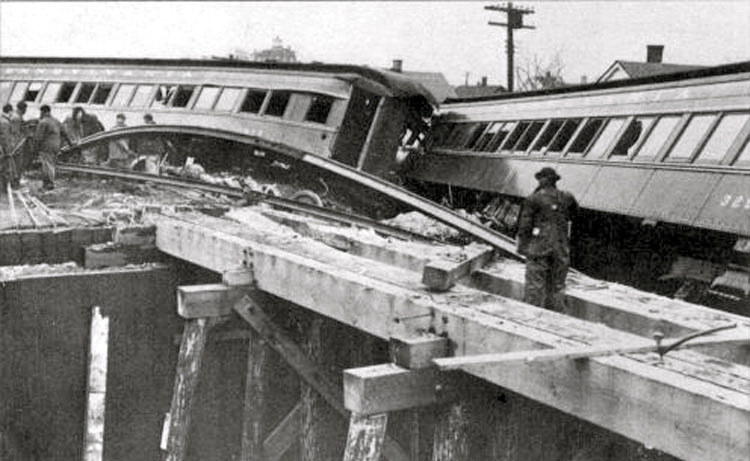
The force of the speeding, overloaded train ripped the rails from the temporary trestle, but the trestle remained standing.
The wreck occurred in a heavily populated area so help was very quick to arrive. The Woodbridge fire and police departments were the first official rescue agencies to appear. They found it extremely difficult to climb up the slick, muddy embankment to get to the wrecked coaches, and nearly impossible to pull the injured from the train and back down through the mud. Ladders were laid down on the embankment and the rescuers used the rungs as a sort of stairs. The Woodbridge Fire Department used their ladder truck for nearly the same purpose, except they were able to extend the ladder over the embankment and directly onto the coaches. 

Ambulances, first aid squads, and medical personnel came from at least twenty neighboring communities and cities. The Perth Amboy General Hospital, the nearest urban hospital, was alerted that there would be a large influx of injured passengers. Perth Amboy went into full disaster mode and received nearly all the people whose injuries were serious enough to need immediate and intensive medical care. First aid squads assisted those injured who were able to walk with treatment at the site. The number of injured and dead passengers was so great that a local grocery supplier had its trucks pressed into service as additional ambulances, and later as hearses. 

Within thirty minutes, an enormous crowd had arrived and surrounded the crash site. Some volunteered to help, but the majority had come out of morbid curiosity to watch the bloody drama unfold. The vast numbers of onlookers, pushing in on each other, rapidly became a calamity within itself. Ambulances experienced great difficulty getting in or out. Rescue workers had to struggle to get through the crowds. Vital rescue equipment was smashed under the mass of feet. Seeing how the behavior of the crowd was delaying the rescue operation, and possibly costing the lives of victims in dire need of immediate attention, Governor Alfred Driscoll called in the New Jersey National Guard for crowd control. The Guardsmen stood side by side, arms linked, forming a human chain, after which the rescue and recovery efforts moved forward at a rapid pace. 

The whole area was lit with acetylene torches and countless flashlights could be seen bouncing about as the rescuers searched for anyone still clinging to life. When a survivor was found, a call went out for assistance. The rescuers would work in a group to chop, cut, or pry away any obstructions that might be pinning the victim, then they would be loaded onto a stretcher and carried down the ladders to the street. 

Some victims were able to leave the wreck by themselves, whether they had received medical treatment and been released or had been uninjured. Many people living near the crash site opened their homes to these stunned and shocked individuals. They were offered food, warm blankets, and most importantly for some - the use of telephones. They needed to call home to assure their families that they were alive and to find transportation home. 

As it became apparent that the number of dead would be high, a place had to be found to store the bodies until identifications could be made. There was no place large enough that could accommodate the huge number of bodies being pulled from the wreckage. It was decided that the garage at the Woodbridge Fire Department would serve as a temporary morgue, but the idea of laying bodies on the dirty floor of a garage was repugnant. The problem was solved when a local butcher donated large rolls of waxed brown paper. As each body was brought into the garage, a sheet of the brown paper was unrolled and the blood-spattered workers gently placed the body on the paper. Then another sheet of paper was cut and laid over the body.  Witnesses described how “the feet of the dead sprawled limp, uncovered by the paper shrouds.” 

Some of the bodies brought into the morgue were so severely mutilated that it took hours to identify them, and then only by an article of clothing or a personal belonging. As word of the morgue’s location spread, terrified family and friends of anyone who was supposed to be on the train that evening lined up outside, hoping against hope that their loved one would not be lying on the floor. 

One of the last living victims to be freed, his body partially crushed, found trapped under one of the heavy steel wheels that had been ripped from one of the coaches. The rescue and recovery continued nonstop until the last body had been removed from the wreckage. It took over seven hours. The National Guardsmen stayed to watch over the site throughout the night to prevent looting and keep souvenir hunters from climbing on the wreck and getting hurt. 

The day after the crash, the FBI opened an investigation looking for evidence of sabotage. Finding none, the case was closed. 

The Pennsylvania Railroad (PPR) conducted its own investigation and laid the entire blame at the feet of Engineer Joseph Fitzsimmons. The PRR was accepting no culpability, even though they had failed to install any yellow warning lights to signal a change in speed ahead, or to signal an unexpected change in the track conditions, such as a shift of 50 feet and a new temporary trestle. 

The Interstate Commerce Commission was ordered to make an investigation into the cause of the wreck.  A public hearing was convened the day after the crash. A string of witnesses including PRR employees, passengers, expert engineers and community members who witnessed the crash. Fault was found with the operational practices of the PRR. New rules and guidelines were put in place in order to reduce the possibility of a repeat accident of this kind.

The Middlesex County prosecutor’s office found the fault lay with the PRR for the accident. It was discovered that the PRR had a company safety rule that yellow signals were to be installed at all go-slow areas, regardless of paper notices posted in the offices. It was further discovered that the PRR branch that operated along the north Jersey Shore had a practice of ignoring the rule.  The assistant prosecutor voiced outrage that the PRR was using Fitzsimmons as a scapegoat. He brought 85 counts of manslaughter against the PRR. However, the charges were later dropped when it was determined that the cost of the court proceedings would bankrupt the county. In the end, they agreed to an out-of-court settlement.

A year after the accident, the bridge had been rebuilt and all debris, wreckage, and evidence of the crash had been removed and the trains were “back on track.”  In preparation for the anniversary of the crash, a group of survivors requested that the rush hour train would stop at the site of the crash just before 6:00 p.m. for a brief ceremony to commemorate the loss of life. Administrators at the PRR denied the request. Instead, the group stood at the rear of the train and threw out a spray of 85 flowers onto the track as they neared the crash site -- one flower for each life that was lost. 

But this is not the end of the story. According to legend, there is a haunting that has occurred at the site where the train plunged off the trestle…

The story of “The Broker” was adapted from a story by Rene Kruse in the book A PALE HORSE WAS DEATH by Troy Taylor and Rene Kruse. The ending of the account is a ghost story about the site of the crash… and you can see the story in the book. Print editions of A PALE HORSE WAS DEATH is available from the website or you can get digital editions on Kindle and Nook from Amazon.com and Barnes and Noble. 

Thursday, December 27, 2012

HORROR FOR THE HOLIDAYS

GHOSTS OF THE ASHTABULA BRIDGE DISASTER

The holiday season of 1876 should have been a joyous time for those in northern Ohio. Christmas Day had just passed and America’s Centennial Year was coming to an end with a New Year’s Celebration that was only days away. However, on December 27, the region was blanketed by an intense winter storm that showed no signs of letting up. This could have been taken for an ominous sign that dark days were ahead but no one had any idea just how dark those days would become.

In the wake of that winter storm, the small town of Ashtabula, located in the northeast corner of Ohio, was a white wasteland of snow and ice. A blizzard had hammered the little town with more than 20 inches of snow and wind that whipped along at more than 50 miles an hour. Despite the weather, the town train depot was bustling. Anxious passengers, many leaving town for the holidays or waiting for trains to arrive, crowded into the station. Many of them awaited the arrival of the No. 5 Pacific Express that was running more than two hours late from Erie, Pennsylvania. Weather delays had kept it in the Erie station until after 6:00 p.m. Many of those waiting in the depot had friends and family on the train or needed to make the connection to continue their own journey.

While things may have been anxious in the station, the scene was much more relaxed and festive aboard the No. 5 train. The warm and snug passengers were seemingly oblivious to the frigid conditions outside as two locomotives pulled two express cars, two baggage cars, one smoking car, two passenger cars and three sleeping cars along at a steady ten miles per hour. The passengers ate and chatted, played cards or slept peacefully in their berths. Others prepared to leave the train at Ashtabula or warmed themselves near the coal-fired heaters that provided heat for all of the cars, except for the smoking car, which had an old-fashioned wood stove. All of the cars were cozily lit by oil lamps, providing the illusion of being completely separated from the storm outside. The exact number of passengers aboard the train remains a mystery to this day, but it is believed that there were at least 128 passengers and nineteen crew members on the No. 5 as it steamed onto the railway bridge that spanned Ashtabula Creek.

Daniel McGuire, the engineer of the first locomotive, the “Socrates,” was the first to realize that there was a problem. As the engine crossed onto the bridge, he pulled the throttle out and increased the speed of the train. They needed the extra power to drive the train through the two feet of snow on the tracks and to push against the gale force winds that buffeted the train on the open bridge. But as the “Socrates” approached the western abutment of the bridge, McGuire had the sudden sensation that the engine was “running uphill.” He looked back and was stunned with horror as he saw the rest of the train -- the second engine, the “Columbia,” and eleven cars -- collapsing with the bridge as it plunged more than eighty feet downward to the creek below. McGuire pulled the throttle out all the way and the “Socrates” surged ahead. He broke the coupling with the second engine, the “Columbia,” and somehow coaxed the locomotive to safety. As he pulled the brakes on the other side, McGuire heard the chilling sounds of crashing and twisting steel coming from the swirling darkness of the storm.

The Ashtabula depot lay just one thousand feet beyond the bridge and William Alsell, a telegraph operator, was the first person at the station to realize what had happened. He had hoped to hitch a ride through town on the train when it left the station and he had heard the whistle of the No. 5 as it approached the bridge. He was actually walking toward it when it started across the bridge. When he caught a glimpse of its lights, he turned to head back to the depot and gather his belongings when he heard the horrific crash. He spun around just in time to see the lights from the sleeping cars as they fell and then vanished into the darkness. He immediately began running to the bridge, only to discover that the structure was no longer there.

The experiences of the passengers and crew aboard the train were even more horrifying. Miss Marian Shepherd, a survivor of the disaster, was in her sleeper berth and later recalled that she knew something was wrong when the bell rope snapped in two, with one piece smashing an oil lamp and the other knocking over a burning candle. A moment later, she heard a thudding noise that sounded as though the train wheels had jumped the track and were now riding on the wooden ties. This was followed by a tremendous shattering sound as if all of the glass in the entire train had suddenly broken at once. The train car plunged downward and Miss Shepherd distinctly remembered the cry of someone in the car as he wailed, “We are going down!” The scream was followed by the sickening sensation of falling and she desperately braced herself. Outside the sleeping berth, the air was filled with seats, lamps and human bodies as the car pitched into space. Seconds later, the sleeper hit the rest of the No. 5 cars and all of them crashed into the freezing waters of the creek.

A Harper’s Weekly illustration of the aftermath of the crash.


Surrounded by the broken bodies of those who did not survive the fall, Marian struggled to get out of her berth and fight her way to safety. She was in shock and terrified by the screams of the injured around her in the darkness. Those who were alive also tried to get out and cries were mixed with the terror of drowning in the icy water. As it happened, the fear of drowning was second only to the danger of being burned alive. The cars had fallen in an upright position and were now stacked and smashed upon one another, with the bottom layer below the surface of Ashtabula Creek. Within five minutes of the wreck, the last car, with its heater still burning, caught on fire. People like Marian, both dazed and bleeding, managed to stumble out of the cars and saw the winter night illuminated by flames as the cars caught fire one at a time. Within just a few minutes, the remains of the cars and single locomotive had turned into a blazing inferno. The heaters, lamps and the heavily varnished woodwork of the cars combined to engulf the mass of twisted wood and metal into a tower of flames.

The survivors of the disaster would never forget what they saw that night. Most of them worked frantically alongside a rescue crew from town as they tried to pull the wounded and the dead from the burning cars. Finally, the heat grew so intense that they were driven back, unaware that many of those who had been already rescued were now sinking into the waters of the creek. The heat from the fire had melted the ice on the river’s surface and now the water was surging up towards the bloody and burning debris. As they cried for help, the cold water washed into the wreck, drowning many of those still trapped there -- perhaps mercifully when faced with burning to death. One woman, later recalled by engineer Daniel McGuire, was trapped in the wreckage as the fire burned toward her and she begged with someone to cut off her legs and pull her out before the flames reached her. Tragically, no one made it to her in time and McGuire could only watch helplessly as she burned to death. McGuire’s friend, “Columbia” engineer, Peter Levenbroe, had been crushed in the engine when it fell. He died on the way to the hospital in Cleveland.

William Alsell, the telegraph operator, had fallen and stumbled down the snow-covered hill to the wreck just moments after seeing the train plunge to its doom. Kicking out windows, he pulled wounded and unconscious passengers to safety and fought bravely to keep them from the fire and icy waters. Meanwhile, Daniel McGuire, after bringing the “Socrates” to a halt, sprinted to the depot with the terrible news before returning to the scene. A minute later, brakeman A.L. Stone, who had escaped from the last car, limped into the station. He was badly hurt and bleeding but managed to send a telegram to Erie in case another train was following behind the No. 5. Within minutes, every bell in Ashtabula was sounding the alarm for firemen and volunteers.

The situation surrounding the fire, which killed more people than the initial wreck, has been a subject of mystery and debate since 1876. Although the Ashtabula fire department managed to get one engine down to the fire, no hoses were ever connected and no water, save for a few buckets of melted snow, was ever directed at the burning debris. It was rumored afterwards that officials from the Lake Shore & Michigan Southern Railroad forbade anyone to put out the fire. The reason, according to rumors, was that the company’s insurance liability would be less if the passengers were not only dead, but burned beyond recognition, as well. There was no truth to this but it added to the finger-pointing and blame that followed.

The less dramatic reasons were the confusing conditions at the scene. No one had ever seen anything like it before and when Ashtabula fire chief G.A. Knapp arrived on the scene 45 minutes after the crash (possibly intoxicated), he found a scene of total pandemonium. There was no organized effort to do anything. Passengers and rescuers were simply trying to save anyone they could and were hampered by the fire, the water, smoke, snow and treacherous terrain. Efforts were further impeded by the hundreds of spectators who had gathered and by the activities of thieves, who boldly robbed the wounded and helpless passengers. The terror at the scene was increased by the terrible snapping noise created by the paint on the train cars as it ignited.

Fire Chief Knapp gazed in bewilderment at the wreck and asked train station agent George Strong which side of the burning mass he and his men should put water on. Strong, more concerned about the advancing flames killing people than where the fire department should direct their water, told him to worry about getting the people out instead. This was likely the right decision, but it never mattered for no actual orders were given by Knapp, Strong or any Ashtabula officials that night. The firemen simply pitched into the efforts of the rescue workers and concentrated their efforts on pulling the wounded from their fiery and watery fates. The fire eventually burned itself out and by daybreak the train was a blackened pile of burned metal, scorched debris and roasted human flesh.

It took more than a week to clean it all up. Although 150 men were eventually sent to the scene by the railroad, they never found all of those who were missing – nor did they identify all of the dead. The main problem was that no one had any idea just how many passengers had been on the train. The conductor’s records showed 128 passengers but others claimed upwards of two hundred were on board when the wreck occurred. The best estimate is that 89 were killed and 63 were injured, five of whom died later. There were nineteen corpses, or parts of corpses, that were never identified. A temporary morgue was set up in the Lake Shore & Michigan Southern freight depot and weeping loved ones searched through the boxes of remains for weeks afterward. Many of them were identified only by jewelry that somehow managed to escape the notice of thieves at the disaster site. After funeral services at two Ashtabula churches were conducted on January 19, 1877, the unidentified dead were buried in nearby Chestnut Grove Cemetery. A monument was created for them in the 1890s, largely funded by Governor William McKinley and Lucretia Garfield, widow of the late president.

A picture postcard of the Ashtabula Bridge Disaster from the late 1800s


The investigations into the disaster began as the fires were still smoldering. At 9:00 a.m. on the day after the accident, an inquest was convened under the authority of Justice of the Peace Edward W. Richards. It lasted for 68 days and dozens of witnesses were heard. The jury in the case reached a series of eight verdicts, all highly critical of the Lake Shore & Michigan Southern railroad and the rescuers at the scene. The verdicts are still considered controversial today.

They ruled that the railroad was entirely responsible for the accident and the deaths and injuries resulting from it. The jury stated that the company had willfully designed, constructed and erected a fatally flawed bridge and then had failed to adequately inspect it for the next eleven years, leading up to the disaster. Additionally, they also found that the railroad, in violation of Ohio law, had failed to warm the passenger cars with a “heating apparatus so constructed that the fire in it will be immediately extinguished whenever the cars are thrown from the track.” Finally, the jury blamed the fire department and the railroad officials at the disaster scene for many of the fire deaths, claiming that they should have put out the fire rather than try to rescue trapped victims.

None of those accused by the jury took it lightly. The Lake Shore & Michigan Southern Railroad eventually paid off about $500,000 in damage claims with little dispute. However, the company refused to admit responsibility for the bridge failure, arguing that the wreck was caused by either the “Columbia” leaving the track, a broken rail or incredibly, a tornado that swept down and wiped out the bridge. The most vocal in rejecting blame was Amasa B. Stone, Jr., a Cleveland millionaire and railroad mogul who had designed and built the bridge. Until the day he died, he insisted the bridge had been sound and that it had to be human error or an act of God that caused the disaster.

Stone was wrong but the truth was more complex than either side would ever have allowed. The original railroad bridge over Ashtabula Creek had been a wooden one. In 1863, Amasa Stone made plans to replace it with a design of his own. The key section was the middle span, a 154-foot piece that sat on two stone abutments that were put up after an extensive fill had narrowed the river valley. It was a variation on the long-used wood and iron truss but Stone’s new design used an all-iron structure, a type that had never been tried and as it turned out, would never be replicated. The new structure was installed in the fall of 1865 and was a series of fourteen panels that were protected against the force produced by the weight of the trains by enormous diagonal I-beams. All of the steel in the bridge was produced at the Cleveland Rolling Mills, which was owned by Stone’s brother, Andros. The crew installing the bridge ran into many problems and at one point, it had to be entirely taken down and then put back up again at great expense. When Joseph Tomlinson, an engineer on the project, warned Stone about the stress on the trusses, Stone fired him. When completed, the bridge was tested by the weight of six locomotives and pronounced safe.

After the disaster, many would remark that it was not so surprising that the bridge fell but that it managed to stay up for eleven years without mishap. It was inspected four times each year by railroad officials, who reported no problems -- except for the suspicious “snapping” noise that train engineers sometimes heard as they traveled over the bridge. Also, among the details missed by inspectors was the fact that the metal on the ends of the beams had been crudely filed down to make them fit. If inspector Charles Collins, who looked at the bridge just ten days before the calamity and found no problems, had gotten down among the I-beams and had seen what many others saw when the ruined bridge was on the ground two months later, he would have shut it down immediately. Several of the I-beams were as much as three inches out of alignment at their juncture with the bearing blocks. Given that the essence of the design was the connection of all of the parts, the displacement of the I-beams meant that it was just a matter of time before something horrible occurred.

Amasa Stone refused to admit guilt, though, and was especially arrogant when questioned by a special investigative committee of the Ohio legislature on January 18, 1877. Not only had the bridge been safe, he insisted, but it had been designed to be stronger than it needed to be. As for the stoves that set the cars on fire, he insisted that he had examined every other type of stove that was available and had dismissed them as unsuitable. The stoves that he had used, manufactured by Baker, had simply been the best. No stove could be designed to extinguish itself in case of an accident. In his final opinion, he stated that the train had jumped the tracks and in turn, had demolished the bridge.

Inspector Charles Collins was the mirror opposite of Stone. The man who had recently inspected the bridge reportedly “wept like a baby” when he saw the wreckage and loss of life in the Ashtabula valley. Although he testified in public that he always thought the bridge was safe, there were whispers that he told a different story to those who were close to him. Some maintained that he had been forced to give favorable reports about the bridge by the company and that he often said that he prayed “it will be a freight and not a passenger train” that fell when the bridge finally went down. Collins took most of the blame for the company after the disaster and there was no question that he blamed himself for the accident. Three days after he testified to the special committee, he was found dead in his bed at his home on Seneca Street in Cleveland. He had blown his brains out with a pistol hours after he completed his testimony.

Fate eventually caught up with Amasa Stone, as well. Although he never accepted any responsibility for the accident and avoided personal legal consequences for it, there is no question that he was hurt by the public perception of him as a “murderer.” His temperament, never a happy one to begin with, became even darker after business reverses and then ill health followed in the wake of the Ashtabula disaster. His only son had drowned while he was a student at Yale and Stone had been plagued with stomach pains and insomnia, sleeping as little as two hours a night. By 1883, he had endured all that he could stand and on the afternoon of May 11, he locked himself in his bathroom and fired a bullet through his heart. When Stone’s wife discovered the bathroom door locked and no response when she knocked, she had the butler climb through the transom. Stone was discovered lying in the bathtub, half-dressed, a silver-plated Smith & Wesson revolver by his side.

There is little to be seen today where the terrible events of December 1876 took place. The river now flows beneath an ordinary viaduct and it is impossible now to imagine the horror, fear and death that took place there. In spite of this, some mysteries do remain. According to some, the No. 5 train was said to have been carrying as much as $2 million in gold bullion on that cold December night. If it was, all of it was lost in the valley below and remains there today, still waiting for someone to find it.
Whether there is lost treasure in the valley or not, there are no ghosts there. Those who lost their lives have strangely not been found at the place where their lives ended so tragically but rather at the Chestnut Grove Cemetery, where the remains of the unidentified were laid to rest. It is there, near the stark, granite obelisk that marks the common grave, where visitors to the graveyard have reported seeing specters walk about. The wraiths, often seen in period warm weather clothing, wander about carrying carpetbags and baskets. Screams are sometimes heard in the darkness and some claim that a burning smell often sweeps through the air nearby.

Just a short distance away from the mass grave is the ornate gothic mausoleum of Charles Collins, the luckless inspector who had missed the fatal flaws in the Ashtabula Bridge. It is ironic that he would be entombed to close to the graves of those who death he inadvertently caused and not surprisingly, his ghost is said to haunt this place, too. According to the stories, the spectral figure of a man has been seen near the tomb. He often appears with his face in his hands, weeping bitterly. “I’m sorry -- I’m so very sorry,” he cries, wringing his hands in torment and then he vanishes, never finding the forgiveness that he so desperately craves.

This story is an excerpt from the book AND HELL FOLLOWED WITH IT by Troy Taylor & Rene Kruse. Available in Kindle, Nook and Print Editions!