AMERICAN HAUNTINGS INK

Tuesday, February 19, 2013

Legally Insane: Murder & Daniel Sickles


LEGALLY INSANE
Murder & Daniel Sickles

On this date, February 19, 1859, one of the most colorful and eccentric politicians and Civil War generals in American history, Daniel Sickles, was cleared of murder charges. But his defense was a novel one – and like nothing that American courts had ever heard before. It seems that the respected politician murdered his wife’s young lover because he was insane at the time. It was the first time that such a defense had ever been attempted in the United States and bizarrely, it worked.

By 1959, murder had already become sadly commonplace in Washington, D.C. so it was rare when a single homicide attracted much attention -- unless that homicide involved a well-known congressman, a famous composer’s son and an attempted cover-up by the president of the United States. With those elements combined, it’s no wonder that Washington society was stunned in February 1859 when they heard of a murder that occurred in wealthy Lafayette Square.

The scandalous event involved Representative Daniel Sickles of New York and his friend, Phillip Barton Key, the son of “Star-Spangled Banner” composer Francis Scott Key. Sickles murdered Key in broad daylight, practically in front of the White House, with a number of witnesses present. But thanks to some help from President James Buchanan and the new legal defense of “temporary insanity”, he got away with it.
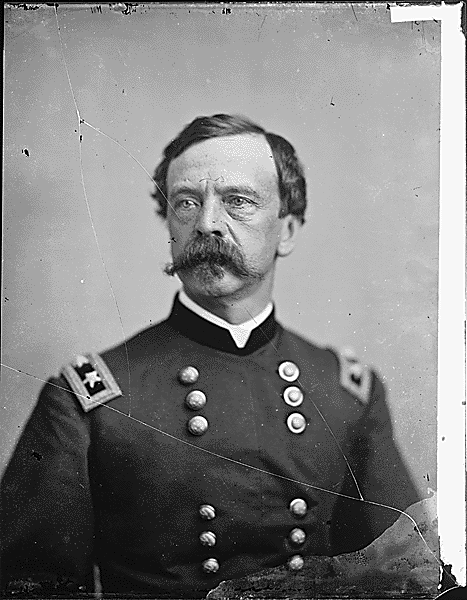
Daniel Sickles – Legally Insane
Sickles was well-known in Washington. He was married to the beautiful daughter of an Italian music teacher and his wife, Theresa, was described as being charming and well-educated, along with being very attractive. After his marriage, Sickles worked in London for the Foreign Service for a short time and then was involved in the election campaign of President James Buchanan. He and his wife moved into their home on Lafayette Square and became a major part of Washington’s elite society. Twice weekly they entertained the influential of Washington and the house became the center of both social and political circles.

Sickles later succeeded in winning back his congressional seat in New York and this caused him to start spending a lot of time away from home, leaving his wife, who had been just 17 when they married, to fend for herself. While Sickles was away, Theresa began being spotted in the company of handsome widower Phillip Barton Key.

Theresa Sickles
Everyone in Washington was soon talking about the affair, which was not carried out very discreetly. Key even rented his own house in Lafayette Square, just a block away from the Sickles home, so that they could get together as often as they liked. Rumor had it that they met at least three times each day. Key would stand in the park in front of Theresa’s home and wave his handkerchief at her whenever he wanted to meet.

Sickles missed all of the signs of the affair, which had started on a sofa in his own parlor. Meanwhile, Key grew even bolder, ignoring warnings of violence that could result if the affair was found out. He boasted that he carried a weapon in his pocket, just in case.

Phillip Barton Key

Gossip about an improper relationship between Theresa and Key eventually made its way to Sickle but it was an anonymous note that convinced him of the affair. The note, which had been slipped under his door read, in part:
 “I do assure you, [Key] has as much use of your wife as you have.”

Sickles investigated and found that the allegations were true. According to House clerk George Woodridge, the revelation “unmanned him completely.” The congressman’s “exhibitions of grief” were so violent that Woodridge assisted him in retreating to a private room near the House chamber to avoid a public scene. Ironically, Sickles himself was not above scandalous accusations. He was censured by the New York State Assembly for escorting a known prostitute, Fanny White, into its chambers. He also reportedly took her to England, leaving his pregnant wife at home, and presented White to Queen Victoria, using as her alias the surname of a New York political opponent.

But his wife’s affair unhinged him. He was enraged and distraught over the affair. He went home and confronted Theresa with what he knew. That same evening, she wrote a long and detailed confession, which was very explicit for those prudish times. She implored her husband to “spare her,” which Sickles did, but only after she signed the confession in front of two witnesses. That night, Theresa slept on the floor of her friend Octavia’s room, while Sickles stayed in the bedroom. Servants later told of hearing sobbing coming from both bedrooms that night.  Sickles told a friend the next day: “I am a dishonored and ruined man”.

The next morning, Phillip Key, not realizing that the affair had been found out, walked past the Sickles house and waved his handkerchief at the window. When Theresa failed to respond to his signal, he left, but came back and tried again later on in the day. On his third trip to the park, Key was met by the Sickles’ dog, which ran out of the house when he saw him. Key made a show of playing with the dog, waving his handkerchief the entire time.

Sickles, however, had seen the less than subtle signals and shouted at George Woolridge and another visitor, Samuel Butterworth: “That villain has just passed my house!” Butterworth tried to placate his friend, arguing that a public scene would only provide more gossip about the affair. Sickles brushed him off, stating that the whole town knew of it anyway. By now, the congressman was well past reason and hardly concerned about appearances.

Arming himself with two derringers, Sickles rushed out of the house and into the park. He screamed at Key: “Key, you scoundrel! You have dishonored my house -- you must die!”

As Key thrust his hand into his jacket, Sickles fired but the shot only grazed the other man. Sickles raised his hand to fire again and Key grabbed by him the collar of his coat. As they struggled, the gun fell to the ground. Sickles pulled away from him and drew the second gun. Key pleaded with him: “Don’t murder me!” Then, he threw a pair of opera glasses at Sickles as a desperate attempt to ward off his attacker.

Sickles was undeterred and fired again. This time, the bullet struck Key, penetrating near his groin. Key murmured that he was shot and collapsed against a tree. Sickles stood over him and pulled the trigger again. The gun misfired. As Key cried in desperation, Sickles calmly re-loaded the derringer and pressed it close to his former friend’s chest. He fired again and this time, the shot was fatal. Even so, Sickles was still not finished. He placed the muzzle against Key’s head and again, pulled the trigger. It misfired again and he stepped away.

Thomas Martin, a Treasury Department clerk, had witnessed the murder and he ran to the scene. Sickles turned to him and asked: “Is the scoundrel dead?”

Several men picked up Key’s body and carried him to a nearby house, where he died a short time later. As he watched them go, Sickles stood at the edge of the park and mumbled the same phrase over and over again: “He violated my bed.”

Sickles turned himself into the authorities immediately after the murder. At about the same time, President Buchanan received news about the incident from a young page, J.H.W. Bonitz, who had witnessed it. After hearing the report, Buchanan lied to Bonitz to try and protect his friend. He told the page that he should get out of town right away. Otherwise, he might be jailed and held without bond as a witness to the crime. Apparently, the president was unaware that others had witnessed the murder too, but his tactic worked on Bonitz. The page took some money that was offered to him by Buchanan and left Washington on the first train.

Before he was taken to jail, Sickles was permitted to make a short visit to his home. A large crowd was gathered outside, hoping for a glimpse of the famous killer. He was escorted inside and he found Theresa lying on the bedroom floor, stricken with grief. He uttered only once sentence to her before he left: “I’ve killed him.”

News of the murder spread throughout the city and dominated newspaper headlines for days to come. Editorials were written that inflated the importance of the killing, stating that it reflected the moral decay of society in general and more specifically, the increasing lawless conditions of Washington.

Sickles was indicted for murder and his trial was a spectacular one. He hired eight of the nation’s most prestigious lawyers to defend him, including Edwin Stanton, who would later become Lincoln’s Secretary of War. The prosecution was hampered from the beginning. Robert Ould, who was appointed by President Buchanan to replace Phillip Key as Washington’s district attorney, was an inexperienced lawyer and incapable of handling such a complicated case. Despite pleas from the Key family (the president was still trying to help Sickles), Buchanan refused to replace him.

The courtroom was crammed with curious spectators when the trial began and people outside peered in the windows, hoping to catch a look at the proceedings. The case itself should have been simple. Sickles stalked and killed Key in an act of “remorseless revenge” and had done the deed in the open with plenty of people watching. He was obviously guilty of the crime with which he had been charged.

But the defense complicated the case by arguing that Sickles had been temporality insane at the time of the murder, and that Key’s defilement of his wife had made him that way. The insanity defense had been well-established in American courtrooms but, at that time, there was no precedent for what the defense called an “irresistible impulse.” Sickles, his counsel attested, had acted in a “transport of frenzy” that was fleeting in nature. He could not resist this impulse and acted in a manner that could not be stopped. For this reason, they said, he was not guilty of the crime. The jury agreed and after deliberating for less than an hour, Sickles was acquitted.

The verdict was followed by a spontaneous celebration in the streets of Washington, including a parade that was led by the U.S. Marine Band. Sickles was not exactly proclaimed a hero but his actions were certainly understood by most. They believed that Sickles had a right to stand up for his honor and one of the jurors in his trial, William Hopkins, even told newspapers: “I would not have been satisfied with a derringer or a revolver, but would have brought a howitzer to bear on the seducer.”

Sickles had been grievously wronged and the public was prepared to welcome him back to his proper place in society. But then Sickles did the unthinkable --- he reconciled with his wife.

All of the goodwill that had followed the trial suddenly vanished and the public was in an uproar. Newspapers turned against him, as did many of his friends. Sickles was not ruined by the murder, but for forgiving his wife. Public reaction was so angry that Sickles was compelled to justify himself in a lengthy newspaper statement that was reprinted all over the country. In the letter, he made no apologies for murdering Key and for taking back Theresa. Instead, he appealed for the right to conduct his personal family life in private. The open letter did little good. Sickles was considered a joke and was ostracized by his fellow members of Congress. Despised and the object of ridicule, Sickles decided not to run for re-election. But his colorful career was far from over.

When the Civil War began, Sickles raised a contingent of men from New York and organized them for battle. His patriotism so impressed President Lincoln that he assured Sickles a position after the war. He managed to wrangle a commission and rose to the rank of major general. At Gettysburg, Sickles continued his controversial career by gloriously disobeying orders. He decided to move his corps forward from its assigned position in General Meade’s “fish-hook” across the battlefield. This jeopardized the entire Union line at the same time that Longstreet’s Confederates were moving to attack the very place that Sickles had been ordered to hold.

Daniel Sickles’ shattered leg – and the cannonball that took it – at the Army’s National Medical Museum
During the battle, Sickles’ right leg was hit and horribly mangled by a cannonball. On his way to the field hospital, where the leg would be amputated, Sickles calmly sipped wine and smoked a cigar. The wound ended his active service but he displayed the stump of his leg as a sign of his valor and heroism. In fact, he was so proud of his wound that he donated the shattered leg to the Army’s National Medical Museum, where it remains on display today. For years after, he visited the leg on the anniversary of its removal.

Despite his one-legged disability, Sickles remained in the army until the end of the war and was disgusted that Lieutenant General Ulysses S. Grant would not allow him to return to a combat command. In 1867, he received appointments as brevet brigadier general and major general in the regular army for his services at Fredericksburg and Gettysburg, respectively.

A photograph of Sickles and his staff after Gettysburg
When the war ended, President Andrew Johnson kept Lincoln’s promise to find Sickles a position in government and appointed him military governor over the Carolinas during Reconstruction. Sickles described his new position: “I am a sort of Sultan, a sort of Roman consul. I was not only the military commander, I was the Governor of these two states; I was the Court of Chancery of these two states. I was a sort of Poobah.”

Soon after the close of the Civil War, in 1865, he was sent on a confidential mission to Colombia to secure its compliance with a treaty agreement of 1846 permitting the United States to convey troops across the Isthmus of Panama. From 1865 to 1867, he commanded the Department of South Carolina, the Department of the Carolinas, the Department of the South, and the Second Military District. In 1866, he was appointed colonel of the 42nd U.S. Infantry (Veteran Reserve Corps), and in 1869 he was retired with the rank of major general.

Sickles served as U.S. Minister to Spain from 1869 to 1874, after the Senate failed to confirm Henry Shelton Sanford to the post, and took part in a controversial affair that almost had the U.S. in a war with Spain. His inaccurate and emotional messages to Washington promoted war, until he was overruled by Secretary of State Hamilton Fish and the war scare died out.

In 1867, Theresa Sickles died at the age of 31. General Sickles remarried four years later to Carolina Creash, whom he had met while serving as the “Yankee King of Spain,” as he called it. He was forced to resign in 1873, but not before reportedly carrying on a steamy affair with the deposed Queen Isabella II.

Not surprisingly, his second marriage was a disaster and he and his wife were estranged for almost 30 years when she refused to return with him to the United States. Sickles managed to stay busy, though. He was president of the New York State Board of Civil Service Commissioners from 1888 to 1889, sheriff of New York in 1890, and again a representative in the 53rd Congress from 1893 to 1895. For most of his postwar life, he was the chairman of the New York Monuments Commission, but he was forced out when $27,000 was found to have been embezzled.

Daniel Sickles in 1902
He had an important part in efforts to preserve the Gettysburg Battlefield, sponsoring legislation to form the Gettysburg National Military Park, buy up private lands, and erect monuments. One of his contributions was procuring the original fencing used on East Cemetery Hill to mark the park's borders. This fencing came directly from Lafayette Square in Washington, D.C. – where he had killed Phillip Barton Key.

Of the principal senior generals who fought at Gettysburg, virtually all, with the conspicuous exception of Sickles, have been memorialized with statues at Gettysburg. When asked why there was no memorial to him, Sickles supposedly said, "The entire battlefield is a memorial to Dan Sickles." However, there was, in fact, a memorial commissioned to include a bust of Sickles, the monument to the New York Excelsior Brigade. It was rumored that the money appropriated for the bust was stolen by Sickles himself; the monument is displayed in the Peach Orchard with a figure of an eagle instead of Sickles' likeness.

Sickles lived out the remainder of his life in New York City and was said to still be a womanizer in his old age. He died on May 3, 1914 at the age of 94. He was buried in Arlington National Cemetery – except for that one leg, of course. It’s still on display at the National Medical Museum.


Monday, February 18, 2013

The Last Ride of Frank James


THE LAST RIDE OF FRANK JAMES
Death of the Outlaw Brother

On this day, February 18, 1915, famous American outlaw – and brother of Jesse James – Alexander Franklin “Frank” James died on his farm near Excelsior Springs, Missouri.  Frank long outlived his more infamous brother, eventually retiring from a life of crime and joining the western show circuit in the dying days of the real “Wild West.”  

Frank James (Right) and his more infamous brother, Jesse
Frank was born in Kearney, Missouri to Baptist minister Reverend Robert Sallee James and his wife Zerelda (Cole) James, who had moved from Kentucky. He was the oldest of three children. His father died in 1851 and his mother re-married Benjamin Simms in 1852. After his death, she married a third time to Dr. Reuben Samuel in 1855 when Frank was 13 years old. As a boy, there was little hint about Frank’s wild life to come… He showed great interest in his father’s sizable library, especially the works of William Shakespeare and he attended school regularly. According to all recollections, he had plans to become a teacher. But then the Civil War got in the way.

Frank was 18 when the Civil War broke out in 1861. Initially, Frank and his younger brother, Jesse, stayed on the family farm, but soon, the violence of the outside world began to intrude on their peaceful farm life. The area where the James family lived was near the turbulent Missouri-Kansas border. Zerelda, a formidable frontier woman, had been raised in Kentucky and was a slave owner, so there was no question that her sympathies were directed toward the South. In May 1861, Frank James enlisted in the Confederate Army. He fought under General Sterling Price in the battle of Wilson’s Creek in southwest Missouri and then on September 13, 1861, the Missouri raiders, including Frank James, besieged Lexington, Missouri. Frank fell ill and was left behind when the Confederate forces later retreated. He surrendered to the Union troops, was paroled, and was allowed to return home. On his arrival, however, he was arrested by the local pro-Union militia and was forced to sign an oath of allegiance to the Union.

By early 1863, Frank, ignoring his parole and oath of allegiance, had joined the guerrilla band of Fernando Scott, a former saddler. He soon switched to the more active command led by William Clarke Quantrill. Frank, and his friend, Thomas Coleman "Cole" Younger were with Quantrill during the 1863 raid on Lawrence, Kansas.

The raid, which has come to be known as the Lawrence Massacre, or Quantrill’s raid, was an attack that was led by a band of Quantrill’s men against the pro-Union town of Lawrence. The town was known as a staging area for “Redleggers” and “Jayhawkers”, which were essentially free-state militias and vigilante groups who made a practice of attacking and burning farms along the western border of Missouri, an area sympathetic to the Confederacy.

The Lawrence raid was masterfully planned by Quantrill. He joined together with a number of other independent guerilla bands and chose the time and day of the attack well in advance. The different groups of Missouri riders approached Lawrence from the east, during the pre-dawn hours. The riders were armed with multiple, long-barreled, cap and ball revolvers, shoved crossways into their double-breasted shirtfronts so that they would not have to reload during the heat of the battle. Quantrill, leading nearly 400 men, descended on Lawrence in a fury. Mayhem ensued during a four-hour frenzy of pillaging, burning and mass executions of most of Lawrence’s male population. By the time that Quantrill’s men rode out of town, one-quarter of Lawrence’s buildings had been burned to the ground, including all but two businesses. Most of the banks and stores were looted and between 185 and 200 men and boys were dead in the streets.

The Lawrence Massacre remains one of the bloodiest events in the history of Kansas and the Jayhawkers wasted no time in retaliating. A day after the attack, surviving citizens of Lawrence lynched a member of Quantrill’s raiders caught in town. On August 25, General Ewing authorized orders that evicted thousands of Missourians in four counties from their homes near the Kansas border. The raids were vicious, thorough and indiscriminate and left the western part of the state wasted and in flames.

The retaliation continued for months afterward. Just three months after the Lawrence raid, a party of Union soldiers invaded the James family farm, looking for information about the location of Quantrill’s camp. Jesse, who was just 15 years old at the time, was questioned, then horse-whipped when he refused to answer the soldiers’ questions. Dr. Samuel, who also denied knowing where the raider’s camp was located, was dragged from his house and was repeatedly hanged from a tree in the yard. Somehow, the doctor managed to survive the interrogation, but his mental state was so affected by the ordeal that he was placed in an asylum in St. Joseph. He remained there until his death in 1908.

After the war, refusing to surrender to the authorities they believed had oppressed them before and after the war, turned to the outlaw life. During his years as a bandit, Frank was involved in at least four robberies between 1868 and 1876 that resulted in the deaths of bank employees or citizens. The most famous incident was the disastrous Northfield, Minnesota, raid on September 7, 1876, that ended with the death or capture of most of the gang.

Five months after the killing of his brother Jesse in 1882, Frank James boarded a train to Jefferson City, Missouri, where he had an appointment with the governor in the state capitol. Placing his holster in Governor Crittenden's hands, he explained, “I have been hunted for twenty-one years, have literally lived in the saddle, have never known a day of perfect peace. It was one long, anxious, inexorable, eternal vigil.' He then ended his statement by saying, 'Governor, I haven't let another man touch my gun since 1861.”

Frank James in 1898
Accounts say that James surrendered with the understanding that he would not be extradited to Northfield, Minnesota. He was tried for only two of the robberies/murders – one in Gallatin, Missouri for the July 15, 1881 robbery of the Rock Island Line train at Winston, Missouri, in which the train engineer and a passenger were killed, and the other in Huntsville, Alabama for the March 11, 1881 robbery of a United States Army Corps of Engineers payroll at Muscle Shoals, Alabama. Among others, former Confederate General Joseph Orville Shelby testified on James' behalf in the Missouri trial. He was acquitted in both Missouri and Alabama. Missouri accepted legal jurisdiction over him for other charges, but they never came to trial. He was never extradited to Minnesota for his connection with the Northfield Raid.

Even in those days, the legend and affection for the James Brothers meant that Frank did little jail time for his crimes. After his surrender James was taken to Independence, Missouri, where he was held in jail three weeks, and later to Gallatin, where he remained in jail a year awaiting trial. Finally, James was acquitted and went to Oklahoma to live with his mother. He never was in the penitentiary and never was convicted of any of the charges against him.

In the last thirty years of his life, James worked a variety of jobs, including as a shoe salesman and then as a Burlesque theater ticket taker in St. Louis. One of the theater's spins to attract patrons was their use of the phrase "Come get your ticket punched by the legendary Frank James." He also served as an AT&T telegraph operator in St. Joseph, Missouri. James took up the lecture show and “Wild West” circuit, while residing in Sherman, Texas. In 1902, former Missourian Sam Hildreth, a leading thoroughbred horse trainer and owner, hired James as the betting commissioner at the Fair Grounds Race Track in New Orleans. He returned to the North Texas area where he was a shoe salesman at Sanger Brothers in Dallas.

In his final years, Frank eked out a living offering guided tours of the James family farm 
In his final years, James returned to the James Farm, giving tours for the sum of 25 cents. He died there on February 18, 1915. He was 72 years old and a largely forgotten figure that would only find fame much later, when interest in the old west became an American obsession. 


Wednesday, February 13, 2013

A Valentine for Bugs -- Aftermath of the Massacre


A VALENTINE FOR BUGS
The Aftermath of the St. Valentine’s Day Massacre

On this date in 1929, the infamous St. Valentine’s Day Massacre took place at the S-M-C Cartage Company building at 2122 North Clark Street in Chicago. In a few moments of savage gunfire, Al Capone effectively wiped out the resistance from the remnants of the North Side mob, founded by Dean O’Banion and by 1929, in the hands of George “Bugs” Moran. On that cold winter morning, Capone missed Moran but managed to kill six other members of the North Side gang, as well as an optometrist who was a friend of the gangsters.

The SMC Cartage Company at the time of the Massacre in February 1929. 
For today’s, history post, though, we’re going to take a look at what happened at 2122 North Clark Street AFTER the massacre took place on February 14.      

We will never know for certain what took place inside of the SMC Cartage Co. on the cold morning of February 14, 1929. Only one man survived the initial slaughter and he never talked. However, historians and crime enthusiasts have spent many years trying to put together the pieces of one of the greatest (technically) unsolved crimes in history. It ended with seven men dead, a flurry of accusations and a blight on the property that never lifted.

The bloody aftermath of the massacre
(Below) A crowd gathered outside to witness the carnage inside the garage.

Chicago, in its own way, memorialized the warehouse on Clark Street where the massacre took place. It became a tourist attraction and the newspapers even printed the photos of the corpses upside-down so that readers would not have to turn their papers around to identify the bodies.

Right after the massacre, the SMC Cartage Company was temporarily boarded up. The building had been leased by Moran gang associate Adam Heyer but was owned by Frank C. Brusky, who moved his own trucking firm (Brusky Overland Movers) into the space in 1930. When he did, he renovated the building, installed two more windows and added space for storage on the second floor.

The building as it looked in 1930, when it was boarded up. 
During the renovations, Brusky discovered a trap door in the corrugated ceiling of the garage, directly above the spot where the Moran gangsters were killed. The door led to a concrete chamber nestled against the second floor wall that was undetectable from below. The chamber contained funnels, a stool, an alcohol hydrometer, a crate that could contain a five-gallon bottle of liquor and a block and tackle system that could lower the crate to the floor of the garage. Brusky called the police, who searched the premises again. They first believed the secret room to be torture chamber but Police Captain Thomas Condon concluded that it was merely an alcohol cache.

By 1935, the building was occupied by Red Ball Movers, Inc., a moving company that also did telephone directory pick-ups and exchanges each year. In 1936, it was purchased by Anaconda Van Lines, which was owned by Samuel J. McArthur.

The building in the 1950s, when it was the Werner’s storage company.
(Below) The Infamous wall where the massacre took pace during the time when the building was owned by the Werners. They were frequently harassed by people wanting to take a look at the wall.
In 1949, the building was taken over by Charles and Alma Werner, who turned it into a moving, packing, shipping and storage office for antique furniture. At the time, they had no idea of the buildings’ bloody past. They soon found that tourists, curiosity-seekers and crime buffs visited the place much more often than customers, all of them asking to see the infamous wall in back. Depending on her mood, Mrs. Werner either turned them away or allowed them to take a look. She once stated that she wished she and her husband had never bought the building. The Werners were later bought out by the city of Chicago, who wanted the place torn down and replaced with apartments for the elderly.

In 1967, the building was demolished. However, the bricks from the bullet-pocked rear wall were preserved and purchased by a Canadian businessman named George Patey. The bricks were packed and shipped across the border and then put together as the main attraction for a traveling crime show that was displayed at shopping centers, museums and galleries. The show was only a moderate success so, in 1971, Patey opened a Roaring Twenties themed nightclub called the Banjo Palace and rebuilt the wall, for some strange reason, in the men’s restroom. Three nights a week, women were allowed to peek inside at this macabre attraction. To make matters even more bizarre, a sheet of clear acrylic was placed in front of the wall so that patrons could urinate and try and hit targets that were painted on the glass. The club closed down in 1976 and the 417 bricks that made up the back wall were placed in storage until 1997.

Businessman George Patey with the infamous bricks
Patey tried offering the wall for sale, along with a written account of the massacre but had trouble selling the entire wall in one piece. Patey, along with a friend named Guy Whitford (who contacted me about the wall in 2002) tried to sell the single piece for some time, without success. The original lot came with a diagram that explained how to restore the wall to its original form. The bricks were even numbered to facilitate reassembly. They remained on the market for several years, but there were no buyers. Eventually, Patey broke up the set and began selling them one brick at a time for $1,000 each. Patey died in December 2004, by which time he had sold most of the bricks. A large number of them are now on display at the crime museum that opened in Las Vegas last year.

But there are legends that say that Patey had some trouble selling some of the bricks. The stories say that some buyers returned their bricks soon after purchasing them. It seemed that anyone who bought one was suddenly stricken with bad luck in the form of illness, financial ruin, divorce and even death. According to the stories, the bricks had somehow been infested with the powerful negative energy of the massacre. This story has been dismissed as a “journalistic embellishment,” but there are many who maintain that it’s the truth. These same people insist that Patey’s 417 bricks were not the only surviving bricks from the warehouse.

In recent years, other bricks have emerged that are said to have come from the wall, or at least from the building itself. These were not bricks purchased from Patey; rather they were smuggled out of the lot by construction workers and curiosity-seekers. It was said that from these bricks, too, come the legends of misfortune and bad luck. Are these bricks authentic? The owners say they are, but the reader will have to judge for himself.

Whatever the legend of the bricks, and whether or not they were somehow "haunted" by the horrific murders, there is little doubt that the massacre site on Clark Street was haunted – at least for awhile.

For many years, people walking along the street, or who lived nearby, reported hearing the sounds of screams, moans, muffled voices and even the unmistakable thump-thump-thump of Tommy gun fire. The garage is long gone now, demolished in a misguided attempt by city officials to erase all vestiges of Chicago's gangster past. 

A portion of the block was taken over by the Chicago Housing Authority and a fenced-in lawn that belongs to a senior citizens’ development now marks the area where the garage once stood. Five trees are scattered about the site and the one in the center actually marks the point where the rear wall once stood, where Moran's men were lined up and mercilessly gunned down. The apartment building where Jeanette Landesman lived and where she heard the sound of the terrified German shepherd barking in the garage still stands but all remnants of the SMC Cartage Company have vanished. Or have they?

This empty lot on Clark Street marks the site of the SMC Cartage Company. Small remnants of the building remain, like the tar line of the roof on the wall of the building next door, and bricks in the back alley that came from the garage. 
According to reports, residents of the senior housing complex built on one end of the lot have had strange encounters in the building, especially those who live on the side that faces the former massacre site. A television reporter from Canada interviewed a woman who once lived in an apartment that overlooked the small park area. She often complained that, at night, she would hear strange voices, sounds and knocking on her door and her window. She complained to the management, who dismissed her claims as imagination but assigned her another apartment. A new tenant moved into the rooms and she also complained of odd happenings, including knocking sounds on her door at night. When she opened the door to see who was there, she never found anyone nearby. One night, the tenant stated that she saw a dark figure wearing an old fashioned-looking hat. He remained in place for a few moments and then faded away. Most of the strange phenomena experienced by the new tenant also faded away and soon eerie events either stopped completely or she became so used to them that they no longer bothered her anymore.
    
Outside, along Clark Street, passersby occasionally reported strange sounds, like weeping and moaning, and the indescribable feeling of fear as they walked past the former site of the garage. Skeptics tried to laugh this off, saying that the sounds were nothing more than the overactive imaginations of those who knew what once occurred on the site, but based on the reports of those who had no idea of the history of the place, something strange was apparently occurring.

Those who were accompanied by their dogs also reported their share of weirdness. The animals seemed to be especially bothered by the section of lawn where the garage’s rear wall once stood, sometimes barking and howling, sometimes whining in fear. Their sense of the tragedy that happened there many years ago seemed to be much greater than that of humans.

However, many believe that what dogs sensed at the site was not the human trauma experienced in the massacre, but rather the trauma that must have been experienced by Johnny May's German Shepherd, Highball. The poor animal must have been terrified by what occurred that morning, from the deafening sounds of the Tommy guns to the bloody slaying of his beloved owner. Tied to the front bumper of the truck, Highball had nowhere to run. It should be noted again that it was not the sound of machine-gun fire that alerted Mrs. Landesman to the horror inside the garage: it was the howling and barking of the dog.

Johnny May’s traumatized German Shepherd, Highball
Tragically, Highball was so traumatized by the events of that morning that he had to be put down after the massacre. Chicago Sun reporter Russell V. Hamm, one of the first newsmen on the scene, said that the dog was never the same again. His bizarre behavior left the police no choice but to put him to death. 

Could the animals that subsequently passed by this empty lot have sensed the trauma suffered by Highball so many years ago? As any ghost buff can tell you, it's the events of yesterday that create the hauntings of today and sometimes, those who lived in the past can leave a little piece of themselves behind to be experienced over and over again.

While the site of the St. Valentine’s Day Massacre seems to be quiet today, the violent events of the city’s gangster era still reverberate over time. Men like Al Capone, whether city officials want to admit it or not, left an indelible mark on Chicago. It seems that the events of St. Valentine's Day 1929 left one, too.

The ghosts of the massacre may not be still around today – but one of them made his presence known for many years after his death. He had a reason for staying behind and, according to his victim, haunted him to the grave.

Want More? Then pick up my book BLOOD, GUNS & VALENTINES, which not only tells about the rise of Capone’s power in the Chicago underworld, but details the St. Valentine’s Day Massacre, who died, who was involved and who was the ghost that haunted Capone for the rest of his life. You get an autographed copy of the book at from the website, or it’s also available in a Kindle edition. 


The Death of William Lemp


THE DEATH OF WILLIAM LEMP
The First Suicide in the Tragic Beer-Brewing Family

On this date, February 13, 1904, William Lemp, the patriarch of one of America’s greatest beer-brewing families, committed suicide in his home, which was located just down the street from his magnificent brewery.

William Lemp
Just a dozen years before, the Lemp brewing empire had reached the summit of its greatness. The size, growth and phenomenal wealth of the business had the family looking with great anticipation toward the new century. They believed, for good reason, that only greater success was coming their way in the 1900s. New construction and renovation were constantly being carried out at the brewery. By the turn of the century, William Lemp had installed a pipeline between the stockhouse and the bottling plant that was unlike anything else in the industry. Fellow brewers, and general tourists, came from around the country to see the pipeline, which had been encased and insulated so that beer could be transported to the bottling machines without any loss of quality or flavor. The new conveyance system was just one of many of William’s modern marvels.

By this time, the brewery covered eleven city blocks if the count included the extensive shipping yards that were located along the Mississippi River. It was producing over five hundred thousand barrels of beer every year with annual sales of more than $3.5 million. The Lemps employed 550 men, with another 650 men working in other departments. The brewery was producing six brands of beer, many of them award-winning, including Tip Top, Standard, Extra Pale, Tally, Culmbacher and, of course, Falstaff. They used more than 600 refrigerated railcars to get the beer to the marketplace and shipped it throughout America and to ports around the world.


 The future certainly looked bright for the company and for the Lemps themselves as the new century dawned – but in truth, their future was anything but bright. One December 12, 1901, Frederick Lemp, the heir apparent to the Lemp throne, died of heart failure at the age of 28. His father learned of the news by telegram and while the family was shocked, William was devastated. Brewery secretary Henry Vahlkamp later wrote, “…suddenly the grief of the father was most pathetic. He broke down utterly and cried like a child. It was the first death in the family. He took it so seriously that we feared it would completely shatter his health and looked for the worst to happen.”

Frederick Lemp
William Lemp was never the same after the loss of his favorite son. The events that followed Frederick’s death became the first indication that the once-mighty empire was beginning to fall apart.

 William Lemp had always been a volatile and passionate man, even though, as a good German, he kept most of those feelings bottled up inside. Those hidden feelings were what made him a good businessmen and his drive for success was what changed the Lemp Brewery from a small, moderately successful local company into a giant national business that had become a force to be reckoned with in the brewing industry. He was a man of great passion, capable of excitable highs, and as his family and friends soon discovered, horrific lows, as well.


When Frederick died in December 1901, William plunged into an abyss of despair. His family and close associate Henry Vahlkamp feared that he might never come out of it. William’s friends and even his employees at the brewery said that he was never the same after Frederick died. It was obvious to all of them that he was not coping well and he began to slowly withdraw from the world. He was rarely seen in public and chose to walk to the brewery each day by using the cave system beneath the house. Before his son’s death, William had taken pleasure in personally paying the men each week. He also would join the workers in any department and work alongside them in their daily activities or go among them and discuss any problems or questions they had. He took great pleasure in teasing the chiefs of the various departments at the brewery, asking them questions that seemingly had no connection to the business of the day. In order to answer, his men had to not only keep the immediate record on their minds, but they also had to know something about the entire history of their department. After Frederick died, these playful practices ceased almost completely. When he did visit the different departments, it was apparent that he was just there to pass the time. William was distracted and disinterested and his joking manner and quick smile were absent.

The Lemp family mausoleum at Bellefontaine Cemetery in St. Louis
This went on for nearly two years. William had ordered the construction of a grand mausoleum for his family on Propsect Avenue in Bellefontaine Cemetery, where the city’s captains of industry were buried. It was the largest in the cemetery and cost $60,000, an amount worth over $1.6 million today. Frederick had been laid to rest there and William frequently visited the tomb. Eventually, he seemed to find a little peace and hints of a return to his former self began to appear in his manner. He finally seemed to be coping with the death of his favorite son, but it was not meant to last.

Lemp family friend, Frederick Pabst, the Milwaukee brewer. The two families were closely tied together by friendship and marriage. Hilda Lemp had married Frederick’s son, Gustav, and Frederick Lemp had been named after his father’s close friend. 

On January 1, 1904, William Lemp suffered another crushing blow with the death of his close friend, Frederick Pabst. This loss made William even more withdrawn and soon he became indifferent to the details of running the brewery. Although he still came to the office each day, he paid little attention to the work and those who knew him said that he seemed nervous and unsettled. It began to seem as though his physical and mental health were beginning to decline.
By February 13, 1904, his suffering had become unbearable.

That morning seemed to be an ordinary one for William Lemp. He arose at his customary hour of 7:00 a.m. and took his time in his personal bathroom, which included a barber’s chair, a marble tub and a massive glass-enclosed marble shower stall that was the first of its kind in St. Louis, which William had imported from an Italian hotel for his own use. After dressing, he ate breakfast but remarked to one of his staff that he was not feeling well. Rather than go to the brewery, he excused himself and went back upstairs to his bedroom.

At 9:30 a.m., William shot himself in the head with a .38 caliber Smith & Wesson revolver. There was no one else in the house at the time except for the servants. Julia had gone downtown to do some shopping and Billy and Edwin, the only children in St. Louis at the time, were already at work at the brewery.

A servant girl, upon hearing the sound of the gunshot, rushed to the door but she found it locked. She immediately ran to the brewery office and summoned Billy and Edwin. They hurried back to the house and broke down the bedroom door. Inside, they found their father lying on the bed in a pool of blood, a bloody wound in his right temple and the revolver still gripped in his right hand. At that point, William was still breathing but unconscious.

One of the boys telephoned the family physician, Dr. Henry J. Harnisch, who came at once. He was soon followed by Dr. Henry Schulz, Dr. Andrew Harscher and Dr. Herman L. Nietert, the former head of the city hospital. They quickly examined William but they knew there was nothing that could be done for him. Dr. Nietert pronounced the wound fatal and waited next to William’s bed until death came to claim him.
Meanwhile, one of the staff had managed to reach Julia Lemp at a downtown department store and her driver rushed her home. She arrived only moments before her husband’s succumbed to his wound. He was pronounced dead at 10:15 a.m.

William had been dressed for work when he ended his life and there was nothing to suggest that he had made any preparations for suicide, or that he had even contemplated it. There were rumors that he had written a letter detailing his plans and bidding farewell to his family, but this was not the case. There was no suicide note. While it is likely that William took his own life in a fit of depression, there is no way that we will ever know for sure. The motives that he hid deep in his heart will always remain a mystery.

A short time after the shooting, the Lemp home was closed to everyone but relatives and those who had been summoned by the family. Brewery employees were posted at the front of the house to intercept callers and newspaper reporters, who flocked to the scene when word spread of the tragedy. All of the curtains were drawn and the mirrors were draped in black. A dark silence settled on the house, which might have appeared vacant if not for the grim-faced brewery workers who were stationed outside.

Billy and Edwin refused to speak to the newspapermen who had gathered. Edwin returned to the brewery office for a short time in the afternoon but he turned away everyone who came to offer condolences. He did confirm through his assistant that his father had committed suicide and the only explanation that he could give was that he was despondent over the deaths of his son and his friend, Frederick Pabst. Henry Vahlkamp agreed with Edwin and added:

Mr. Lemp had been looking extremely bad for some time. When he came back from the funeral of Captain Pabst, he was a changed man. They were lifelong friends and the relations between them were very close – so much so that Mr. Lemp felt the death of Captain Pabst as keenly as that of his own son three years ago.

   I remember when he received word of Fred’s death how he went into street and paced up and down. I walked with him and tried to console him, but it was useless. The death of Captain Pabst brought the former trouble back on his mind. He brooded over these matters constantly. I exchanged greetings with him yesterday and noticed that his condition was the same as it had been ever since his return.

   Funeral arrangements began to be made the following day and family members had to be tracked down from all corners of the world. Charles was in Chicago and bought a ticket on the first train returning home. Annie was on a tour of the Orient and her husband, Alexander, was in Europe. Hilda and Gustav rushed to St. Louis from Milwaukee when the news reached them. They were accompanied by Elsa, who was in Milwaukee for a visit. Louis was on his way back from a trip to Japan and his steamship was due to arrive in San Francisco on February 16. He finally arrived home, along with Annie, after the funeral had already taken place.

The Lemp Mansion
Services were held in the Lemp mansion on February 14. The body was placed on display in the south parlor, next to the conservatory, which was filled with plants and flowers. Before the funeral took place, more than one thousand Lemp employees filed through the house to view the body and pay their last respects. The brewery had been closed for the day. Once the long stream of men, some openly weeping, had departed, family members and friends gathered for a simple memorial service conducted by Dr. Max Hemple of the German Ethical Society. 

After the service, a cortege of forty carriages traveled to Bellefontaine Cemetery. Julia, Elsa and Hilda were too grief-stricken to go to the burial ground. Eight men who had worked for William for more than thirty years served as pallbearers and honorary pallbearers included many notable St. Louis residents, including Adolphus Busch, the owner of the Anheuser-Busch brewery, who had liked and respected his principal competitor. William was placed inside the family mausoleum next to his beloved son, Frederick.

There is no question that William J. Lemp left an indelible mark on the city of St. Louis and the history of American brewing. He was well liked, admired and praised by not only his friends and the people of St. Louis but by his competitors, as well. He was a modest and unpretentious man who did business fairly and honestly. He could dine with the cream of St. Louis society and drink a beer with the lowliest worker on his payroll and get along famously with both. His employees saw him as not only a good boss but as a man that they knew they could go to for aid and advice. Even though most people didn’t know it – because it was not his way to speak of his own virtues – William gave away immense sums to charity each year and never thought of his generosity as anything special. He was a fine man but one who allowed his grief and pain to get the better of him, ending a good life before its time.

According to his will, dated February 1, 1904, William left his entire fortune to Julia. The will read:

I, William J. Lemp, hereby make, publish and declare this to be my last will and testament, hereby revoking all previous wills. I direct the payment of my debts and the closing of administration on my estate as rapidly as the law will permit.

I give, bequeath and devise to my wife, Julia, all my property, real and personal or mixed, wheresoever situate or whatsoever title held, absolutely.

I make no gift her to my children, Annie L. Konta, William J. Lemp, Louis F. Lemp, Charles A. Lemp, Hilda L. Pabst, Edwin A. Lemp, and Elsa J. Lemp, and I make no gift here to my grandchild, Marion Lemp, having perfect confidence that my wife will without any request on my part, and none such is here made, will do best for them.

I hereby appoint William J. Lemp, Jr., Louis F, Lemp, Charles A. Lemp, Edwin A. Lemp or either or any of them that may accept and qualify my executor or executors without bond.
In witness whereof, I have hereunto set my hand this 1st day of February, 1904.

[signed] William J. Lemp

At the time of his death, the brewery was estimated to have been worth about $6 million and William’s personal estate was valued at $10 million.

The complete, true story of the Lemp family, their brewing empire and the ghost stories that have surrounded the family mansion in St. Louis, see my book SUICIDE & SPIRITS: THE TRUE STORY OF THE RISE AND FALL OF THE LEMP EMPIRE. You can get autographed editions from thewebsite and it’s also available as a Kindle edition.