AMERICAN HAUNTINGS INK

Showing posts with label unexplained. Show all posts

Thursday, May 29, 2014

LOST EXPLORER OF THE AMAZON

THE VANISHING OF PERCY FAWCETT

On May 29, 1925, one of the greatest explorers of the early twentieth century, Percy Fawcett, vanished without a trace into the jungles of the Amazon basin in South America. In search of a lost city that was believed to be hidden in the depths of the rain forest, Fawcett, his son, Jack, and a friend left a final written letter – and were never heard from again.

In the first quarter of the twentieth century, before air travel was commonplace, the faraway jungles of the Amazon basin were largely unknown to civilized man. Although much of Brazil had been mapped and explored by that time, the Amazon region and the Matto Grosso lay undisturbed, shrouded in mystery and legend.

And they were strange legends indeed. They were tales of ancient stone towers with lights that never went out and stories of barbaric white Indians with blue eyes and blond hair called the “Bat People,” who lived in caves during the daylight and went out at night and attacked the nearby tribes while they slept. And, of course, the legend of the fabulous lost city that was built in Greco-Roman style, half buried in the sands of centuries, yet glittering like gold in the equatorial sun.

The lost lands of the Matto Grasso haunted writers and explorers for decades. Sir Arthur Conan Doyle wrote one of his famous novels, The Lost World, about an expedition to the unknown lands and adventurers dreamed of venturing into the dark Brazilian jungles.

One such adventurer was Colonel Percy Harrison Fawcett, who dreamed of the uncharted region for nearly twenty years before he vanished without a trace, lured to his death by visions of riches and a fabulous lost city. The story of Colonel Fawcett is a tale of one of the last great explorers in history and it remains one of the great unsolved mysteries of all time.

Percy Fawcett was no wide-eyed treasure hunter, motivated by greed. He was a cautious, deliberate explorer whose goal was cultural discovery. Exploration and adventure was literally in his blood.
   
Fawcett was born in 1867 in Torquay, Devon, England, to Edward and Myra Fawcett. His father had been born to colonist parents in India and was a Fellow of the Royal Geographic Society, gentleman explorers of the day. Percy’s older brother, Edward, was a mountain climber, Eastern Occultist, and popular writer of adventure novels. In 1886, Percy received a commission in the Royal Artillery and served in Trincomalee, Ceylon, (now Sri Lanka) where he also met his wife. While in Ceylon, he spent much of his free time searching for tombs and hidden treasure. Later, he worked for the British secret service in North Africa and learned the surveyor's craft. He was a friend of authors H. Rider Haggard and Arthur Conan Doyle, who used Fawcett's Amazonian field reports as an inspiration for The Lost World.


Adventurer Colonel Percy Fawcett

Fawcett's first expedition to South America was in 1906 when he travelled to Brazil to map a jungle area at the border of Brazil and Bolivia at the behest of the Royal Geographic Society. The society had been commissioned to map the area as a third party, unbiased by local or national interests.
During the expedition, an arduous journey that dragged on for three years, Fawcett claimed to have seen a giant anaconda, for which he was widely ridiculed by the scientific community. It would be a number of years later that science would finally concede that such animals did exist.

Fawcett made seven expeditions between 1906 and 1924. He mostly got along with the locals through gifts, patience and courteous behavior. During these years, he became fascinated by the mysterious secrets of the Brazilian interior, especially the seemingly endless and unknown jungle plateau known as the Matto Grosso. Somewhere in that forbidding jungle, he believed, was a great and ancient city whose artifacts and treasure would prove it to be the true cradle of civilization, pre-dating the cities of Egypt by thousands of years.

Fawcett was convinced the city existed and he referred to it as “Z,” thanks to a rare document that he unearthed in 1901 in Rio de Janeiro. The incredible lost city, which purportedly rested on the side of a cliff, was discovered by a Portuguese expedition that went into the Matto Grosso in 1743. The expedition had been in search of the gold, silver and diamond mines of adventurer Melchior Dias-Moreya, a half-Indian, half-Portuguese soldier of fortune who was known to the natives as “Moribeca.” He had allegedly discovered the mines in 1610. Moribeca was imprisoned when he would not reveal the location of the mines and he died in 1622, his secret intact. The Portuguese expedition of 1743 in search of the fabulous mines went off course and ended up wandering through the Matto Grosso. By accident, they stumbled into a steep crevice and then climbed through an artificial breach in the cliff wall, following ancient paved steps.

Once they entered the passageway, the explorers walked into a giant city in ruins – wide streets, huge temples, and elaborate courtyards surrounded by massive buildings. Mysterious inscriptions, which were copied down by the amazed adventurers and that remain undeciphered to this day, decorated the temples, walls and buildings. In addition to a wealth of archaeological treasure, a nearby river was said to actually glitter with massive gold deposits.

The Portuguese were stunned and overwhelmed by their accidental discovery, but lack of food and depleted supplies forced them to abandon the city and search for a way to get home. Only three members of the expedition survived and stumbled, lost and bedraggled, to the coastal state of Bahia, where they told their weird tale in 1754. The eleven-year journey was soon forgotten, except for a detailed report that was filed away in the Biblioteca Nacional in Rio. Colonel Fawcett found the report there and became determined to find the city himself.

The Great War interrupted Fawcett’s plans and he returned to Britain for active service in the Army. After the war ended, he returned to Brazil and launched his first expedition to look for the “Lost City of Z” in 1920. The exploration ended when one of the colonel’s companions suffered a nervous collapse. Fawcett had to all but drag his men back to civilization, complaining that the explorer of the modern day was soft in comparison to the Portuguese adventurers who had none of the luxuries of the 1920s. It was Fawcett’s habit to travel fast and with little equipment, living off the land and getting assistance from what friendly natives could be found. Unfortunately, the native population of central Brazil was sparse. The Indians that did live in the Matto Grosso were hostile and superstitious and were more apt to kill intruders than to accept their gifts and trinkets.


Colonel Fawcett on one of his expeditions into the jungle.

Fawcett refused to give up his dream of finding the lost city and, in 1924, submitted a new plan to the Royal Geographical Society. On this new expedition, he would be accompanied by his son, Jack, and another young Englishman, Raleigh Rimmel. The expedition would leave civilization at Cuyaba and travel north to the Paranatinga, moving downriver by canoe and then moving east on foot, crossing the Xingu River, then the Araguaya River, making for Port Imperial on the Tocantins and then emerging from the Matto Grosso at Barra de Rio Grande on the Sao Francisco.

The three men would travel light, which most explorers thought was a terrible mistake. Fawcett was mad, they said, to enter the area without heavy supplies; one earlier expedition had entered the Matto Grosso with fourteen hundred men, a large amount of food and equipment and all but three of the men had starved to death. Fawcett explained to the society, which would fund the exploration, that “no expedition could carry food for more than three weeks, for animal transport is impossible owing to lack of pasture and blood-sucking bats.” Porters were out of the question because most of the tribes hated and feared their neighbors and would rarely accompany anyone beyond the limits of their own territory. Food was also a problem for a large group. Wild game was not plentiful and while there was enough to feed a small party, a larger one would starve.

Some members of the society questioned the reason for the expedition. Fawcett could not be sure of the exact location of “Z,” or if he knew, he wasn’t telling anyone. They also knew that Fawcett faced unknown jungle trails, vicious attacks by swarms of lethal insects, snakes and other dangerous animals, jungle sicknesses, the fear of falling asleep in the wrong spot where swarms of vampire bats might attack – and worse. Fawcett was, as usual, undaunted and only looked at the positive side of the near-impossible journey, “Science will, I hope, be greatly benefitted, geography can scarcely fail to gain a good deal, and I am confident that we shall find the key to much lost history.”

Colonel Fawcett speaking with one of the expedition’s guides shortly before he disappeared.

The three explorers walked into the wilderness at Cuyaba on April 20, 1925. By May 29, they reached the point where Fawcett had turned back in 1920 – Dead Horse Camp, now called Camp Fawcett. It was from this point, at the dark edge of the Matto Grosso, that Colonel Fawcett’s last words were recorded:

Here we are at Dead Horse Camp, the spot where my horse died in 1920. Only his white bones remain. My calculations anticipate contact with the Indians in about a week or ten days, when we should be able to reach the waterfall so much talked about… our journey has been no bed of roses. We have cut our way through miles of cerraba, a forest of dry scrub; we have crossed innumerable small streams by swimming and fording; we have climbed rocky hills of forbidding aspect; we have been eaten by bugs… Our two guides go back from here. They are more and more nervous as we push further into Indian country… We shall not get into interesting country for another two weeks. I shall continue to prepare dispatches from time to time, in hopes of being able to get them out eventually through some friendly tribe of Indians. But I doubt if this will be possible.

Fawcett, his son, Jack, and their friend, Raleigh Rimmel, entered the jungle and were never heard from again. The Royal Geographical Society held out hope for two years, the length of time that it was estimated it would take for Fawcett’s party to reach “Z,” but by 1927, things were looking grim. Even the most stalwart believers, with the exception of Fawcett’s wife, who never gave up hope of seeing her husband and son again, were resigned to the fact that they would never return.

Dr. Hogarth of the Royal Geographical Society released a public statement: “We hold ourselves in readiness to help any competent and well-accredited volunteer party, which may propose to proceed on a reasonable plan to the interior of Brazil in order to try for news of Colonel P.H. Fawcett… I am forecasting a mission of inquiry alone, not one of relief. The latter is out of the question, as Colonel Fawcett himself stated emphatically, when he proposed to go where none but he could hope to penetrate and pass.”

Hogath’s announcement was interpreted as an appeal for a search party and thousands of adventurers, from experts to crackpots, immediately volunteered to cut their way through the jungle in search of Fawcett and his companions. The Brazilian government believed that the Fawcett party, exhausted and starving, was killed by one of the various tribes that lived along the Xingu River.

But reports from the Brazilian jungle claimed that Fawcett still lived. A Sergeant Roger Couturon, retired from the French Army, reported in the pages of a Rio newspaper in November 1927 that he had been hunting alligators near Cuyaba and had met a white man in the jungle. Couturon said, “He was a man of fifty to sixty years old with luxuriant grayish hair and a pepper and salt beard. He was wearing khaki shorts, like those worn by scouts with a wide-brimmed hat.” Couturon approached the man and saw that his bare legs were covered with mosquito bites, although the old man seemed not to care. He was standing silently, watching as the insects continued to devour his legs. He assumed the old man was a foreigner and addressed him in English.

“I say, man, the mosquitoes seem to be taking care of you,” the Frenchman said.

The old man looked up at him. His face showed obvious signs of fatigue and the general weakness brought on by fever. But his eyes were straight and forceful and Couturon got the impression that the man had been a soldier. Finally, he replied, “Those poor animals are hungry, too.”

Couturon went on his way that day, but he told several stories about the old man, whom he believed to be Fawcett. He said the explorer was living in a luxurious ranch in Brazil’s interior and that he had given up on the civilized world and had become a jungle recluse. He also claimed that he had gone mad in the jungle and that some Indians that found him had made a white god of him. In Peru, some months later, the inventive Couturon insisted that he had met Jack Fawcett, who was living a life of ease and begged him not to inform the British government. Since the Fawcett party had been declared dead, Couturon said, Mrs. Fawcett was receiving a handsome pension and Jack didn’t want her to lose this. (Mrs. Fawcett never received a pension) Such fanciful reports further confused the Fawcett disappearance.

The first official expedition in search of Colonel Fawcett was led by Commander George Dyott, a fellow of the Royal Geographical Society. He led a party into the Matto Grosso in May 1928.  Dyott’s party was large and well-equipped and carefully followed Fawcett’s three-year-old trail from Dead Horse Camp down the Rio Kuliseu. Along the river, Dyott questioned the chief of the Anauqua Indians, who told him that Fawcett had reached the dangerous Kuluene River sometime in 1925. Both Jack Fawcett and Rimmel were physical wrecks by that time and almost unable to speak. Fawcett, obsessed with finding the lost city, practically carried the younger men across the river and into the unknown jungles to the east. For five days, the Anauqua and Kalapolo Indians, who inhabited both sides of the river, watched the camp fires of the white men. On the sixth day, Fawcett’s fires went out and the Anauqua believed that they had been murdered by a fierce inland tribe called the Suya. A short time later, Dyott spoke with a chief of the Kalapolo, who told him that the Anauqua were lying and that they had killed Fawcett and his companions.

Dyott never found the Fawcett party’s remains and after spending more time with the Anauqua, he became suspicious of them and his expedition slipped away under the cover of darkness, abandoning much of their equipment. Upon his return to civilization, he announced that Fawcett was, in all probability, dead.

But was he really? Not everyone believed this to be the case.

In 1931, a Swiss trapper named Stephen Rattin was in the Matto Grosso and reported seeing a “tall man, advanced in years, with blue eyes and a long beard” living with an unknown tribe north-northwest of Cuyaba, along the Iguassu Ximary, a tributary of the Sao Manuel River. Rattin spoke with the white man, who was dressed in animal skins, in English while the Indians occupied themselves with getting drunk. The man did not identify himself as Colonel Fawcett but explained that he was a captive and had formerly held the rank of colonel in the British Army. He asked that Rattin contact Major T.B. Paget, a friend of his who lived in Sao Paolo, and inform him that he was alive but his son was “asleep.” Paget had been the man who had helped to fund Fawcett’s last expedition. Before being taken away by the Indians, the white man showed Rattin a signet ring that Mrs. Fawcett later identified as belonging to her husband.

When he returned to civilization, Rattin, whose story sounded authentic to many, mounted his own expedition to search for the captive man when he was told that it may have been Colonel Fawcett. The expedition, however, ended in failure.

Other expeditions followed, including one led by Vincenzo Petrullo, who, like Dyott, believed that Fawcett’s party had been murdered. In 1932, another expedition was led by Robert Churchward. Peter Fleming, a member of the Churchward party (which was actually more of a hunting trip than a search party), later wrote about the expedition, which reached the conclusion that Fawcett’s party, near death from fatigue and starvation, was murdered by the Kalapolo Indians as an act of mercy. Fleming added, however, “there still remains an infinitesimal, a million to one, chance that Fawcett is still alive. If he is, we must assume that he is in some way mentally deranged.”

Throughout the 1930s, Fawcett legends multiplied. He was reportedly seen all over the Matto Grosso and it seemed that almost every adventurer who traveled north of Cuyaba returned with a story about having seen Fawcett alive. No less than fifty depositions were recorded by a Cuyaba notary public, all attesting to Fawcett’s whereabouts. Many of the stories were contradictory: one gold miner saw three skeletons in a cave and believed they were the Fawcett party. A trapper said that he had run across the colonel alive and urged him to return to civilization but he had refused to face public admission of his failure to find the lost city. One man saw him on the Tocantins River married to four native women and worshipped as a god. Another swore that he had seen his dried and shrunken head hanging from a string in an Indian’s hut.

In 1934, an American newspaper reporter, Albert de Winton, went to find Fawcett and he too disappeared in the Matto Grosso. In 1937, a missionary, Martha L. Moennich, came out of the Brazilian interior with a story about a half-breed “white” Indian boy called Dulipe. Found in 1926 at an Indian village by Reverend Emilio Halverson, Dulipe was believed to be the son of jack Fawcett and a local Indian woman. Moennich had seen Dulipe in 1926 and again in 1937. The Fawcett family refused to accept this story. If Dulipe had a white father, they said, it was not Jack Fawcett.
In 1943, a Brazilian newspaper organized a research expedition that was headed by a reporter named Edmar Morel. It concluded that the explorers had been killed by Indians.

Orlando Villas Bôas with the bones he said were those of Colonel Percy Fawcett

In April 1951, Orlando Vilas-Bôas of the Central Brazil Foundation said that he had discovered the bleached bones of Colonel Fawcett after traveling into Kalapolo country. The bones were sent to England, where they were tested and it was discovered that they did not belong to Fawcett. The teeth, as well as the dead man’s stature, were not correct. Even as late as 1955, Edward Weyer, Jr., a writer and adventurer, claimed that he met an aged white man in the Matto Grosso who might have been Fawcett.

In January 1952, the last formal expedition was launched in search of clues of the fate of the Fawcett party. Members of the expedition included Orlando Vilas-Bôas and Brian Fawcett, the colonel’s youngest son. They talked to many Indians and visited a site that was purported to be the Fawcett party’s grave – but Brian was not convinced that it belonged to his father and brother.


Strange stories still come from Brazil about this famous missing explorer, but Colonel Percy Fawcett’s disappearance still remains a mystery. We will never know what really happened to him, but one can dream that this real-life “Indiana Jones” really did find the lost city of his quest. Perhaps he remained there, never to return to civilization. The mystery will never be solved and Colonel Fawcett remains as lost today in the wilds of the Matto Grosso as the legendary city that he so diligently sought.


Thursday, April 17, 2014

THE AURORA, TEXAS AIRSHIP CRASH

THE AURORA, TEXAS AIRSHIP CRASH

On April 17, 1897, something very strange happened in the small town of Aurora, Texas. A mysterious metallic airship crashed down on a local farm, killing the pilot in the process. He was buried in the town cemetery and has been there ever since – the source of a mystery that will likely never be solved. Over the years, UFO buffs have claimed this “airship” as their own, speculating that the pilot was an alien, based on a newspaper story that stated he was “not of this world.”

But I don’t think that’s what the witnesses meant when they described the pilot, or his strange craft. I believe the Aurora crash is just one small part of a much greater mystery that was taking place in the skies over America in late 1896 and 1897.


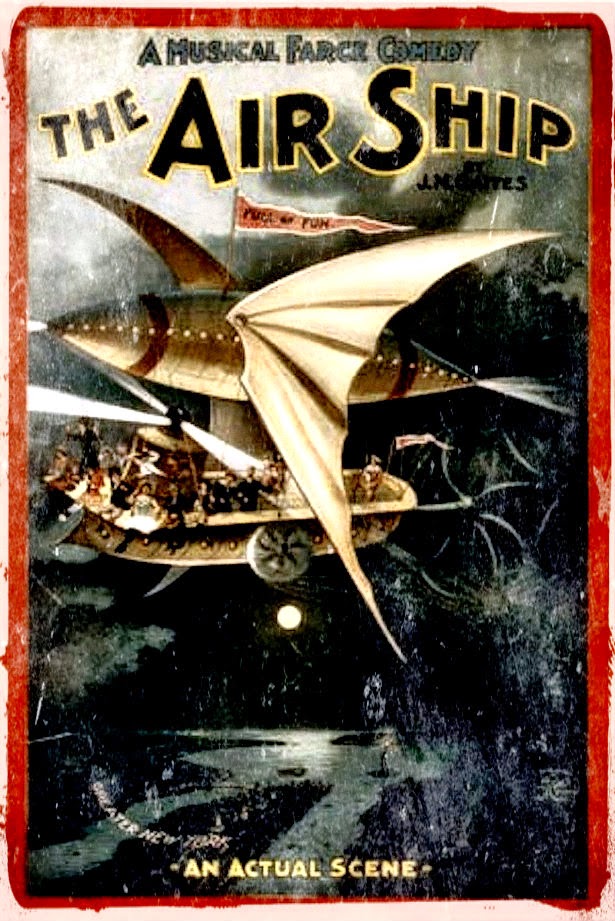
In the last years of the nineteenth century, a rash of sightings occurred in the skies across the United States of strange, airships – cylindrical-shaped and constructed from weird metal and shiny steel. The reports came in from everywhere, despite the fact that their construction, and very existence, was seemingly an impossibility at the time. No known aircraft, save for hot air balloons, flew under their own power before the Wright Brothers left the ground at Kitty Hawk. So, what were these strange ships? Who had constructed them and perhaps strangest of all, who was flying them?

Reports of the alleged crewmen and pilots usually described them as human-looking. Most of them carried extraordinary messages to the people on the ground, while others seemed to have superior intelligence, odd skin tones and weird speech patterns. It was popularly believed that the mystery airships were the product of some inventor who was not yet ready to make knowledge of his creation public. Thomas Edison was so widely speculated to be the source behind the alleged airships that in 1897 he "was forced to issue a strongly worded statement" denying his responsibility.

Reports of the aircraft, which had vast metal wingspans and arrays of bright lights, first appeared in California in 1896. Hundreds of people saw the airships as they began what seemed to be a leisurely eastward tour across America.


The first sighting occurred on November 18, 1896 and was reported in the Sacramento Bee and the San Francisco Call newspapers. Witnesses claimed that they saw a light moving slowly over Sacramento on the evening of November 17. Some witnesses said they could see a dark shape behind the light. A man named R. L. Lowery reported that he heard a voice from the craft issuing commands to increase elevation in order to avoid hitting a church steeple. There were no churches in the area, but there was a tower on a local brewery. Lowery further described the craft as being powered by two men exerting themselves on bicycle pedals. Above the pedaling men seemed to be a passenger compartment, which lay under the main body of a dirigible. A light was mounted on the front end of the airship. Some witnesses reported the sound of singing as the craft passed overhead.

The next day, a witness claimed to see the airship – or one just like it – on the ground. According to the November 19 edition of the Stockton Daily Mail, Colonel H.G. Shaw stated that while driving his buggy through the countryside near Stockton he came across what appeared to be a landed aircraft. Shaw described it as having a metallic surface, which was completely featureless apart from a rudder, and pointed ends. He estimated it had a diameter of twenty-five feet and a total length of around one hundred and fifty feet. Three slender men, each standing close to seven feet tall, were outside the airship "emitting a strange warbling noise." The men reportedly examined Shaw's buggy and then tried to seize him, apparently attempting to force him to accompany them back to the airship. When the doughty Colonel Shaw resisted, they fled back to the ship, which lifted off the ground and sped out of sight.

On November 21, the airship with the mystery light appeared again over Sacramento. It was also seen over Folsom, San Francisco and Oakland later that same evening and was reportedly viewed by hundreds of witnesses.

Soon after, the mysterious ship began traveling eastward across the country, wreaking havoc, creating mayhem and leaving very puzzled witnesses in its wake. Some of the stories of the airship were very strange. For instance, one witness from Arkansas – allegedly a former state senator named Harris – was supposedly told by an airship pilot (during the tensions leading up to the Spanish-American War) that the craft was bound for Cuba, to use its "Hotchkiss gun" to "kill Spaniards.” In one account from Texas, three men reported an encounter with an airship and with "five peculiarly dressed men" who reported that they were descendants from the lost tribes of Israel. They had learned English, they said, from the 1553 North Pole expedition led by Sir Hugh Willoughby, an early English Arctic voyager. An article in the Albion, Nebraska, Weekly News reported that two witnesses saw an airship crash just inches from where they were standing. The airship suddenly disappeared, leaving a man standing where the vessel had been. The airship pilot showed the astonished men a small device that supposedly enabled him to shrink the airship small enough to store the vessel in his pocket.  

In April 1897, the St. Louis Post-Dispatch published a story reporting that one W. H. Hopkins encountered a grounded airship about twenty feet in length and eight feet in diameter near the outskirts of Springfield, Missouri. The vehicle was apparently powered by three large propellers and was crewed by a beautiful nude woman and a bearded man, also nude. Hopkins attempted with some difficulty to communicate with the crew in order to ascertain their origins. Eventually they understood what Hopkins was asking of them and they both pointed to the sky and "uttered something that sounded like the word 'Mars.’”

The mysterious aircraft arrived in Illinois a short time later. The first sightings were in Evanston and in several other communities near Chicago. The local newspapers quickly spread the news that the airship was filled with “English spies,” although why the English would have wanted to dispatch spies to the American Midwest was left unstated. More than five hundred people witnessed a ship that was said to be in full view for over forty-five minutes. One description stated that the airship was “composed of two cigar-shaped bodies attached by girders” and others claimed that it had wings and sails.

A newspaper illustration of the Chicago sighting

The airship reportedly stayed in the Chicago area for three days and was there long enough to be photographed by a newspaper dealer named Walter McCann. He was picking up his daily newspapers at the Northwestern Railway depot when he saw the ship coming toward him from the south. A short time before, his son had won a camera in a contest for signing up newspaper subscribers and McCann ran into his store and snatched it up. He ran back outside and snapped a photo of it. He then ran down the railroad tracks and took another photo a few minutes later. After the plates were developed, McCann gave copies of the photos to all of the newspapers who requested them but he refused to sell the negatives. The staff artists and etcher for the Chicago Times-Herald subjected the photos to acid tests and proclaimed them to be authentic. Sadly, the photos have since been lost.

After departing from Chicago, the airship began a tour across Illinois. It was spotted in dozens of cities and there seemed to be no rhyme or reason to its route. It appeared in both northern and southern Illinois, being in one region on one day and the other on the next. For instance, on April 5, it made an appearance in the southwestern Illinois town of Nashville and on April 8 was seen up north in Dixon, Rock Island and Sterling. The craft buzzed over Elgin, Jerseyville, Kankakee, Taylorville, East St. Louis, Edwardsville, Jacksonville, Ottawa, Quincy, Decatur, Lincoln, Hillsboro, Peoria and many other locations. Even if we discount many of the reports as being merely excitement or practical jokes that were generated by newspaper stories, there are still scores of credible and very similar accounts. The last Illinois airship sighting took place in Rossville on April 25, and then the ship continued on its strange journey.

In the midst of the airship reports, one of the strangest incidents linked to the craft (or apparently one of many such crafts) allegedly took place in the town of Aurora, Texas. The story appeared in the Dallas Morning News on April 19, 1897, but the incident had occurred two days before, on April 17. According to the reporter:

About 6 o’clock this morning the early risers of Aurora were astonished at the sudden appearance of the airship which has been sailing around the country. It was traveling due north and much nearer the earth than before.

Evidently some of the machinery was out-of-order, for it was making a speed of only ten or twelve miles an hour, and gradually settling toward the earth. It sailed over the public square and when it reached the north part of town it collided with the tower of Judge Proctor’s windmill and went into pieces with a terrific explosion, scattering debris over several acres of ground, wrecking the windmill and water tank and destroying the judge’s flower garden.

The pilot of the ship is supposed to have been the only one aboard and, while his remains were badly disfigured, enough of the original has been picked up to show that he was not an inhabitant of this world.

As mentioned, the occupant of the craft was dead and mangled, and while UFO researchers believe that the pilot was an alien, the newspaper only states that he was “not an inhabitant of this world.” This could have referred to his looks, his dress, or the fact that he was flying an airship that should not have existed – not that he was an alien. However, there was a note that strange "hieroglyphic" figures were seen on the wreckage, which resembled "a mixture of aluminum and silver ... it must have weighed several tons." In 1973, interest was revived in this story and metallic material recovered from the presumed crash site was shown to contain an unusual percentage of aluminum and iron. The story ended by noting that the pilot was given a "Christian burial" in the town cemetery. During the investigation of the possible crash site, researchers discovered the alleged stone marker used in this burial. Their metal detectors indicated a quantity of foreign material might remain buried there. However, they were not permitted to exhume whatever may have lain below, and when they returned several years later, the headstone was gone. Incidentally, there is now a Texas Historical Commission marker in the cemetery mentioning the incident.

The Aurora Cemetery. The Texas Historical Commission marker is located to the right of the cemetery gate and mentions the airship crash and the pilot that was buried in the graveyard.

The stone marker that was placed on the pilot's grave. The design of the airship was etched crudely on the stone. 

According to local legend, wreckage from the crash site was dumped into a nearby well. Adding to the mystery was the story of Brawley Oates, who purchased Judge Proctor's property around 1945. Oates cleaned out the debris from the well in order to use it as a water source, but later developed an extremely severe case of arthritis, which he claimed to be the result of drinking contaminated water from the wreckage that was dumped into the well. As a result, Oates sealed up the well with a concrete slab and placed an outbuilding atop the slab in 1957.

It’s not surprising that many have come to believe this story is a hoax. One of the most outspoken believers in the hoax was Barbara Brammer, a former mayor of Aurora. Her research revealed that in the months prior to the alleged crash, Aurora was plagued by a series of tragic incidents. The local cotton crop was destroyed by a boll weevil infestation, a fire on the west side of town destroyed several buildings and killed a number of people, a spotted fever epidemic caused the town to be quarantined and finally, a planned railroad reached a point twenty-seven miles from Aurora, but never made it to town. Essentially, Aurora, which had nearly three thousand residents at the time, was in danger of dying out. Brammer believed the story was designed as a last-ditch effort to keep Aurora alive. Her theory was further supported by the fact that there was never any follow-up to the story. She also pointed to the fact that Judge Proctor never had a windmill on his property.

Unfortunately, Brammer’s theories of the hoax also work toward making the story seem legitimate. For starters, Judge Proctor did have a windmill on his property. The remains of it have since been found, along with the well that Brawley Oates thought was contaminated. They also found melted metal at the site, which turned out to be aluminum, which was very rare in the late nineteenth century. There was an actual grave marker at the site in the cemetery (later stolen) that supposedly marked where the pilot was buried and ground-penetrating radar has revealed the presence of a casket-shaped object under the ground.

And as far as the idea that the story was a hoax cooked up to save the town? Well, the tragic incidents might also explain why there was no follow-up story to the airship’s crash. With all of the terrible things that had just occurred, it’s not really that surprising that the pilot was simply buried and the people moved on with their lives. There were more important things going on in Aurora at the time than the crash. It wasn’t until the 1970s that anyone really took an interest in the story again.
 
What really happened in Texas in 1897? Who knows? While I don’t think there is any conclusive proof that an airship crashed to earth on that day in April, I do think something unusual happened, but what it was, we’ll probably never know.

In time, the airship reports faded away, leaving a mystery behind – and a lot of people to argue about what really happened. As one can imagine, theories abound. Attempts to uncover the truth about the airship reports reveal some unhappy realities: newspaper coverage was unreliable; no independent investigators spoke directly with alleged witnesses or attempted to verify or debunk their testimony; and, with a  only one exception, no eyewitness was ever interviewed, even in the 1950s, when some were presumably still living. That single witness was a former San Francisco Chronicle employee named Edward Ruppelt. In 1952, Ruppelt stated that he had been a copyboy in 1897 “and remembered the incident, but time had cancelled out the details.” He did say that he, along with the newspaper’s editor and the news staff had seen the airship but they never told anyone what they had seen because they didn’t want people to think they were “crazy.”

There will always be many who dismiss the 1896-1897 airship wave as some massive hoax. Even at the time, there were many attempts to explain the airship sightings as hoaxes, pranks, publicity stunts and hallucinations. One man suggested the airships were swarms of lightning bugs that were misidentified by observers. It’s also very likely that many of the newspaper reports were, in fact, hoaxes, riding the wave of a national craze for goofy, off-beat tales. Stories created out of whole cloth by enterprising reporters do tend to stand out, though, since most of them have a tongue-in-cheek tone and are heavily sensational. Furthermore, the supposed authors of many such newspaper hoaxes make their hoax obvious by stating – in the last line – that he was writing from an insane asylum, or something to that effect.

Over time, the 1896-1897 airship wave has become probably the best investigated of all historical anomalies. The files of almost 1,500 newspapers from across the United States have been combed for reports, an astonishing feat of research. The general conclusion of investigators was that a considerable number of the simpler sightings were misidentification of planets and stars, and a large number of the more complex sightings were the result of hoaxes and practical jokes. A sizable number, though, remain perplexing.

What were the ships and better yet, who was flying them? In 2009, author J. Allan Danelek made a case for the idea that the mystery airship was the work of an unknown individual, possibly funded by a wealthy investor from San Francisco, who built an airship prototype as a test vehicle for a later series of larger, passenger-carrying airships. Danelek not only laid out a plausible scenario, but demonstrated how the craft might have been built using materials and technologies available in 1896 (including speculative line drawings and technical details). The ship, Danelek proposed, was built in secret as a safeguard from patent infringement, as well as to protect investors in case of failure. Noting that the flights were initially seen over California and only later over the Midwest, he speculated that the inventor was making a series of short test flights, moving from west to east, and following the main railroad lines for logistical support, and that it was these experimental flights that formed the basis for many – though not all – of the newspaper accounts from the era. Danelek also noted that the reports ended abruptly in late April 1897, suggesting that the craft may have met with disaster, effectively ending the venture and permitting the sightings to fall into the realm of legend.

These ideas were not far off from some of the theories posed at the end of the nineteenth century – a time of great popularity for science-fiction writers like Jules Verne and H.G. Wells. In fact, the idea that a secretive inventor might have developed a viable craft with advanced capabilities was the focus of Jules Verne's 1886 novel Robur the Conqueror. Steerable airships had been publicly flown in the United States since 1863, and numerous inventors were working on airship and aircraft designs. In fact, two French army officers and engineers, Arthur Krebs and Charles Renard, had successfully flown in an electric-powered airship called the La France as early as 1885, making no fewer than seven successful flights over an eleven-month period. Also during the 1896-1897 period, David Schwarz built an aluminum-skinned airship in Germany that successfully flew over Tempelhof Field before being irreparably damaged during a hard landing. Both events clearly demonstrated that the technology to build a practical airship existed during the period in question, though if reports of the capabilities of the California and Midwest airship sighted in 1896-97 are true, it would have been considerably more advanced than any airship built up to that time.

Several individuals, including Lyman Gilmore, Charles Dellschau and Thomas Edison (who issued a strong denial) were later identified as possible candidates for being involved in the design and construction of the airships, although little evidence was found in support of these ideas.

How can we explain the mysterious airship (or airships) that crossed America in 1896-1897? Was it a hoax, a case of mass hysteria? Perhaps, but this seems unlikely based on the unrelated and completely unconnected witnesses who spotted and reported it. In Chicago, there was a sighting that allegedly included several hundred people, all describing it in almost exactly the same way.

If the ship was real, then who were the passengers? They had strange messages to pass along and seemed to be almost constantly at work on their vessel. During one encounter that took place in Texas, an airship passenger actually asked for help in repairing his craft. He handed the witness current American money and asked him to fetch supplies from the local hardware store. But how could ordinary materials function in the baffling airship?

The mystery remains unsolved. It seems unlikely that the airship was built by the mechanical means of the time period and yet it apparently existed. The passengers on the ship appeared to be normal humans, taking what seemed to them to be a normal trip, aboard a machine that could not exist – and yet did.

This is a small excerpt from Troy’s book, CABINET OF CURIOSITIES 2. If interested in more about the unexplained, click on the link to see more about the book!


Tuesday, April 1, 2014

CABINET OF CURIOSITIES 2

AMERICA'S UNEXPLAINED IN 20 OBJECTS


Cabinet of Curiosities 2: A look inside of America's Greatest Unexplained Mysteries by way of 20 objects linked to the Unknown

Mysteries have baffled us since time began and no one knows that better than author Troy Taylor, who pulls open the curtain on another collection of the strange and the unusual from the weirdest corners of America. In this second book in a series, he traces the history of the unexplained in the United States by using 20 bizarre objects that made a mark on the world of the weird as we know it! In these startling exhibits, readers will marvel at objects that might never know existed, like plaster casts of hairy giants; a frozen monster that may – or may not have been – a hoax; cellar stones from a vanished town; a cannonball fired at a winged creature; metal bolts from a bridge that collapsed mysteriously; evidence of giant birds; a photograph that shouldn’t exist – and yet scores of people remember seeing it; the wreckage of an airship that couldn’t possibly exist – and yet it did; a horned human skull; bones of giants; unbelievable objects that have fallen from the sky; furniture burned by inexplicable means; a poison-scented handkerchief left by an elusive gasser; and much more! Pay your admission and come inside – the strange side of America is waiting for you! Click Here to Order the book!

Just how weird is America? Come inside and find out... Join author Troy Taylor as he takes you back in time to the days of the American sideshow, when anything seemed possible -- and probably was! In this compelling, weird, bizarre and head-scratching book, he reveals the mysteries that have been haunting America for centuries, from enigmatic spook lights to mysterious figures that vanish without a trace, time slips, strange happenings, objects, people and artifacts that should never have existed -- and yet they did -- and much more! Some of the weird objects linked to the unexplained include:

* Plaster Casts: Monsters in the woods during American history
* Minnesota Iceman: A carnival sideshow attraction that was a clever hoax -- or was it?
* Broken Ship's Compass: The unsolved mystery of the Mary Celeste
* Stones from a Cellar Wall: the true story of what really happened at Dudleytown
* Stephen Decatur's cannonball: Did the American hero really fire a shot at the Jersey Devil?
* Metal Bolts from a Lost Bridge: Did the mysterious Mothman really cause a terrible disaster?
* A Lock of White Hair: Did giant birds really invade America in 1977 -- and was a boy almost carried away by them?
* The Thunderbird Photograph: America's most famous photo of the unexplained -- did it really exist?
* Horned Human Skull: Weirdo's, monsters and giants... what has American archaeology been covering up?
* Picture Postcard: The story of the mysterious Hornet Spook Light, a Route 66 attraction
* Empty Bottles: The story of "Popper the Poltergeist," America's first paranormal reality TV show
* A Poison-Scented Handkerchief: The weird tales of America's "Mad Gassers"

And... a mysterious rock painting of a mythical creature -- that may have been real; mystery airships that wreaked havoc across the country; a t-shirt linked to the bizarre history of werewolves in America; a patch of dead grass that marked the last location of a man who vanished without a trace; the mummy of a little man that should not have existed; rocks, ice, fish, frogs, blood and more strange things that have fallen from the skies; burned furniture linked to one of the strangest poltergeist cases in American history; a red-winter parka that was last seen on a girl who vanished -- one of many who walked a deadly trail to another place and time; and more!

Check out the second installment in this ongoing series -- see more about the book and order your copy today!


Tuesday, February 26, 2013

"Popper the Poltergeist"


“POPPER THE POLTERGEIST”
America’s First Paranormal Reality Show

In February 1958, strange things were happening on Long Island. A house belonging to a family named Herrmann was being beset by strange and inexplicable incidents that were attributed to a ghost who was dubbed “Popper” (for reasons that will soon become obvious). But what was really happening in the house? Was it an unseen force from beyond -- or was it something else? On this date, February 26, Popper even got the attention of researchers from J.B. Rhine’s famous parapsychology lab at Duke University, but they came no closer to solving the mystery than anyone else.

The “Popper” case remains unique in the annals of the supernatural for a variety of reasons, not the least of which is the fact that this became the first haunting that was actually shown on television. Wide-eyed audiences all across the country stared at their television screens in amazement as Popper literally performed for the cameras. These films became the ghost’s claim to fame, but were only a small part of the weird happenings!

The Herrmann family became the reluctant stars of America’s first paranormal reality TV show
Popper first made himself known at around 3:30 in the afternoon of February 3, 1958. The James Herrmann family lived in Seaford, New York, a suburb on Long Island, about 30 miles from New York City. Their white and green ranch-style home at 1648 Redwood Path had been built in 1953 and contained three bedrooms, a bathroom, a kitchen, a small dining room, a living room and a basement that was divided between a utility room and a playroom. In other words, it was a typical 1950s-era home in a quiet, conservative neighborhood with public parks and tree-lined streets. It was the last place that you would expect anything out of the ordinary to occur.

That February 3 was a day like most any other. It was clear and cold outside and Lucille Herrmann, a registered nurse, was there to welcome her children home from school and to prepare dinner. The children were Lucille, 13, and James, 12, two ordinary kids with ordinary interests. Their ordinary world, however, was about to change.

Soon after the children entered the kitchen, chaos erupted in the house. In a matter of moments, various bottles containing liquid in different rooms of the house suddenly began to pop their caps and dance around. No one saw the bottles move or explode, but all of them heard the caps as they popped loose and the bottles’ contents went spewing into the air.

They would later discover an opened bottle of bleach in the basement utility room, a bottle of liquid starch in the kitchen, bottles of shampoo and medicine in the bathroom and a bottle of holy water that had opened in the master bedroom and was lying on its side with the contents spilled. Each of the bottles had been sealed with twist-off metal or plastic caps. There were no corks or crimped caps that might have somehow come loose.

Puzzled, Mrs. Herrmann called her husband, who worked for Air France in New York City, and reported the strange “popping” sounds they had heard. Herrmann was just as confused by the incident as his wife was, but since no one had been hurt, he decided there was no need for him to go home early.

Following his usual schedule, Herrmann took the train to Long Island and arrived home just before 7:00 p.m. During his commute, he pondered his wife’s call and was sure that he had a solution for the mystery. He believed that some sort of chemical reaction in the products had caused the bottle lids to blow and the fact that they did so at the same time was merely a coincidence. Perhaps it had been caused by some sort of excessive humidity in the house? He quickly investigated the bottles when he arrived home and confessed to being baffled when he found that they were screw-top lids. How could they have simply popped off?

The excitement over the event having passed, and since nothing more had happened, the family decided to write the experience off as “just one of those funny things.” Two uneventful days passed and the popping bottles were almost forgotten.

Then, on Thursday, once again at about the same time that the Herrmann children came home from school, another half dozen bottles popped their lids. A bottle of nail polish burst open, as did a bottle of rubbing alcohol, a bottle of bleach, detergent, starch and the bottle that contained holy water on Mrs. Herrmann’s dresser. It was an almost exact repeat performance of February 3.

On Friday night, it happened again. Only this time, when the bottles began to pop open, James Herrmann began to suspect that he knew the culprit responsible for the multiple containers’ strange behavior. He surmised that his science-loving son had somehow rigged the bottles to pop in order to scare his family. He thought that perhaps his son had planted some carbonated capsules inside the bottles and timed it so that he could get home from school in time to see the startled expression on his mother’s face.

As he developed this theory, Herrmann spent the entire weekend secretly observing Jimmy. He was determined to catch him in the act of tampering with a bottle. It’s no wonder that he was surprised on Sunday morning, February 9, when several caps popped off bottles of starch, turpentine and holy water, leaving the containers rocking back and forth on the shelves. Herrmann had kept a close eye on Jimmy, so how could the boy have managed to put something inside the bottles without his father seeing him do it? Feeling baffled and a bit angry, Herrmann burst into the bathroom, where Jimmy was brushing his teeth, and accused him of rigging the bottles to pop. The boy vigorously protested his innocence and as if to prove the point, Herrmann was startled to see a bottle of medicine suddenly move across the top of the sink and fall into the basin. A moment later, a bottle of shampoo also slid across the sink and fell with a thud to the floor.

Jimmy Herrmann, posing with some of the broken items in the house 
Still skeptical, Herrmann immediately examined the bathroom, searching for hidden wires or strings. He found nothing and finally realized that there were things going on in the house that he could not explain. Unsure of what else to do, he called the Nassau County Police Department and spent the next several minutes on the phone trying to get Lieutenant E. Richardson, the desk officer who answered the call, to take him seriously. When he heard the story, Richardson accused Herrmann of either playing a practical joke or drinking too much, but he was soon swayed by the earnest tone of the man’s voice. It helped that Herrmann had a good reputation in the community. Richardson promised to send someone to investigate.

Officer James Hughes went to the house feeling skeptical and perhaps wondering how he managed to wind up with the nutcase calls. Within a few minutes, though, he had changed his mind about the nature of the case when several bottles in the bathroom popped their lids and fired them in his direction. He quickly concluded that the Herrmanns did indeed need help.

Detective Joseph Tozzi was assigned to look into the case. He read Hughes’ report of the incident in the bathroom with interest. While not willing to pass judgment without actually visiting the scene, he was relatively sure the Herrmanns were experiencing some natural phenomenon or were simply imagining things. Or, he noted with the cynicism of a veteran police officer, the popping bottles could be getting some help a human source.

Detective Joseph Tozzi
On February 11, Detective Tozzi began his vigil at the Herrmann house. That same evening, a perfume atomizer overturned and spilled perfume in the daughter’s bedroom. There was no one in the room at the time, according to reports. Over the next few days, the disturbances seemed to center around the bottle of holy water in the parents’ bedroom. On several occasions, the lid of the bottle popped off and once, after hearing the distinctive sound, Mr. Herrmann dashed into the room and found the bottle on the floor. He picked it up and found it strangely warm to the touch.

Later that same day, on February 15, the activity took another turn. As the Herrmann children were watching television in the living room with Marie Murtha, their middle-aged second cousin, a porcelain figurine on an end table next to the couch began to wiggle and then shot two feet through the air, making a loud crashing sound as it landed on the floor. To the amazement of Miss Murtha and the children, the figurine was unbroken.

After this last demonstration, the Herrmanns decided to turn to another source for comfort and to aid the stumped Detective Tozzi in his investigations. They contacted Father William McLeod of the Church of St. William the Abbott for help. As devout Catholics, the Herrmanns believed that the church could help them where ordinary methods had failed. Father McLeod came to the house and sprinkled holy water in each of the rooms. Unfortunately, “Popper,” as the poltergeist came to be called, had decided that he didn’t want to leave.

During the two weeks since Popper had made his first appearance in the Herrmann house, news of the strange happenings had leaked to newspapers, radio and television reports. The story received a great deal of publicity, even meriting articles in Time and Life magazines. If the beleaguered family thought that mopping up spilled liquids and having their possessions broken by an unseen force was bad, then the onslaught of public attention was worse. During the day, the Herrmann home was surrounded by reporters, photographers, curiosity-seekers and an astounding array of television equipment. While the Herrmanns managed to get used to these intrusions into their lives, they weren’t quite prepared for some of the strangeness that came with it.

Detective Joseph Tozzi being interviewed on television
Letters and telephone calls came every day. Many of them proposed logical solutions, while others assured the Herrmanns that Martians had landed nearby or that the problem in the house was the spirit of a long-dead Indian chief or that the Russians were tunneling under Long Island to invade New York. The Herrmanns managed to stay patient with everyone, though. They never turned anyone away and they listened attentively to all the calls and suggestions that came in, even those who shouted “Repent!” into the telephone at midnight or proclaimed that “the Sputniks are here!”

Many of the letters and visitors were less easy to tolerate, however. Letters arrived in barely intelligible scrawl, condemning the Herrmanns for their sins and suggesting that they had invited these “tricks of Satan.” Ministers from all sorts of dubious faiths conducted rituals on the front lawn of the house. One man in a blue serge suit, who claimed to be a “holy man from Center Moriches,” (a nearby town on Long Island) knelt in the yard and prayed for 10 minutes. Then he stood and announced: “Everything is all right. You have been forgiven.” With that, he left -- but “Popper” remained.

But not all of the suggestions and attempts to help were so bizarre. One man who came to the house, Robert Zider, was a physicist from Long Island’s Brookhaven National Laboratory. He brought a set of dowsing rods with him and went over the property with them. When he was finished, he stated that he believed there were underground streams below the house. He thought that the water might be creating a “freak magnetic field.” Detective Tozzi examined this idea at length, but a geological survey suggested that the information was inaccurate.


Tozzi’s case file grew thicker and thicker with added notes, observations, research and facts that he collected. At one point, he had been walking down the basement stairs with Jimmy Herrmann when a bronze statue of a horse weighing nearly 100 pounds flew across the basement and hit the detective in the legs. Jimmy had been nowhere near the statue and no one else was down there. How had it happened? Tozzi had absolutely no idea.

He had checked with the Air Force and after studying their flight plans, they had told him that sonic booms from passing jets could not have caused the disturbances. He also ruled out radio waves by contacting the Radio Corporation of America (RCA). The Long Island Lighting Company had set up a delicate oscilloscope in the basement, but they had detected no underground vibrations. Building inspectors from the town of Hempstead pronounced the house structurally sound. The Seaford Fire Department even inspected a well on the property to see if changes in the water level could be causing the disturbances. However, they found that the water level had been stable for at least five years. Although puzzled, Tozzi remained determined and he tried valiantly to discover a source for the happenings.

He finally found hope in a letter from a woman named Helen Connolly of Revere, Massachusetts. She wrote that she had experienced odd events in her living room, where chairs and furniture moved about. She didn’t have a ghost in her house, but rather a heavy downdraft through her fireplace. When capped with a rotary metal turbine, the flying tables and chairs ceased to fly. Mr. Herrmann immediately had one installed on his own chimney, convinced that the strangeness was finally coming to an end.

But that wasn’t meant to be.... No sooner had the workmen completed the installation than a porcelain figurine launched itself from a table and smashed against a desk. The figurine had managed to travel a distance of more than 12 feet. It left a dent on the wood that was broadcast to television audiences all over the New York metropolitan area.

On February 20, events became even more violent. Another figurine was smashed against the desk, a bottle of ink popped its screw cap, then sailed into the air and splashed its contents on the wall and a sugar bowl flew off the table under the watch of Detective Tozzi. It had been close to Jimmy but not within his reach. Needing a break, the Herrmann family spent the night with a relative. Tozzi stayed in the house, but the rest of the night passed without incident. When the family returned the next evening, though, the sugar bowl again flew from the table and this time, it shattered into pieces.

On February 24, Tozzi was startled to his feet by the sound of a loud noise from Jimmy’s room. No one had been in the room or near it, yet a large bookcase had managed to fall facedown onto the floor. The next night, while Jimmy was in the room doing his homework, his record player lifted and moved 15 feet across the room. A small statue of the Virgin Mary flew more than 12 feet and struck a mirror frame in the master bedroom. A bookcase filled with encyclopedias was upended. A heavy glass centerpiece from the dining room table flew up and stuck a cupboard, chipping away a piece of molding before falling to the floor. A world globe shot down the hallway from Jimmy’s room and just missed Detective Tozzi. A newspaper photographer named John Gold from the London Evening News witnessed his flashbulbs lift off a table and fly through the air to strike a wall. In addition, Popper had begun knocking on the walls to get attention, although no attempts to “communicate” with the ghost (if indeed it was a ghost) were ever made.

Tozzi had become concerned about the new violence in the disruptions. Until that point, the activity had been limited to popping bottle tops. He had explored every possible explanation that he could come up with and while he was not prepared to say the house was haunted, he was all out of fresh ideas. About this same time, the staff of scientists at the Parapsychology Laboratory at Duke University, North Carolina, became interested in the events reported in the Herrmann home. This group of researchers, under the leadership of Dr. J.B. Rhine, had already compiled a mass of evidence that supported the idea that certain people, under the right circumstances, could influence the behavior of objects without touching them. They called it psychokinesis, or PK.

As the disturbances at the home continued (and in fact, increased) Dr. Rhine’s assistant, Dr. J. Gaither Pratt, traveled to New York and arrived at the Herrmann house on February 26. Pratt believed that someone in the house was unknowingly causing the strange incidents to occur. Meanwhile, other researchers came to believe that the incidents in the house were being caused by an actual ghost, a poltergeist, or “noisy spirit.” These prankster ghosts traditionally targeted religious items, as the disturbances had done with the holy water and the Virgin Mary statue in the Herrmann house.

On the other hand, strong evidence remained for the idea that there was a human component behind the haunting. It had been noted by the Duke researchers that an adolescent child, usually a girl, was almost always among the members of the household being plagued by poltergeist phenomena. They believed it was possible that this young person might be capable of psychokinesis during the height of puberty. In every case, though, the young person might be unaware that she or he was unconsciously causing the events to happen, making them as bewildered as the adults around them. In the case of the Herrmann house, Jimmy (according to Detective Tozzi’s notes) was at or near the scene of the poltergeist disturbances more than 75 percent of the time. For many incidents, he was the sole witness. However, the detective had cleared the boy of deliberately causing any of the disturbances.

Like the others who came before him, Dr. Pratt was welcomed into the Herrmann residence and greeted warmly. He explained that he had come as an observer and he spent most of the time there chatting with Jimmy, playing cards with him, helping him with his homework and generally just being around the young man. There was no sign of strangeness during the visit. Popper was absolutely quiet.

Pratt then summoned another colleague from North Carolina, William G. Roll. Together, they interviewed the family members and were convinced that none of them were perpetrating a hoax. “The family was much too shaken for it to be a colossal hoax,” Pratt told a United Press reporter.

Things were quiet for the next several days, as though the poltergeist did not want to perform for the scientists. Then, on March 2, one month after Popper first arrived, he decided to make himself known again. All of the Herrmanns were in the house to witness what took place. First, a dish vaulted from a kitchen cabinet and shattered on the floor. Then, a night table flipped over in Jimmy’s room. Popper was back and yet there was still no explanation as to who, or what, he was. Two days later, a bowl of flowers slid down the dining room table and jumped into the air. A bookcase turned end over end in the cellar.

But this would not be Popper’s farewell performance. That event would occur on March 10 while Mrs. Herrmann, Jimmy, and Lucille were getting ready for bed (James Herrmann was away on business). Pratt and Roll suddenly heard a loud popping sound in the cellar and they hurried downstairs to see what it was. They found that a bleach bottle, sitting in a cardboard box, had somehow lost its plastic lid.
For reasons unknown, this became the last act of the Herrmann family poltergeist. There had been a record of 67 recorded disturbances between February 3 and March 10. The Herrmanns had been visited by detectives, building inspectors, electricians, plumbers, firemen, parapsychologists and half of the “nutcases” on the East Coast and yet none of them had been able to present a satisfactory explanation for what had occurred in their home.

Weeks after the household returned to normal, “experts” still came to investigate and to theorize about what had taken place. As late as August 1958, the scientists at Duke still had no clue as to what had happened and why. By this time, the Herrmanns had had enough of investigations and just wanted their lives to get back to normal. James Herrmann no longer cared why the disturbances had taken place, he was just happy they were over. Mrs. Herrmann told an Associated Press reporter: “I don’t think there is a definite solution. It was just one of those things with no rhyme or reason to it. But there was a definite physical force behind it.”

What did happen at the Herrmann house on Long Island? No one really knows. “Popper” the Poltergeist, and the strange incidents that followed in his wake, is just as puzzling today as “he” was in 1958.

The story of “Popper” and many of America’s weirdest poltergeist cases can be found in my book INTO THE SHADOWS, which is available in print on the website at and as a Kindle edition!